






Archaeologists digging at a 13,800-year-old site in interior Alaska have unearthed thousands of artifacts and fossils, including what may be the bones of the earliest domesticated dogs in the Americas, the earliest needles and dwellings in the Western Hemisphere, and stone tools that reveal cultural connections across the Bering Land Bridge.
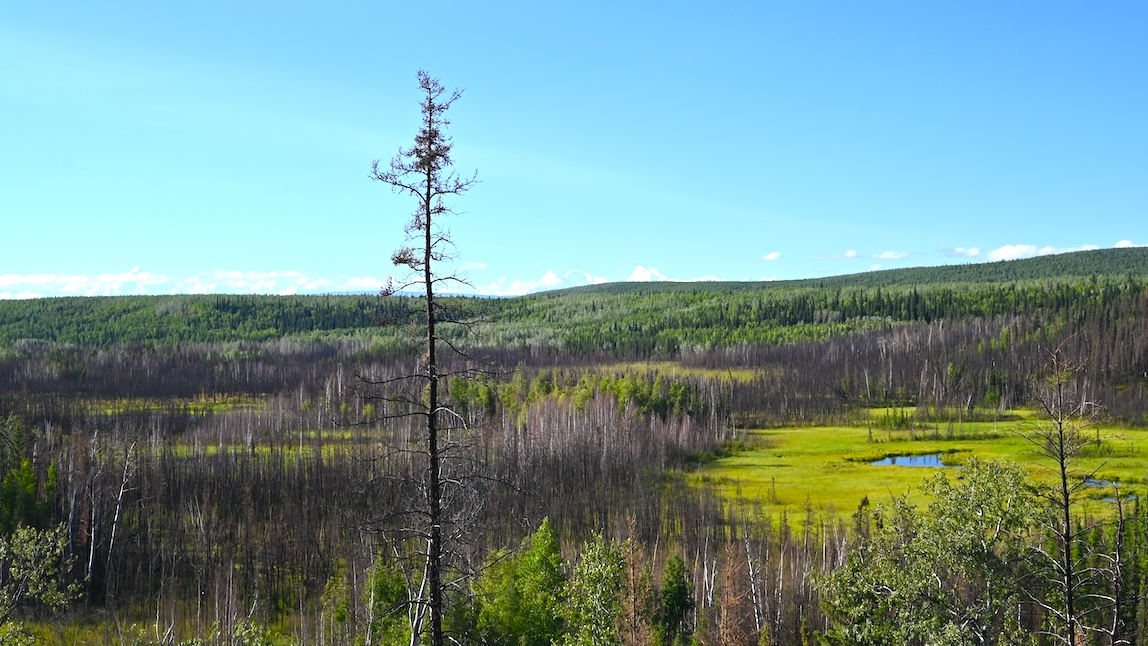
At a site called Shégˊ Xdaltthˊíˊ (which means “They Were There” in the Alaska Native Athabascan language), about 34 miles (55 kilometers) southeast of Fairbanks, archaeologists have excavated an encampment that some of the first people to settle in North America used off and on for a millennium.
Shégˊ Xdaltthˊíˊ is located in eastern Beringia, the geographical region that connected northeast Asia and northwest North America during the last ice age. The most recent archaeological and genetic studies suggest that the ancestors of today’s Indigenous Americans entered the continent around 21,000 years ago. But since Beringian sites are often the remains of small seasonal hunting camps and are scattered across a large geographic area, much is still unknown about the earliest people who called the Western Hemisphere home.
Latest Videos FromLive Science
“I expected we’d find hunting tools and knapping [stone tool making] debris surrounding a hearth or two, but I had no idea that we’d stumble into a base camp with tens of thousands of artifacts,” study first author Kelly Graf, an archaeologist at the University of Kansas, told Live Science in an email. “It was a total surprise!”
In a study published Wednesday (Oct. 14) in the journal Science Advances, Graf and co-authors detailed their discoveries at Shégˊ Xdaltthˊíˊ, focusing on the earliest occupation, which occurred around 13,800 years ago, as evidence of people “settling in” to their new territory.
The researchers found a hearth, a small pit, and a dirt stain where a wooden post had once stood, likely the remains of a lean-to or early tent house. Additionally, the archaeologists unearthed stone tools, bone needles and a pendant made from an antler. Nearby, they found an earth oven, which was full of charcoal and animal bones and was likely used to slow-cook meat for a large family group.
“The complex feature at Shégˊ Xdaltthˊíˊ represents the earliest potential case of a habitation structure in North America,” the researchers wrote in the study. “Early Alaskans knew their surroundings well.”
Get the world’s most fascinating discoveries delivered straight to your inbox.
Cross-cultural links
The archaeologists were also surprised by the stone tools recovered at Shégˊ Xdaltthˊíˊ because they are distinctively shaped and unique to central Alaska. Known as diamond-shaped hafted bifaces, the tools were crafted from rhyolite and basalt and are similar to those typically found much farther west in Beringia, in modern-day northern Siberia. Additionally, obsidian artifacts discovered at Shégˊ Xdaltthˊíˊ reveal that people brought the volcanic rock to the site from a geological source hundreds of miles to the northwest.
Bones from more than a dozen wolf-like animals suggest a further connection to Asia, according to the researchers. An analysis of the jaw of one of the animals showed that it was not from a dire wolf (Aenocyon dirus) or from a Pleistocene Beringian or gray wolf (Canis lupus sp.) but rather a population of wolf-like animals unique to central Alaska. Current genetic evidence suggests that early domesticated dogs in North America came from Siberian wolves. The timing and geographical location of Shégˊ Xdaltthˊíˊ provides circumstantial evidence that the people may have been dog owners.
“Like humans, potentially, the canids of Shégˊ Xdaltthˊíˊ and other early Alaskan sites were recent immigrants from Asian Beringia,” the researchers wrote.
Although Shégˊ Xdaltthˊíˊ reveals a relationship with sites in Asia, there is also evidence of connections with early American sites south of the Canadian ice sheets, according to the study.
One clue to these connections is the presence of bone artifacts in a sewing kit. The archaeologists found eight bone needle fragments at Shégˊ Xdaltthˊíˊ. Previously, the only recovered eyed needles had come from Paleoindian sites in temperate North America. Therefore, the needles from Shégˊ Xdaltthˊíˊ are the oldest needles ever discovered in the Western Hemisphere, and they reveal connections with sites farther south, according to the study.
Another clue is the pendant, which was crafted from antler. The pendant had a hole drilled at one end and was fashioned into a point at the other end. This piece of ancient jewelry is similar to personal adornment items found farther south in North America.
“The co-occurrence of these cultural features at the single site of Shégˊ Xdaltthˊíˊ is truly notable,” the researchers wrote, and they “highlight the strong cultural connection between early Beringians and Americans.”
It is still unclear whether the people at Shégˊ Xdaltthˊíˊ were traveling to make these connections. “It would be hard to pin down whether or not they were moving back and forth during a lifetime, but at least we can say there is a connection,” Graf said.
Archaeologists recovered bison bone and a hearth, among other things, at the Beringian site.
(Image credit: Kelly Graf)
Further work in Beringia is needed
Future excavations in Beringia could help archaeologists learn more about the earliest people in the Americas, according to Graf. “Alaska is a big place and so remote, so there are really just a few small areas that have been intensively investigated,” she said.
Spencer Pelton, an archaeologist at the University of Wyoming who was not involved in the research, wrote in an accompanying perspective published in the journal Science Advances that early Indigenous sites in Beringia are key to understanding the peopling of the Americas.
“Shégˊ Xdaltthˊíˊ is remarkable because it is the oldest site in the Americas containing a large and rich assemblage of features, artifacts, and faunal refuse indicative of prolonged residential occupation, providing an unprecedented glimpse into the lives of North America’s first residents,” Pelton wrote.
Graf is already planning future archaeological excavations in the area. “We’re hoping to bring some younger Alaska Native folks out with us in the coming summers,” she said, as incorporating local knowledge is important to the project. “Two of our co-authors are elders from Alaska Native corporations nearest to the site,” she said. Elders named the Shégˊ Xdaltthˊíˊ site and have visited it to discuss where to excavate and what the archaeologists might find.
There is much left to learn about what was happening in Beringia 14,000 years ago, the researchers wrote, particularly since there are currently only two archaeological sites — including the 24,000-year-old Bluefish Caves site in the Yukon — that suggest humans were settling in Beringia considerably earlier.
Graf, K.E., Goebel, T., Henry, A., Hockett, B., Shelley, N., Antonosyan, M., Meachen, J., Sewing, M., Harbort, M., Esdale, J.A., Allaun, S.A., Gore, A.K., Rasic, J.T., Roberts, P., Combs, E., Charlie, D. (2026). Highlights from an early base camp in Beringia 13,800 years ago: Shégˊ Xdaltthˊíˊ and the Late Pleistocene peopling of Alaska. Science Advances. https://www.science.org/doi/10.1126/sciadv.aeh0802
How much do you know about the first people to reach the Americas? Find out with our First Americans quiz!