






Centuries ago in Peru, a decapitated individual’s head was turned into a “trophy.” Now, a careful look at this trophy head reveals that despite a potentially problematic birth defect, the individual survived into early adulthood.
Based on several photos of the head, a researcher spotted that the individual was born with a cleft lip, Beth Scaffidi, an assistant professor of anthropology and heritage studies at the University of California, Merced, wrote in a new study.
The latest study, published Nov. 3 in the journal Ñawpa Pacha, is the first time an orofacial cleft has been documented in an Andean trophy head, offering a “unique opportunity” to explore how ancient peoples of the region viewed such conditions, Scaffidi wrote in the paper.
“This finding is important because it shows that people survived, and even thrived, with this condition in the ancient Andes,” Scaffidi told Live Science in an email. “It helps show that what we define as a disability and how we respond to it is culturally, rather than biologically, determined.”
Trophy heads
For millenia, ancient peoples in parts of the Andes mountains in South America, as well as the surrounding regions, collected severed heads as trophies, processing them for preservation and display purposes, Scaffidi said. Most known examples date to between roughly 300 B.C. and A.D. 800, often originating from around modern-day Nazca in coastal Peru’s Ica department (Peru has 24 departments, or regions). Trophy heads were likely passed down as heirlooms through generations, Scaffidi said.
“Most trophies were mummified naturally in the arid desert environment, and many preserve hair and flesh,” Scaffidi said. “We still debate whether these heads were lovingly curated remains of beloved ancestors or souvenirs of violent conquest of enemies, but many do also display violent injuries received before and around the time of death.”
During a research project, Scaffidi came across an intriguing example in the catalog of the Museum of Modern and Contemporary Art in Saint-Etienne, France, purportedly originating from the Ica department.
Scaffidi examined photographs of the mummified head and determined that the individual was probably male and a young adult at the time of death. Based on the visible facial structures, she diagnosed the individual with a cleft lip.
Perhaps the most serious complication of orofacial clefts is difficulty latching during breastfeeding, but these conditions can also cause respiratory, hearing and speech issues, she wrote in the study. Today, these birth defects are typically treated with surgery in the first few months of life, but in the ancient Andean world they would have presented a significant challenge to mothers and caregivers during the baby’s infancy. The individual Scaffidi studied, for example, would likely have required specialized care to receive nourishment as an infant.
A special status
But not only did this individual survive into early adulthood, it is possible that their condition even granted them special status, Scaffidi said. Cultural responses to orofacial clefts in the ancient Americas varied widely, from shame to veneration. But taking into account what is known about the worldviews of ancient Andean peoples specifically, it is likely this individual was perceived as sacred and afforded a high-status role throughout life and beyond, Scaffidi said.
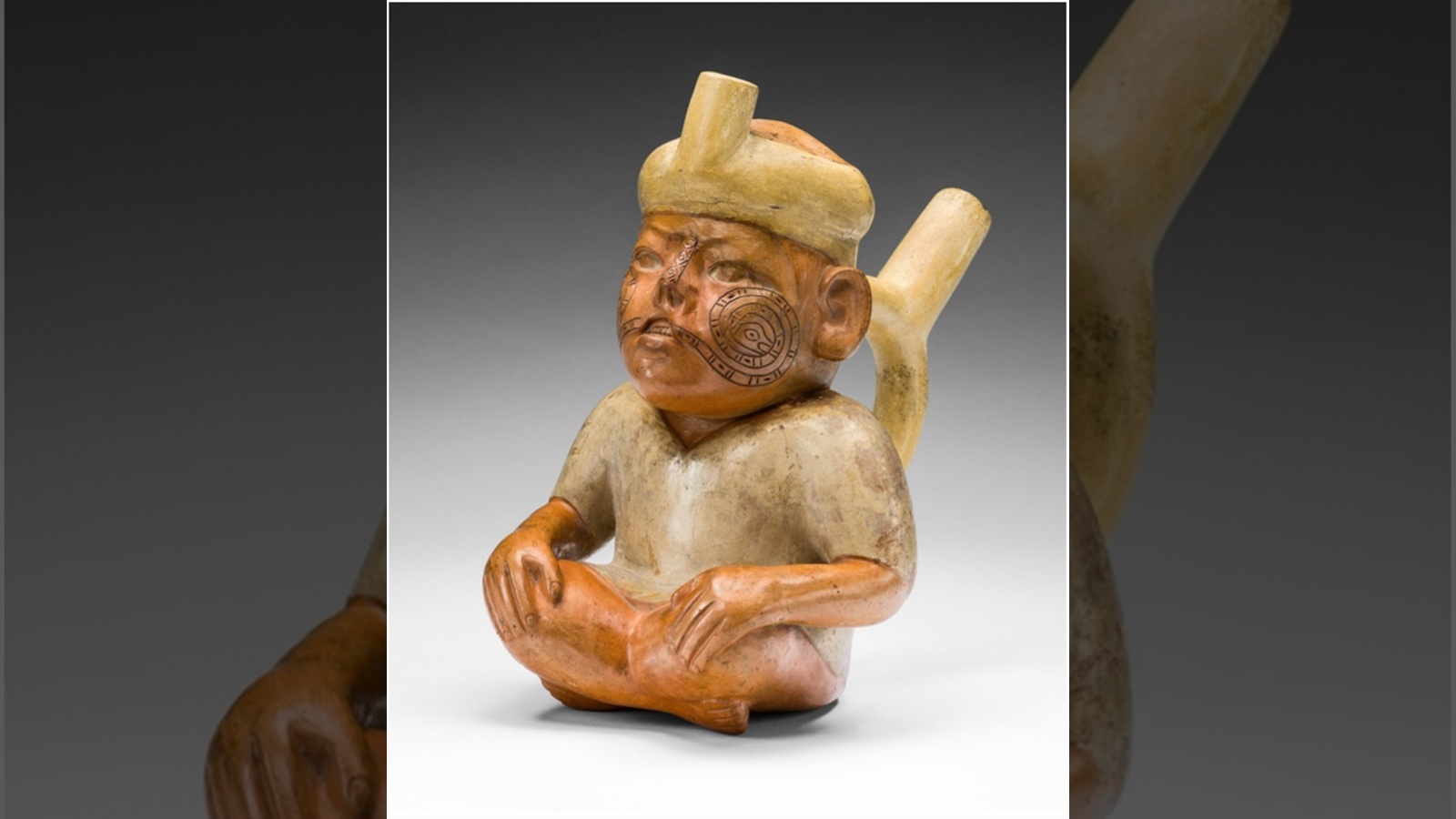
In the absence of documentary or textual sources, ancient ceramic vessels from the region — particularly those produced by the Moche culture (A.D. 200 to 850) of northern Peru — provide clues as to how congenital conditions might have been understood at the time.
In the study, Scaffidi found 30 ceramic representations of orofacial clefts that had already been documented from the wider Andean region, 20 of which were from Moche areas. These examples mostly depict males adorned in elite jewelry, head wrappings, or performing shamanic or medical activities, suggesting that they were people of importance. Other research suggests that the Moche believed facial markings protected them from supernatural harm, thus, birth defect markings were revered.
Previous research has indicated that Andean trophy heads were often collected from individuals perceived as having supernatural powers, with the belief that the people taking the heads could use this power to benefit their own communities.
The collection of this particular subject as a trophy head, even through potentially violent means, is consistent with the idea that orofacial clefts were celebrated by the takers, Scaffidi said. What may be seen today as a disability was likely considered a “blessing,” according to the study.