




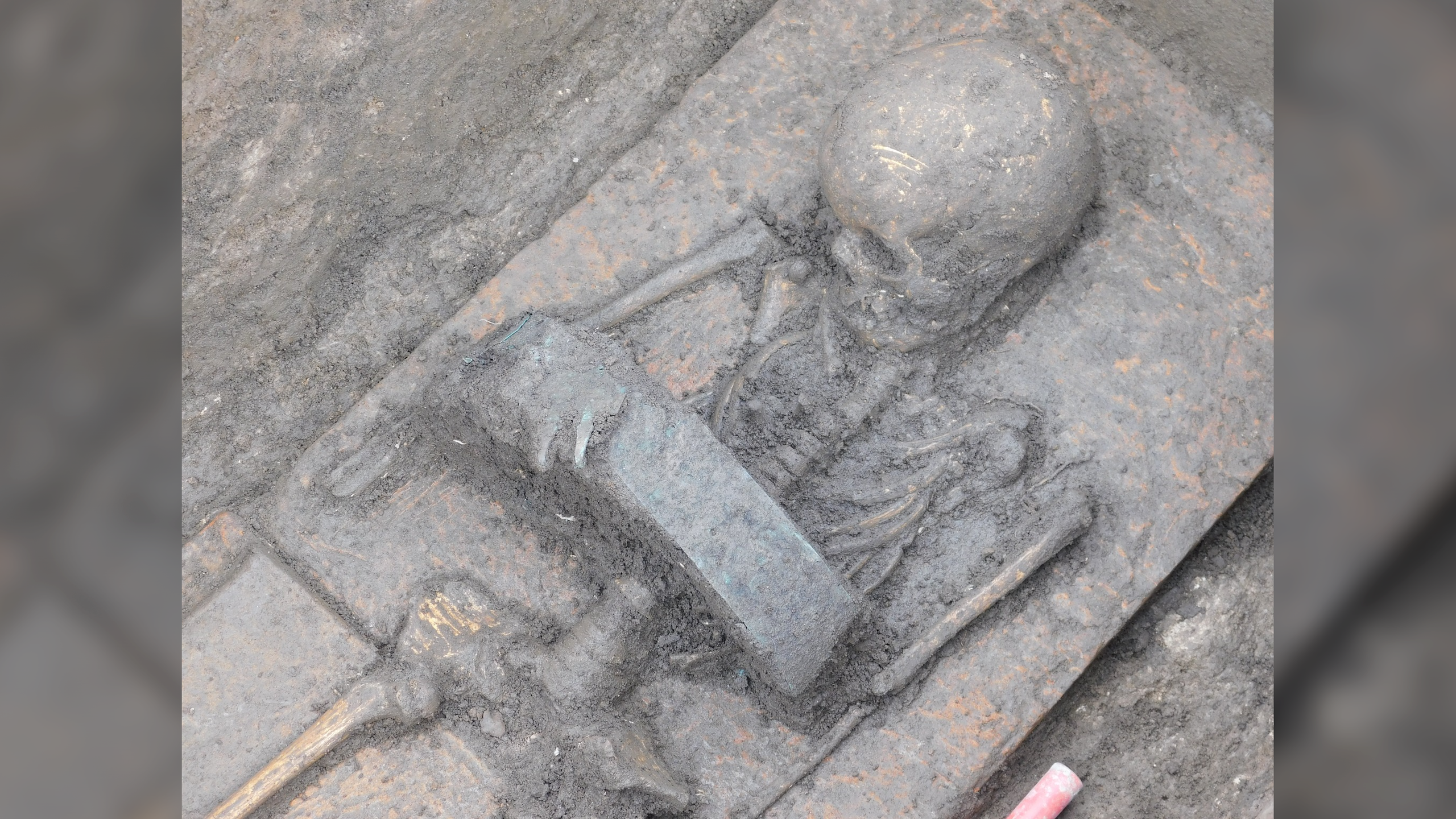
Archaeologists in southern Italy have uncovered the graves of two children who were buried wearing large bronze belts nearly 2,500 years ago. The metallic accessories are unusual because they are typically found only in adult male burials from the pre-Roman Samnite culture.
During recent work at the site of a former tobacco factory in Pontecagnano, a town in the Campania region of southwest Italy, archaeologists excavated part of an ancient cemetery containing 34 burials dated to the fourth and third centuries B.C., according to a translated statement from the Superintendency of Archaeology, Fine Arts and Landscape of Salerno and Avellino. Roughly half of the graves contained the skeletons of children between the ages of 2 and 10 years old.
Article continues below
Pontecagnano was first settled in the ninth century B.C. by people from the Villanovan culture, who introduced highly skilled bronzeworking practices to southern Italy. Two centuries later, Etruscan groups transformed Pontecagnano into a commercial hub for Greek, Phoenician and Italian traders. And by the fifth century B.C., the Samnites — warlike tribes that lived in the mountains of southern Italy and spoke a language called Oscan — had moved into Pontecagnano. The city remained a Samnite hub until the Roman conquest of southern Italy in the third century B.C.
The Pontecagnano cemeteries have revealed key information about the Samnites’ burial practices. Their graves were organized by family unit, and most took the form of earthen pits covered with a tile roof. Grave goods offered to the dead included a variety of pottery, but some artifacts were gender-specific: Men were buried with warrior-coded artifacts like spearheads, javelins and bronze belts, while women were given rings and brooches.
But in the new excavation, archaeologists discovered two children between the ages of 5 and 10 who were buried with bronze belts typical of adult male burials. Archaeologists had previously unearthed at least one additional example — a 12-year-old child wearing a bronze belt — at Pontecagnano. “It’s a find of great significance,” archaeologist Gina Tomay told the Italian news outlet ANSA in 2021. Tomay also said that the boy lived in the fourth century B.C. and was buried with ceramic cups to ensure he had food and wine in the afterlife.
Experts aren’t sure why these children were buried with an accessory typical of a warrior. However, sixth-century A.D. Anglo-Saxon graves of boys buried with belts and other warrior gear in the U.K. may have been placed there to speak of “the men these children might have become,” archaeologists have previously suggested.
Excavations are ongoing in various sectors of the town of Pontecagnano due to public and private construction projects, so the overall results of the archaeological work have not yet been made public. The superintendency plans to announce the new discoveries at this important pre-Roman settlement once research is complete.