







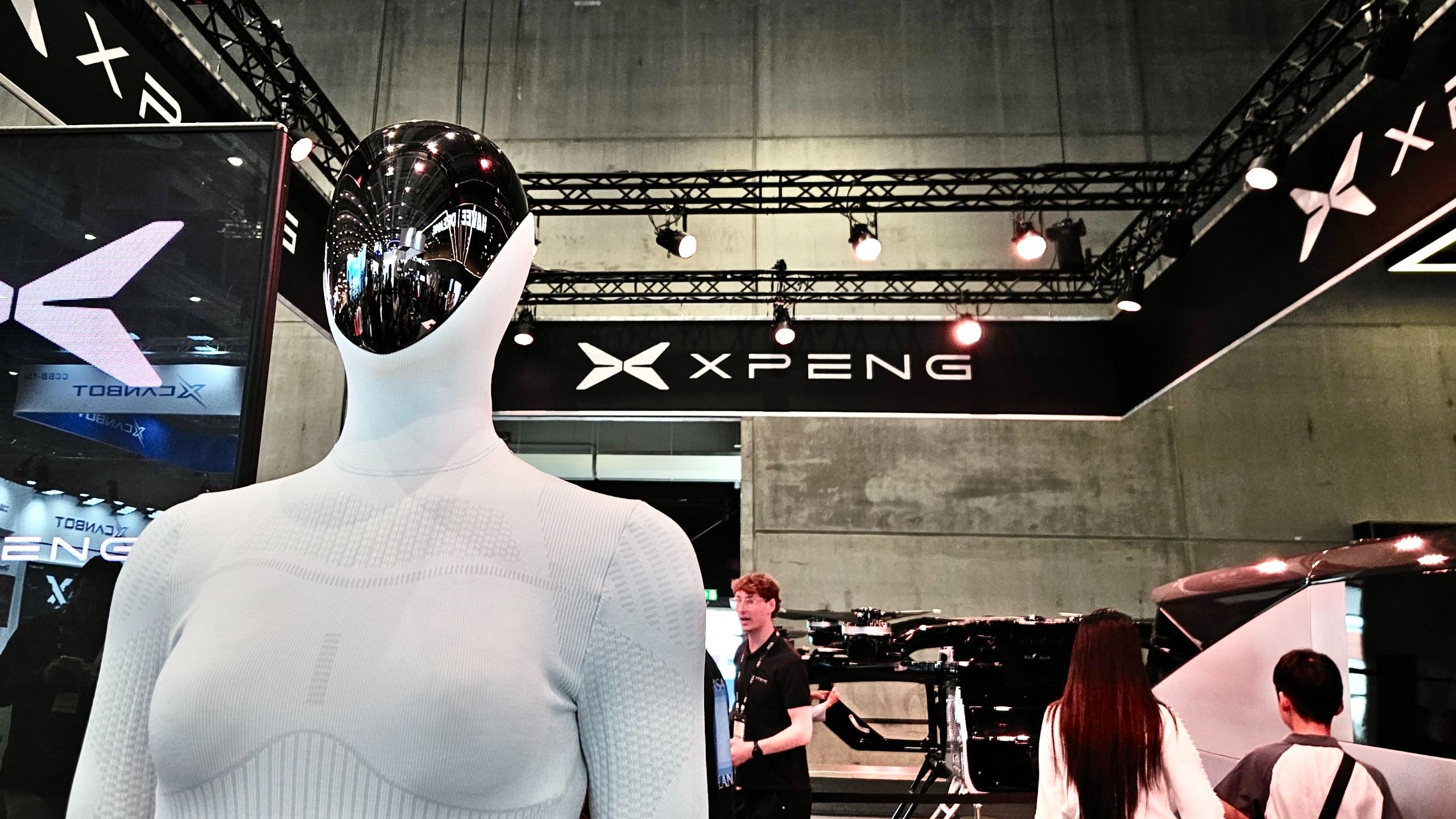
BERLIN — An eerily lifelike humanoid robot made by Chinese technology company Xpeng has now entered mass production, company representatives revealed. They say it’ll be the first such machine to walk itself off the production line.
The humanoid robot, dubbed IRON, went viral last year after presenters sliced it open onstage to prove a human wasn’t inside. Xpeng will now produce units through its existing production facilities, with no word on how many its factories will aim to build.
The fabric skin-clad machine comes in different body shapes and even genders, but all stand approximately 5 feet 7 inches tall (173 centimeters) and weigh 143 pounds (65 kilograms). The prototype included 82 degrees of freedom (DoF) head to toe, including 22 DoF in each hand. They can also move at speeds of up to 6.5 feet per second (approximately 2 meters per second), which is equivalent to a fast power walk.
Latest Videos FromLive Science
In conversations with Live Science, Xpeng representatives claimed that their machines will one day be used in homes to help with domestic chores like cleaning and folding laundry. They likened the introduction of humanoid robots more generally to the rise of smartphones in the mid-2000s and expect robots to proliferate on a similar scale over the next few years.
As such, they have extremely lofty expectations for IRON, with the company branding it the world’s first “high-level, general-purpose” humanoid robot. Representatives added that it can receive instructions, plan its strategy, navigate the environment intelligently, and avoid obstacles without trial and error. The robot also has a “self-charging” feature, meaning it will seek out designated charging cabins and plug itself in when low on battery.
The rise of humanoid robots
If the claims bear out, it will place IRON among the first such machines powered by artificial intelligence to be built on a massive scale. Competitors that have also entered mass production include American robotics company Figure AI’s Figure 03, which in May participated in a live-streamed production line demonstration, as well as the Chinese AGIBOT, which reached 15,000 units in June.
One notable company that hasn’t entered its robot into mass production is Tesla. The Optimus robot is still in factory assembly, and its release has been delayed four times since 2022, most recently last year. Xpeng representatives were keen to point this out in briefing materials shared with Live Science, without mentioning other humanoid robot makers.
Get the world’s most fascinating discoveries delivered straight to your inbox.
IRON’s makers claim it’s more advanced than its counterparts. Rather than building separate AI engines, the company has deployed the same “world model” to power the robot as that used in its fleet of AI-enabled electric vehicles (EVs) and its flying car prototypes.
The prototype IRON humanoid robot is 5 feet 6 inches tall and weighs 143 pounds.
(Image credit: Keumars Afifi-Sabet/Live Science)
One of the biggest challenges in robotics is that, given the physical world’s messiness, AI systems struggle to navigate and manipulate their environment unless conditions are controlled. That’s why we’re used to seeing robots either completing tasks slowly or getting things spectacularly wrong. Researchers, therefore, are increasingly focusing on building world models and other layers like improved vision-language-action (VLA) systems that enable them to better plan their actions a few steps ahead.
Xpeng representatives won’t share detailed information about the proprietary AI system powering IRON, but each robot features three frameworks that combine so it can function autonomously.
The frameworks include VLA, which combines visual perception, natural language, and physical motor control; a vision-language model (VLM) — combining vision encoders with text readers; and a vision-language-task/thought (VLT) model, which representatives say gives IRON reasoning capabilities that enable it to think through assigned tasks.
Each IRON robot is powered by three Turing AI chips that offer a collective 2,250 trillion operations per second (TOPS) of AI processing power. This means it can run a model equivalent to Meta’s Llama 3.2 (launched in 2024) locally without needing to access the internet. By contrast, most new laptops that can perform simple on-device AI tasks (like altering your webcam video feed in real time) tap into approximately 50 TOPS.
“We aim to build a new type of robot with full generalization capabilities that can truly become part of everyday life, create a better life for people, and ultimately become a companion in their lives,” said He Xiaopeng, the company’s chairman and CEO, in a statement shared with Live Science.
The company will first install these robots in its own showrooms and technology campuses while it continues to validate new ways to use them. Then in 2027, external shipments will target commercial customers for roles in areas such as customer service or guided tours in China primarily, and then in other countries.