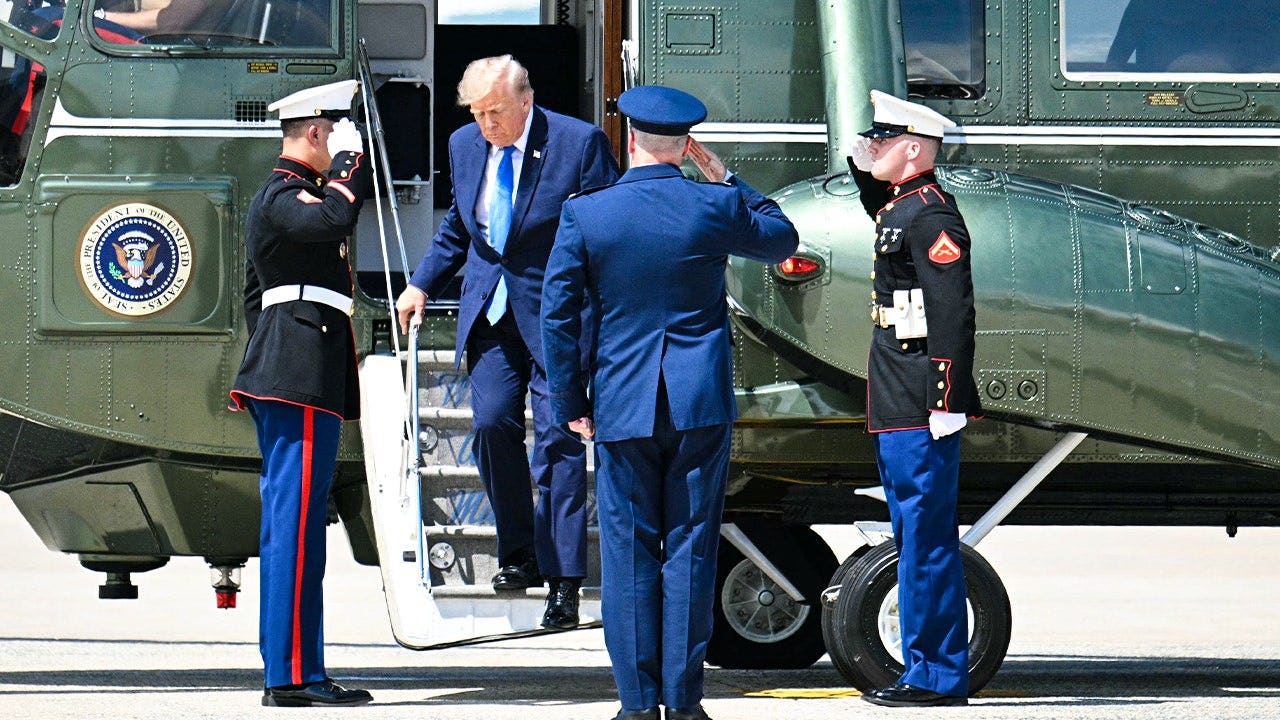





WASHINGTON — The Federal Aviation Administration is investigating why air traffic controllers at Washington’s Reagan National Airport did not stop flights Tuesday when President Trump’s helicopter, Marine One, took off from the nearby White House lawn, as required by safety protocols.
The airport is located fewer than five miles as the crow flies from the executive mansion and air traffic is supposed to be stopped whenever the president takes to the skies to ensure “standard separation” — enough distance between aircraft to avoid the risk of a collision.
The Wall Street Journal first reported on the investigation.
Marine One’s crew repeatedly attempted to contact the Reagan National control tower before departure Tuesday, stating the presidential helicopter was “three minutes to lift.”
Eventually, the tower responded: “You’ve got traffic rotating off Runway One, E-170.”
The Marine One crew responded they would keep a “momentary delay” before proceeding.
The helicopter lifted off from the Ellipse near the White House at 2:33 p.m. ET to carry the president to Joint Base Andrews, where he boarded Air Force One for travel to Los Angeles.
One minute later, at 2:34 p.m. ET, tracking data showed an American Airlines flight operated by Envoy Air departed Reagan National for Pensacola, Fla.
“There was momentary loss of separation after which the aircraft continued to move away from one another,” the FAA told The Post in a statement.

“The air traffic controller was in contact with both the commercial pilot and Marine One pilot during the loss of separation. As the White House has said, the President was never in danger. We are continuing to review the incident and will implement any appropriate corrective actions based on our findings.”
Air traffic patterns at Reagan National Airport have been a source of concern since an American Airlines regional jet collided with an Army Black Hawk helicopter while on approach to the hub on the evening of Jan. 29, 2025, resulting in 67 deaths.
The FAA imposed permanent restrictions on helicopter operations around the airport in the aftermath of the tragedy.
FAA rules require aircraft to remain separated by at least 1.5 miles horizontally and 500 feet vertically.