When the Japanese Smart Lander for Investigating Moon (SLIM) spacecraft, nicknamed the “Moon Sniper,” face-planted onto the lunar surface in 2024, an experimental rover told Earth scientists what happened. Rolling autonomously through the lunar dust, the transforming sphere-shaped robot — not unlike Star Wars’ BB-8 droid — photographed and transmitted images of the upside-down lander to Earth, completing its mission while SLIM slowly froze.
Now, a new paper, published Wednesday (June 10) in the journal Science Robotics, describes how that feat was possible and explains the role such rovers could play on future moon missions.
“The results highlight the potential of such platforms … as independent explorers, capable of accessing environments beyond the reach of a primary large spacecraft,” the research team wrote in the paper, which was led by Daichi Hirano, a scientist with the Japan Aerospace Exploration Agency who designed the rover.
The ball-shaped rover, called the Palm-Sized Lunar Excursion Vehicle 2 (LEV-2), was one of the payloads on SLIM, which made a soft lunar touchdown on Jan. 19, 2024. The feat made Japan the fifth nation to reach the moon, but trouble arose when SLIM couldn’t generate power with its solar panels.
While SLIM was running on reserve battery power, it deployed LEV-2 — a morphable, spherical robot that could change shape using two wheels inside the ball, depending on the terrain it encountered — as well as LEV-1, a rover that “hopped” across the terrain. After being deployed, LEV-2 operated for about 100 minutes and relayed information through LEV-1, before losing communication.
Despite its short life, LEV-2 proved crucial to the mission’s troubleshooting, as it showed that the SLIM lander had fallen upside-down on the surface, the authors wrote in the new paper.
“The palm-sized rover accomplished autonomous lunar exploration by navigating around the SLIM lander, capturing images of both the SLIM lander and its environment and transmitting selected images through wireless communication on the lunar surface,” the team explained.
Get the world’s most fascinating discoveries delivered straight to your inbox.
Against the odds, SLIM managed to get just enough solar power to survive three frigid lunar nights (each lunar night lasts about 2 weeks, when the moon’s Earth-facing side is angled away from the sun). SLIM transmitted to controllers in February, March and April, before falling silent and being declared dead in late August. Meanwhile, LEV-2 met its primary mission objective to obtain and transmit images of the spacecraft, “thereby providing critical supplementary data for a comprehensive assessment of the lunar landing outcome,” the team wrote.
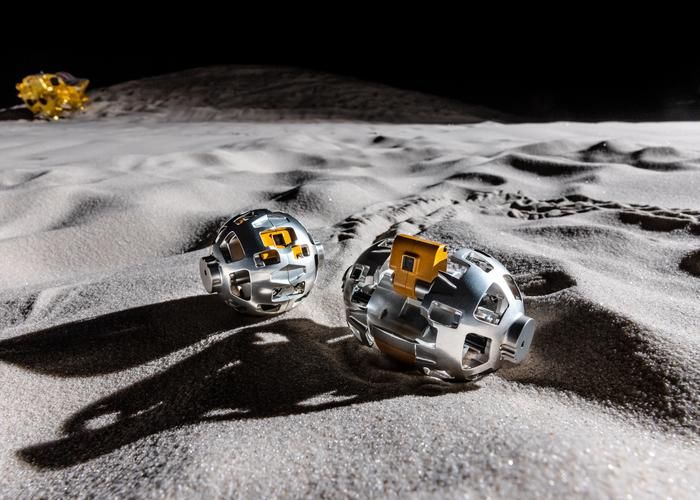
A photo showing LEV-2 in ball form (left) and expanding to traverse the moon with its metal wheels (right). A model of the SLIM lander sits rightside-up in the background.
(Image credit: D. Hirano)
LEV-2 also demonstrated technologies that would be crucial for future missions to the moon and Mars, the authors added. For example, its morphable mobility tech successfully propelled the rover around the surface, and the robot showed “autonomous navigation and control systems” while processing images to traverse the lunar surface.
Lessons learned
The team also extracted some “lessons learned” from the mission to improve on the morphable rover design for future excursions.
First, they will aim to record the vehicle status more frequently. LEV-2 sent telemetry every 32 seconds, which “limited direct observation of status changes and actions.”
Second,there’s a need to enhance communications. Communication dropouts betweenLEV-2 and LEV-1 “limited the available telemetry needed to reconstruct state [spacecraft-shape] transitions during surface operations,” the team noted.
Finally, there’s a need to improve the rover software. Controllers could see LEV-1 recovering from wheel-rotation locks and issues with its attitude, due to its fault detection and recovery systems. But the software had a limited number of states and transitions preloaded, which could present an issue on longer missions, especially if the unexpected happens.
While the small vehicle had limitations, the investigators noted that LEV-2 met its goals and that the technology has room for improvement.
“In the long term, this approach may enable more flexible, robust, and cost-effective planetary exploration missions,” they said. “The lessons learned from this mission provide practical guidance for the design and operation of next-generation distributed space robotic systems.”