





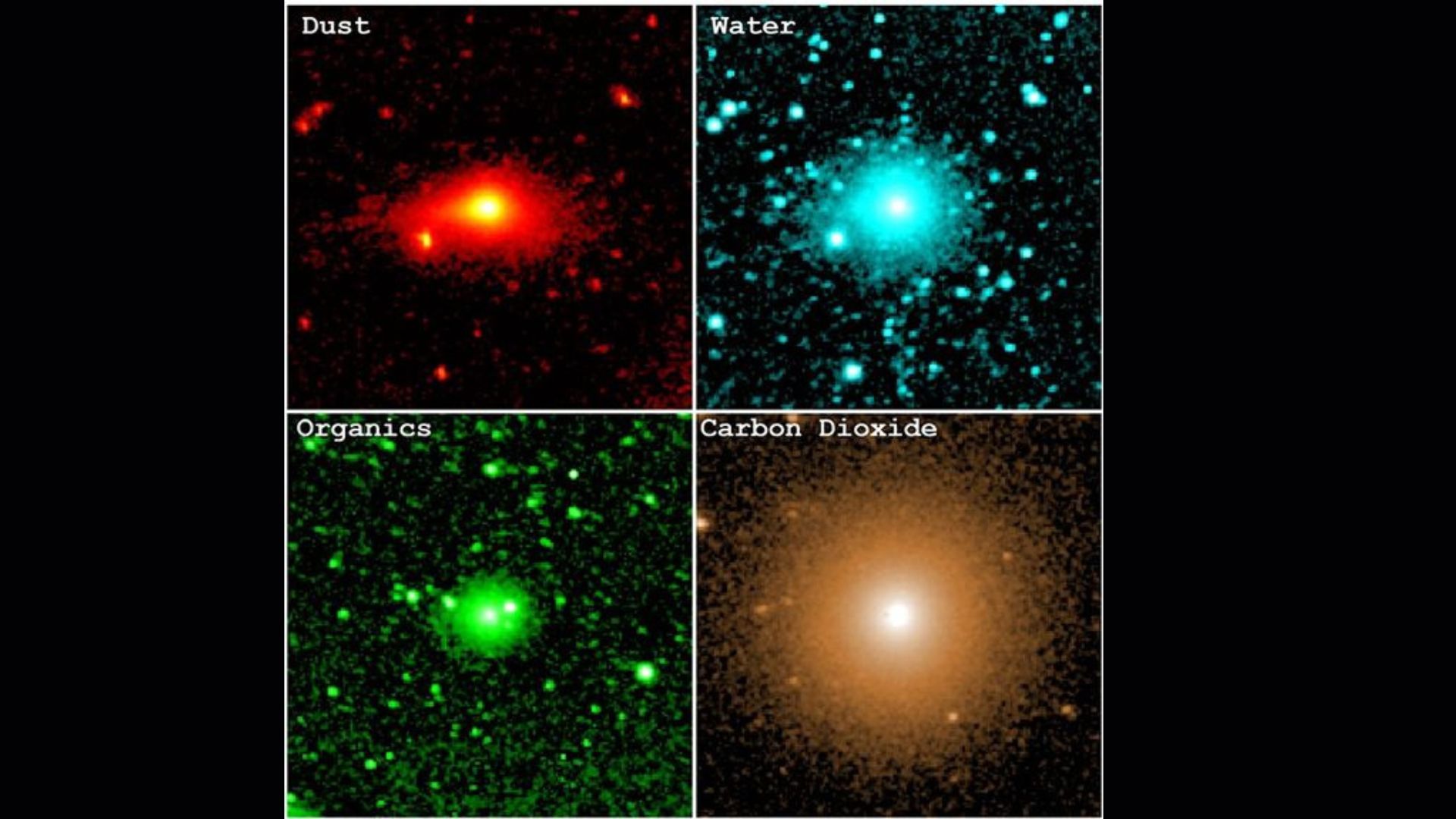
The interstellar comet 3I/ATLAS shed the building blocks of life as it flew past Earth last year, according to new data from NASA’s SPHEREx space telescope.
From its position in orbit, SPHEREx watched the rare interstellar visitor swing around the sun and make its closest approach to Earth in December, before the comet began its long journey back out of our solar system.
The SPHEREx researchers published their findings in the February issue of the Research Notes of the AAS (American Astronomical Society), which presents work in progress that has yet to be peer reviewed.
Comet 3I/ATLAS became a celestial celebrity in 2025, being only the third interstellar visitor ever detected and potentially the oldest comet ever seen. The comet’s origins have been the subject of considerable speculation, with repeated suggestions that it could be an alien spacecraft. However, nearly all astronomers are confident that 3I/ATLAS is a natural comet from another star system, and the new findings don’t change that.
Comets heat up as they fly closer to stars, causing ice on their surfaces to sublimate into gas. These newly unleashed gases can erupt from the comet’s surface in jets, wrap around the comet’s body in a cloud called a coma, and sweep away behind the comet to form a long tail. Researchers are able to detect and study these gases, and thereby explore a comet’s makeup.
“Comet 3I/ATLAS was full-on erupting into space in December 2025, after its close flyby of the Sun, causing it to significantly brighten,” study lead author Carey Lisse, an astronomer at Johns Hopkins Applied Physics Laboratory in Maryland, said in the NASA statement. “Even water ice was quickly sublimating into gas in interplanetary space. And since comets consist of about one-third bulk water ice, it was releasing an abundance of new, carbon-rich material that had remained locked in ice deep below the surface.”
“We are now seeing the usual range of early solar system materials, including organic molecules, soot, and rock dust, that are typically emitted by a comet,” Lisse added.
Though these organic molecules may be typical for a comet, they could still be remarkable in their own way. One popular theory holds that comets may spread the seeds of life to bodies across the cosmos, potentially including Earth.
Astronomers first detected comet 3I/ATLAS in July, 2025, when they spotted an unknown object whizzing along at around 137,000 mph (221,000 km/h) within the orbit of Jupiter. Researchers think it has been travelling through space for billions of years, gaining momentum from a gravitational slingshot effect as it whips by other stars and nebulae. After swinging past the sun, reaching the closest point to our star (perihelion) at the end of October, the comet came within about 168 million miles (270 million kilometers) of our planet in December.
SPHEREx (short for the Spectro-Photometer for the History of the Universe, Epoch of Reionization, and Ices Explorer) launched into low-Earth orbit in March, 2025, and just happened to get a decent view of the comet from Dec. 8 to 15.
The space telescope is designed to scan the entire night sky using 102 separate infrared color sensors, which will help researchers better understand the universe, including the gases around comets, and search for the ingredients of life. Getting a view of an interstellar visitor so soon after launch wasn’t on SPHEREx’s itinerary, so the timing of the comet 3I/ATLAS flyby was a lucky break for researchers.
“Our unique space telescope is gathering unprecedented data from across the universe,” deputy study lead author Yoonsoo Bach, a researcher at the Korea Astronomy and Space Science Institute, said in the statement. “But in this case, our galaxy delivered a piece of a faraway star system to us only a few months after launch, and SPHEREx was ready to observe it. Science is sometimes like that: You’re in the right place at the right time.”
3I/ATLAS is currently soaring toward a close approach with Jupiter, where NASA’s Juno spacecraft will get one last chance to study it up close before the comet leaves our solar system forever.