





Thousands of previously undetected tiny earthquakes have revealed the edge of a miniature tectonic plate slamming into Alaska near the Denali Fault.
The microplate could be focusing seismic energy in a straight line in a region under the Alaska Range of mountains, potentially contributing to large earthquakes and the development of small volcanoes in the area.
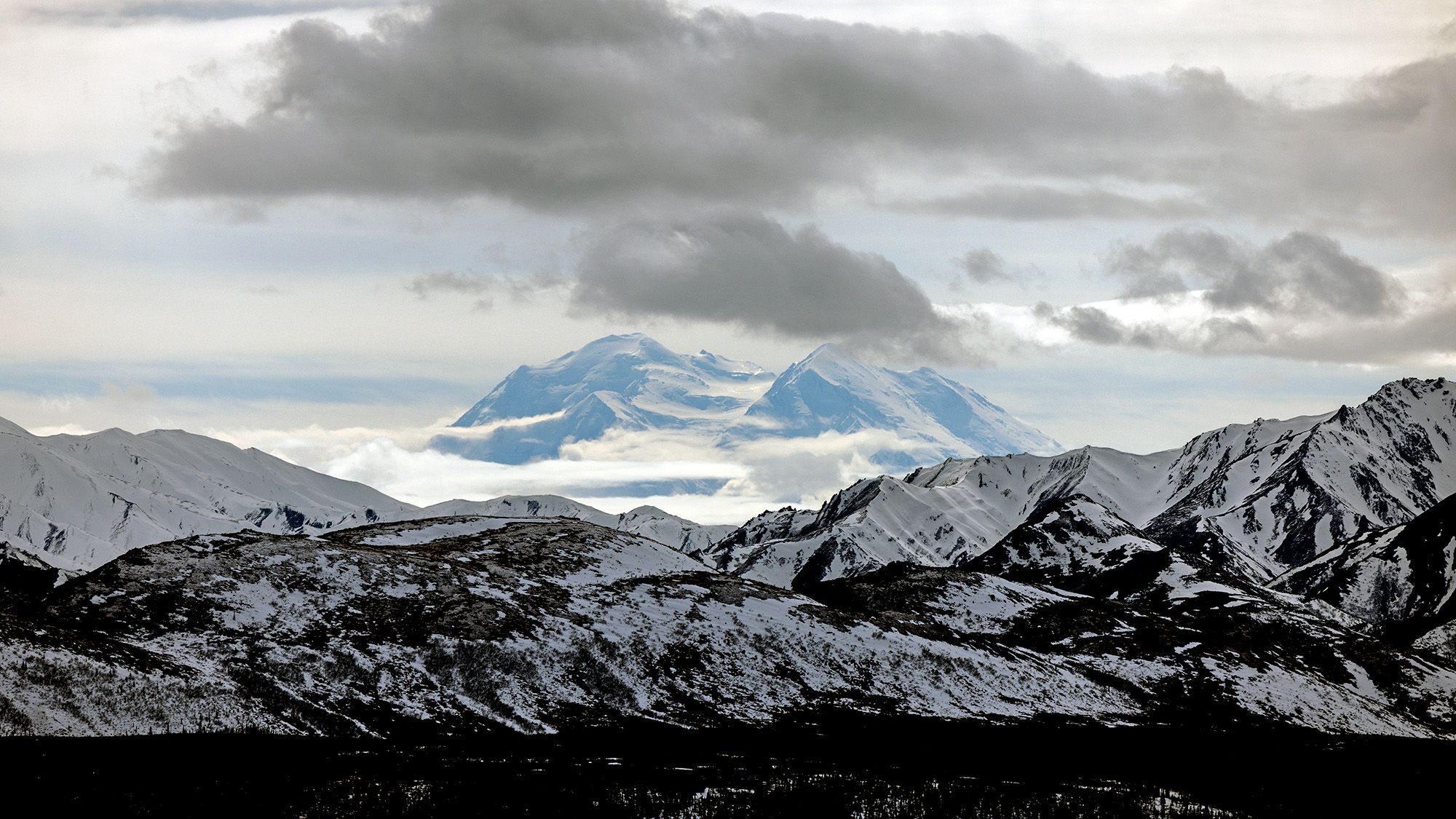
The Yakutat microplate is an ocean plateau that is thicker than the Pacific oceanic crust surrounding it. Formed by volcanoes tens of millions of years ago, this block of crust is now being pushed under the North American Plate in Alaska in a process called subduction. But because it is thicker and more buoyant than the surrounding oceanic crust, the microplate pushes up the Alaska Range, which includes North America’s highest mountain, Mount McKinley (also known as Denali).
“Being able to identify where the Yakutat microplate is in the subsurface has helped us understand the tectonics,” said Meghan Miller, the study’s first author and a seismologist at the Australian National University.
Study co-author Meghan Miller deploys a temporary seismic station. The data from these stations revealed a hidden microplate’s location.
(Image credit: Sarah Roeske.)
Part of the plate is still off the coast of Alaska, sticking out like a slipper under a rug. But the precise location of the edge of the plate that has already subducted under the continent has been hard to pinpoint. Miller and her colleagues installed seven new seismometers south of the Denali Fault, which runs through the Alaska Range. This is a tectonically active region, most famous for a 2002 magnitude 7.9 earthquake that was felt as far away as Seattle.
But it wasn’t a giant temblor like 2002’s that revealed the hidden edge of the Yakutat. Instead, it was unmasked by about 3,000 newly discovered minuscule earthquakes clustered in a clean line running from northwest to southeast for 155 miles (250 kilometers) under the Denali Fault. The “very sharp, linear pattern” also aligns with a series of small volcanic cones and rock-type changes in the deep subsurface, Miller and her colleagues reported in the new study, published June 4 in the journal The Seismic Record.
The researchers suspect that the leading edge of the plate is focusing seismic energy toward the surface. The plate’s location also aligns with the initiation point of the 2002 Denali quake, which started on a nearby fault, Miller told Live Science, but exploring that idea further will require computational modeling.
Get the world’s most fascinating discoveries delivered straight to your inbox.
“What we were postulating is that the edge of the Yakutat plate is influencing all these different types of processes,” Miller said.
Miller, M., Zhang, P., Pickle, R. Waldien, T., Roeske, S. (2026). Razor‐Sharp Edge—The Yakutat Slab Dissecting South‐Central Alaska. The Seismic Record. https://doi.org/10.1785/0320250055