



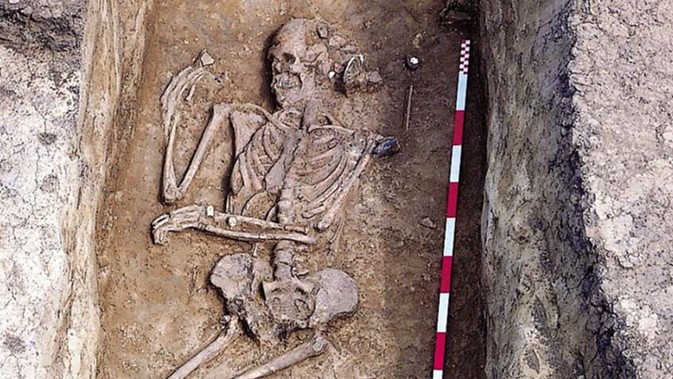
A Stone Age woman buried with male-associated artifacts in what is now Hungary is revealing that her society embraced complex identities and flexible gender roles 7,000 years ago, a new study finds.
The analysis focused on activity-related skeletal changes to gain insight into past people’s overall physical workload, upper-limb overuse, and toe hyperextension (which can result from a kneeling posture). While all of the Stone Age men and women had high overall physical workloads and engaged in activities involving kneeling, the researchers discovered that the male skeletons had evidence of right-sided upper-limb overuse — possibly related to throwing movements — that indicated differences in men’s and women’s use of their arms.
Men and women were also buried differently. In one cemetery, most female skeletons were placed on their left side and were buried with shell bead belts, while most male skeletons were found on their right side and were interred with polished stone tools. But according to the study, two male skeletons and five female skeletons were buried in ways that didn’t align with expectations, revealing that the association between biological sex and body position in death was not absolute.
One older adult female burial was particularly unusual. Hers was the only female skeleton the researchers found buried with polished stone tools, and her toes revealed a kneeling activity pattern more like that of the males in the cemetery. According to the researchers, this burial suggests that “females may have assumed roles traditionally associated with males” in the society and that gender roles “were fluid and shaped by multiple intersecting factors.”
Study first author Sébastien Villotte, a researcher at the French National Center for Scientific Research, told Live Science in an email that there is no clear evidence this woman had a unique social role, such as shaman. The other people who were buried in ways that did not align with their biological sex may have had “individual trajectories that do not fit in with an ‘ideal’ pattern,” Villotte said. “This is the period in Central Europe when people began to express previously existing gender roles in a new arena.”
Villotte, S., Szeniczey, T., Kacki, S., & Anders, A. (2026). Fixed and fluid: The two faces of gender roles—A combined study of activity patterns and burial practices in the European Neolithic. American Journal of Biological Anthropology, 189(2), e70217. https://doi.org/10.1002/ajpa.70217