






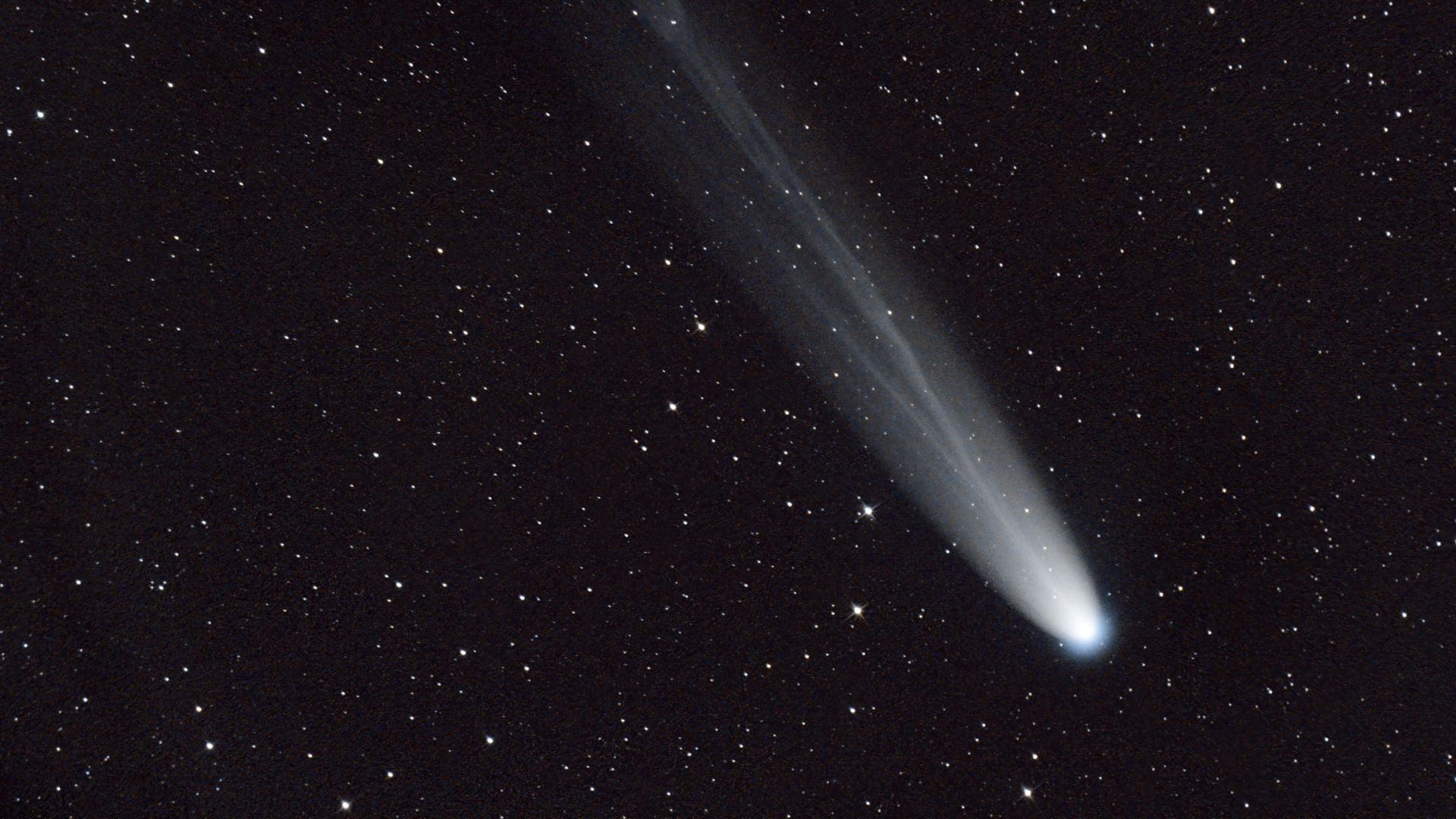
A rare “sungrazer” comet is about to pass very close to our star and could become visible in daylight — or it could completely disintegrate before our eyes. Either way, there could be something special to see in the night sky, with a large tail potentially visible late this week.
Comet C/2026 A1 (MAPS) was discovered Jan. 13 by French astronomers at the AMACS1 Observatory in Chile. Although the comet was initially thought to have a nucleus measuring around 1.5 miles (2.4 kilometers) wide, astronomers later reduced the estimate to under 0.25 miles (0.4 km) based on James Webb Space Telescope observations taken in February.
C/2026 A1 (MAPS) is expected to get within 98,000 miles (158,000 km) of the sun’s surface and pass through the lower regions of the sun’s outer atmosphere, or corona, at 9:30 a.m. EDT (13:30 UTC) Saturday (April 4), according to the British Astronomical Association (BAA). According to the European Space Agency, many Kreutz sungrazers evaporate, but if they survive, they could put on a spectacular show.
Because C/2026 A1 (MAPS) is traveling into the sun’s glare, it will be difficult to see before April 4. If it survives its close encounter with the sun — even if it fragments — it could become visible for a short time after sunset in the evenings that follow. Unless it breaks apart before it gets close to the sun, there will be a possibility of seeing a potentially large and bright tail in the western evening sky starting around April 9, according to the BAA.
If that occurs, Comet C/2026 A1 (MAPS) will be the first of two comets visible in April, with the likely dimmer but more predictable C/2025 R3 (PanSTARRS) set to become an easy binocular target close to April 20.