





The San Andreas and San Jacinto fault systems are at their highest levels of tectonic stress in 1,000 years, raising the threat of a major, imminent earthquake that could devastate Southern California, a new study finds.
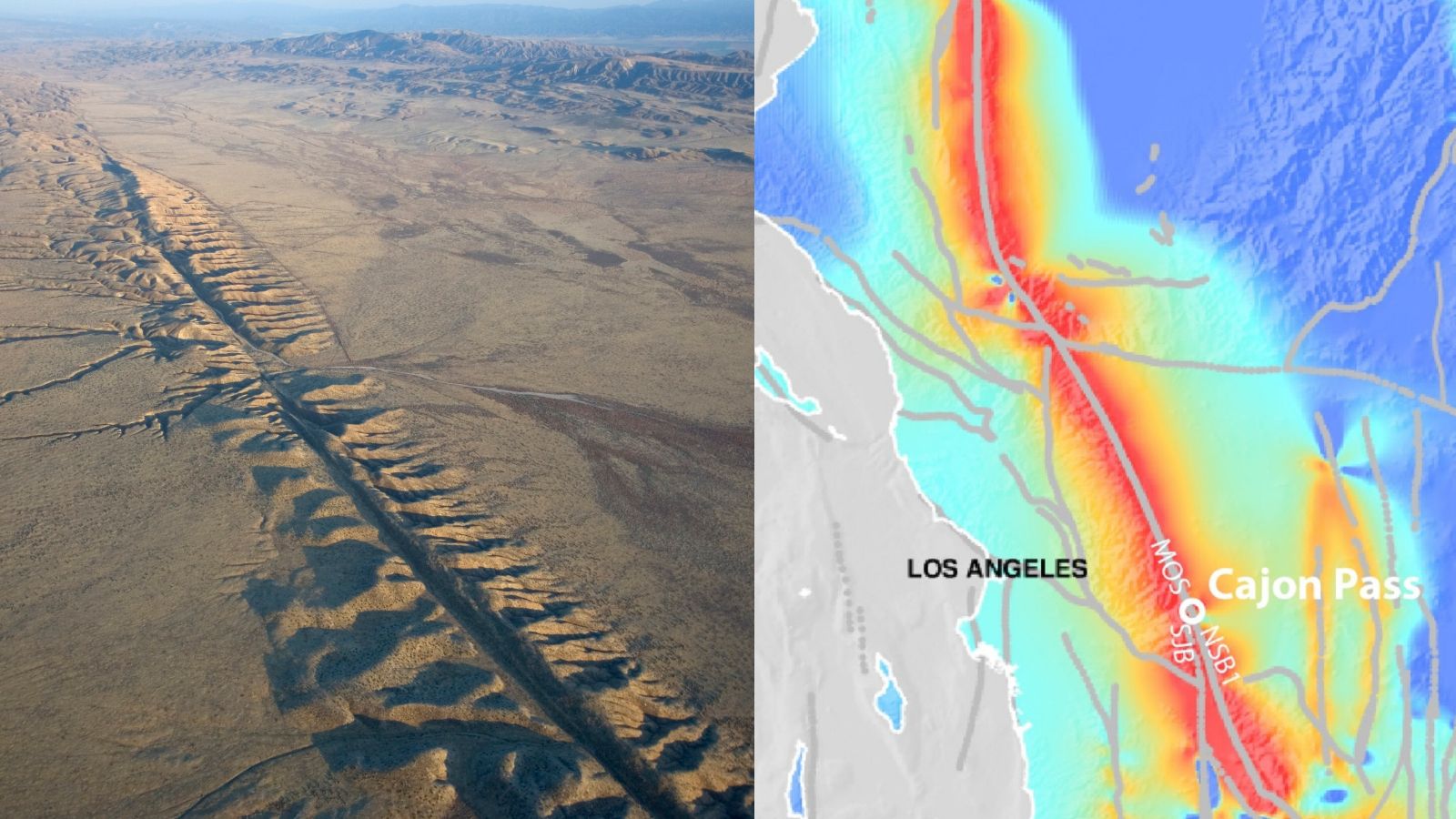
The faults could rupture separately or together, thanks to an “earthquake gate” between them at Cajon Pass, where the San Jacinto fault splits from the main trace of the San Andreas fault. Researchers discovered that the Cajon Pass can prevent or facilitate earthquakes moving between the faults, depending on how similar their stress levels are at the time of rupture.
And right now, the San Andreas and San Jacinto faults appear to have comparable, extremely elevated stress levels, potentially spelling trouble for Los Angeles, San Bernardino, Riverside and the Coachella Valley, the team warned.
Cajon Pass, where the San Andreas and San Jacinto faults connect, is an “earthquake gate” that can facilitate the spread of ruptures.
“Our results show that stress levels on multiple fault segments are now at or above the highest values seen in the past millennium and that the region may be capable of a large through-going rupture involving both fault systems,” study first author Liliane Burkhard, a planetary geologist at the University of Bern in Switzerland and at the University of Hawaii at Manoa, said in a statement.
The San Andreas and San Jacinto faults have caused 36 earthquakes with magnitudes of 6.4 or above in the past 1,000 years. Southern California’s last “big one” was a magnitude 7.9 event in 1857, when a 205-mile (330 kilometers) segment of the San Andreas fault slipped horizontally between Parkfield and Cajon Pass. That rupture did not propagate through Cajon Pass, but a similar megaquake in 1812 did, suggesting this could happen again in what is now a much more built-up and densely populated environment, according to the study.
Almost 170 years have passed since the 1857 megaquake, raising fears that another huge earthquake could be due to hit soon.
To estimate this risk, Burkhard and her colleagues built a model replicating the last 1,000 years of major earthquake activity along the southern San Andreas and San Jacinto fault systems.
Get the world’s most fascinating discoveries delivered straight to your inbox.
The researchers used observations such as tree-ring records and age data from sediments that have been displaced to reconstruct Southern California’s earthquake history. They fed this information into the model, which simulated the accumulation, release and propagation of tectonic stress in the San Andreas and San Jacinto faults.
The results, published June 3 in the Journal of Geophysical Research: Solid Earth, suggest the San Andreas and San Jacinto faults are primed for an Earth-shattering rupture, which may involve the earthquake gate at Cajon Pass opening to unleash more destruction than a single-fault event would on its own.
If a rupture were to occur along the two branches of the San Andreas fault that connect at Cajon Pass, it would be a joint rupture, according to the study. If both branches of the San Andreas fault and the San Jacinto fault were involved, this would constitute a tripartite rupture.
The chance of each event happening and the timing of a potential rupture are unknown, but understanding how much stress is building up inside the system could help planners and policymakers prepare for whatever comes next, Burkhard said.
“What we can say is that the system is critically stressed, and that physics-based models like this one give us a clearer picture of the range of scenarios we should be prepared for,” she said. “That information matters for hazard assessment, infrastructure planning, and emergency preparedness.”
The researchers say their model could apply to other fault junctions and be used as a tool for hazard assessment globally. “We are using rigorous, quantitative science to better understand the risk facing millions of people,” Burkhard said.
Burkhard, L. M. L., Smith‐Konter, B. R., Scharer, K. M., & Sandwell, D. T. (2025). Cajon Pass and the Southern San Andreas Fault System: Earthquake cycle stress Accumulation and Present-Day Loading. Journal of Geophysical Research Solid Earth, 131(6). https://doi.org/10.1029/2025jb033213