




There’s a new T. rex in town, but this one didn’t hunt on land. It ruled the ancient seas.
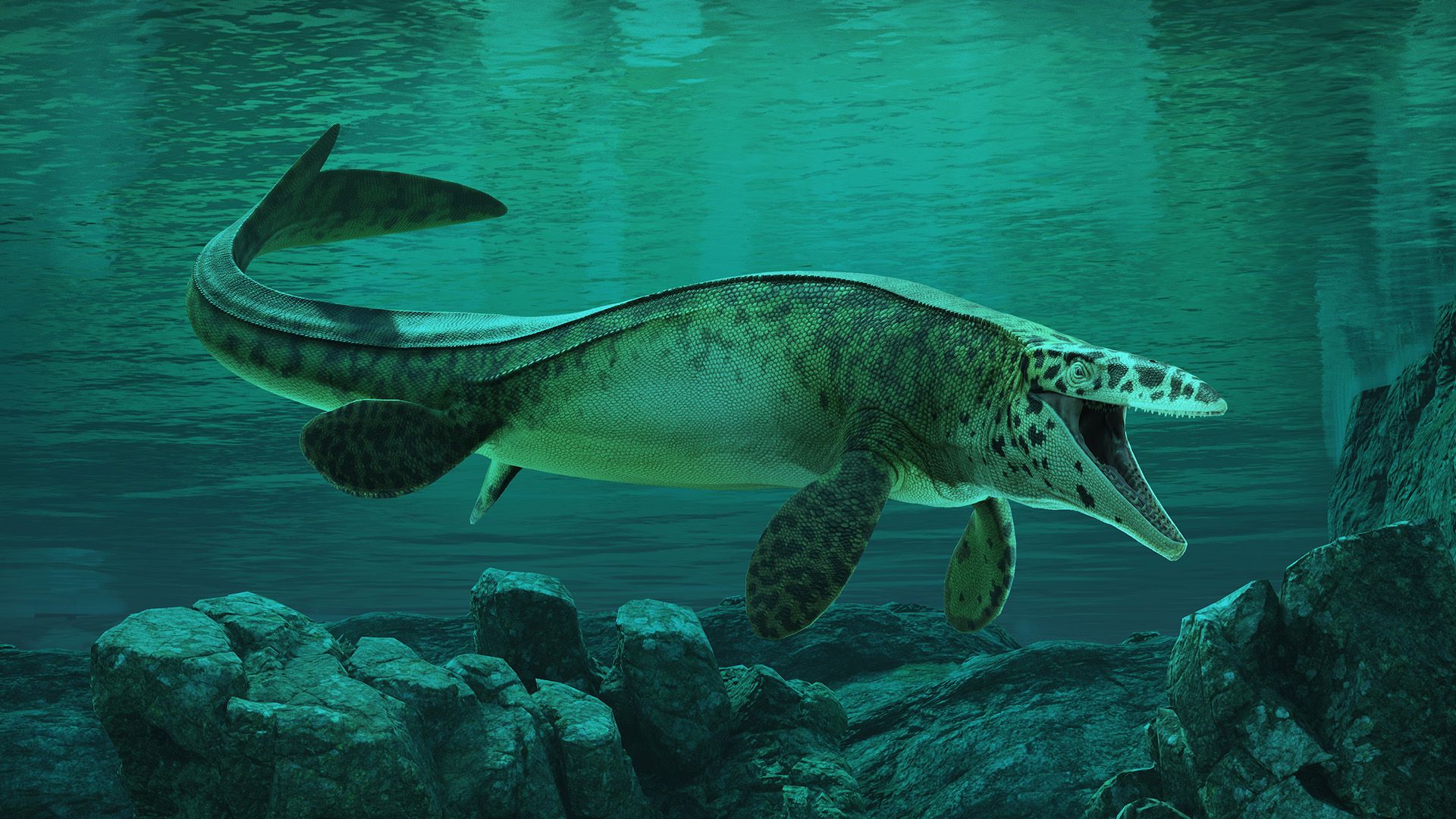
Scientists have described a new species of mosasaur, a member of a marine reptile group that lived at the same time as dinosaurs during the Cretaceous period (145 million to 66 million years ago). The newly named species fits into an already known genus: Tylosaurus. But its new species name, Tylosaurus rex — T. rex, for short — sets it apart from the other mosasaur species in the group.
The mosasaur T. rex measured up to 43 feet (13 meters) long, or about the length of a tour bus. It had finely serrated teeth, unusually powerful jaws, and evidence on its fossils of violent combat with its own species.
“Everything is bigger in Texas and that includes the mosasaurs, apparently,” study first author Amelia Zietlow, a research associate of paleontology at the American Museum of Natural History in New York City, said in a statement.
A misidentified species
While examining a fossil in the American Museum of Natural History’s collection, Zietlow noticed that a specimen labeled as Tylosaurus proriger — a well-known mosasaur species first described in 1869 — didn’t quite match others of its kind. The unusual fossil was discovered in 1979 near an artificial reservoir outside Dallas.
After comparing the specimen with the original name-bearing fossil of T. proriger held at Harvard’s Museum of Comparative Zoology, Zietlow and her colleagues found that it belonged to a newfound species. This specimen wasn’t the only misidentified specimen of this species; more than a dozen fossils at other institutions shared the same traits.
Compared with T. proriger, the newly described T. rex was 13 feet (4 m) longer, had finely serrated teeth (which T. proriger lacked) and lived several million years later. Most T. proriger fossils were discovered in what is now Kansas and are roughly 84 million years old, while the fossils now identified as T. rex are mostly from Texas and date to about 80 million years ago. At that time, the Western Interior Seaway stretched from the Gulf of Mexico up to the Arctic and was home to many sea creatures, including mosasaurs.
A Tylosaurus specimen, originally found in 1979, is now on display at the Perot Museum of Nature and Science in Dallas.
(Image credit: Courtesy of the Perot Museum of Nature and Science)
A violent tyrannical king
The new T. rex‘s anatomy suggests that, like its mosasaur relatives, it was a formidable marine predator. In addition to its massive size, T. rex had strong jaw and neck muscles.
Some fossils show signs of brutal injuries. One specimen in the collection of the Perot Museum of Nature and Science in Dallas, nicknamed “the Black Knight,” is missing the tip of its snout and has a fractured lower jaw. The researchers suspect the damage was caused by another individual of the same species.
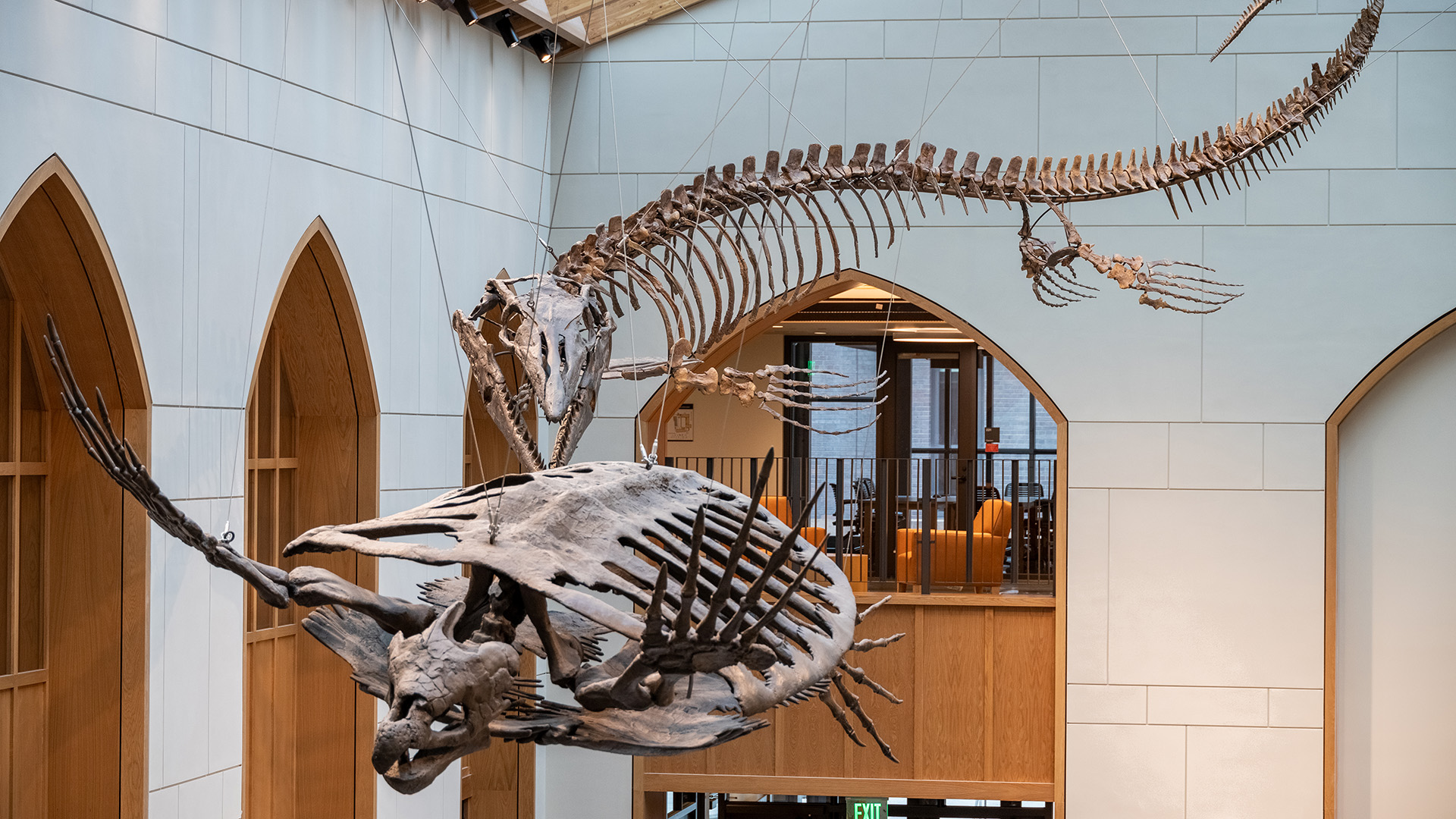

The “Sophie” specimen, displayed at the Yale Peabody Museum, was once considered Tylosaurus proriger and now will be reclassified as Tylosaurus rex.
(Image credit: Courtesy of the Yale Peabody Museum)
“Through our study and examination of well-preserved fossils collected throughout the north Texas region, we have evidence of violence within this species to a degree not previously seen in other Tylosaurus specimens,” study co-author Ron Tykoski, vice president of science and curator of vertebrate paleontology at the Perot Museum of Nature and Science, said in the statement.
A name to remember
Other famous mosasaur specimens once identified as T. proriger will now be reassigned to to T. rex, including “Bunker,” a large specimen on display at the University of Kansas that was discovered in 1911, and “Sophie,” a specimen displayed at the Yale Peabody Museum.
The name also nods to an earlier idea. In the late 1960s, paleontologist John Thurmond recognized that large tylosaurs from northeast Texas might represent an unknown species. He informally called them Tylosaurus thalassotyrannus, meaning “sea tyrant.”
This is not the first time “T. rex” has had a naming twist. The land-dwelling Tyrannosaurus rex almost ended up with the name Manospondylus gigas, after paleontologist Edward Cope described two partial backbones from South Dakota in 1892. Those bones were later linked to T. rex, but they were too incomplete to clearly define the species when they were first described. By the time the bones were connected to T. rex, its name was already deeply embedded in scientific literature and popular culture.
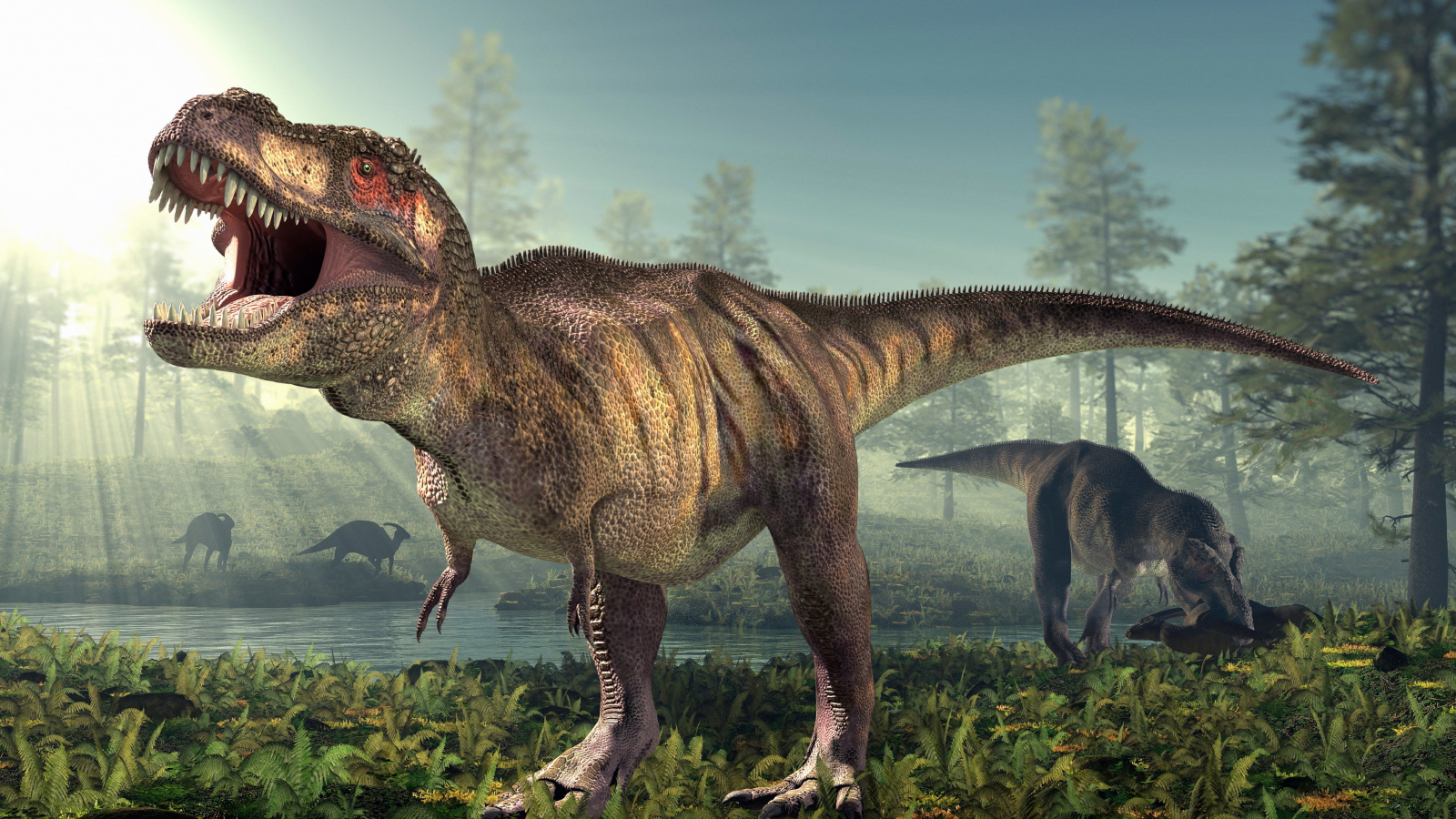

Tyrannosaurus rex almost had a different name.
(Image credit: ROGER HARRIS/SPL via Getty Images)
While the aquatic T. rex seems to have resolved the misidentification issue, the new study also revisited another long-standing problem in mosasaur research: The dataset used to study mosasaur evolutionary relationships has changed little in nearly 30 years. By reanalyzing the evolutionary data on the species, the team also proposed a new evolutionary family tree among tylosaurs and argued mosasaur evolution needs a broader reassessment.
“This discovery is not just about naming a new species,” Zietlow said. “It highlights the need to revisit long-standing assumptions about mosasaur evolution and to modernize the tools we use to study these iconic marine reptiles.”
Zietlow, A. R., Polcyn, M. J., & Tykoski, R. S. (2026). A gigantic new species of tylosaurus (Squamata, Mosasauridae) from Texas : and a revised character list for phylogenetic analyses of Mosasauridae. Bulletin of the American Museum of Natural History, 482, 0003–0090. https://hdl.handle.net/2246/7549
T. rex quiz: How much do you really know about the king of the dinosaurs?