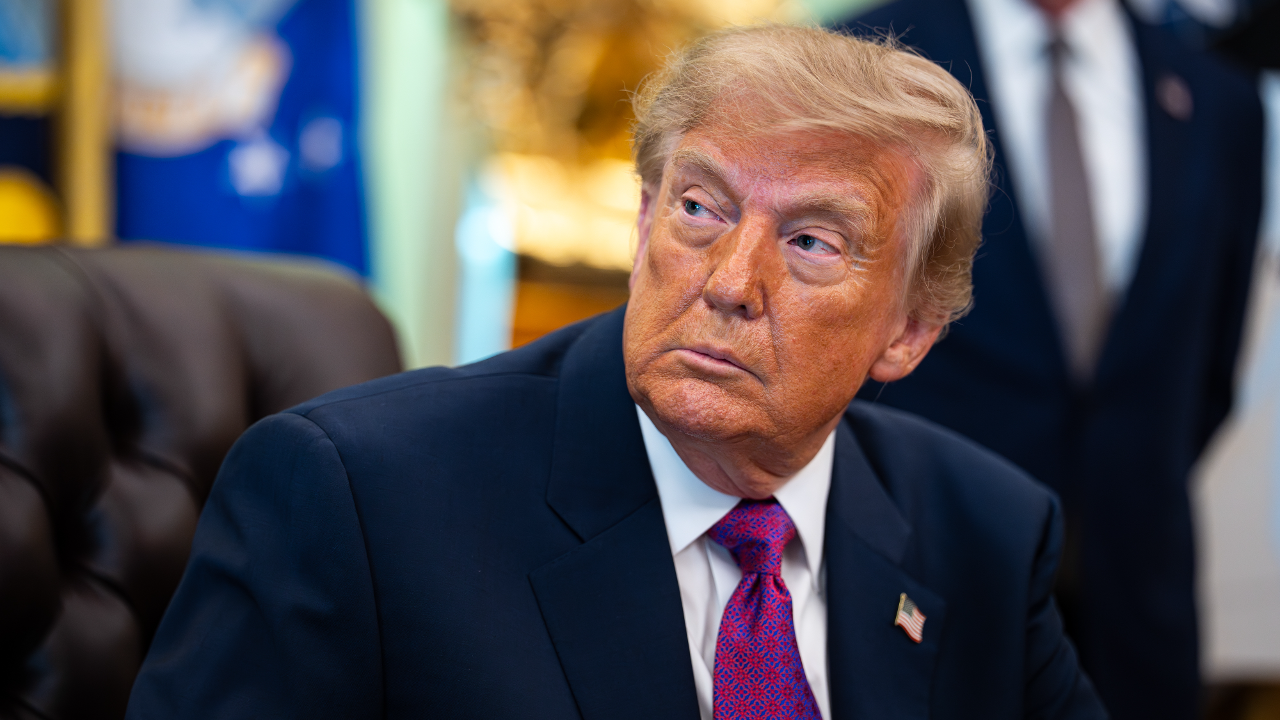






WASHINGTON — President Trump on Monday restarted the US naval blockade of Iran’s ports, and — in a big departure — said the US would be charging money for providing the safe passage of ships in the Strait of Hormuz.
The announcement comes after Iran has sought to charge tolls for commercial vessels passing the key waterway — which was previously toll-free before the US and Israel unleashed their war on Iran on Feb. 28.
“The U.S.A. will be, from this point forward, known as ‘THE GUARDIAN OF THE HORMUZ STRAIT,’ but as such, and as a matter of FAIRNESS, will be reimbursed, at the rate of 20% on all cargo shipped, for any and all costs necessary to do the job of providing safety and security to this very volatile section of the World,” he added.
“The process and formation will begin immediately.”
The turmoil in the strait comes after the American military pummeled regime forces over the weekend to restore international shipping through the critical oil chokepoint.
US Central Command (CENTCOM) announced late Sunday that American forces hit dozens of Iranian targets, including missile and drone capabilities as well as small boats, coastal radar sites, and Tehran’s air-defense systems.
A US naval blockade had been imposed earlier in the conflict but withdrawn ahead of the signing of a 14-point Memorandum of Understanding with Iran in mid-June.
That document stipulated vessels transiting the Strait of Hormuz for a 60-day period would not be charged and guaranteed “safe passage” while Iranian and US negotiators hashed out a final deal to conclude the conflict.
“The Islamic Republic of Iran will conduct dialog with the Sultanate of Oman to define the future administration and maritime services in the Strait of Hormuz in discussion with other Persian Gulf or littoral states in line with the applicable international law and the sovereign rights of coastal states of the Strait of Hormuz,” it stated.
But the negotiators were never able to see eye to eye after the removal of the US naval blockade.
Iran declared that all ships “will not be covered by safe passage guarantees and will not benefit from insurance coverage or associated liabilities” if not proceeding through maritime routes that Tehran approved.
Iran had initially sought to collect up to $40 billion annually with Oman through its tolls, but Omani officials rejected that.
US Central Command had been working recently with the International Maritime Organization to escort ships through the southern channel of the Strait of Hormuz, which hugs the Omani side.
Iran then chose to fire on commercial ships in recent weeks, reigniting the conflict and hampering negotiations.
“What we’re demanding is that the Iranians issue a public statement that acknowledges all channels of the Strait of Hormuz are open, and they’re not shooting at ships anymore,” a US official said Friday.
“They’re either going to give us that statement, or we’re not going to have a good outcome.”