



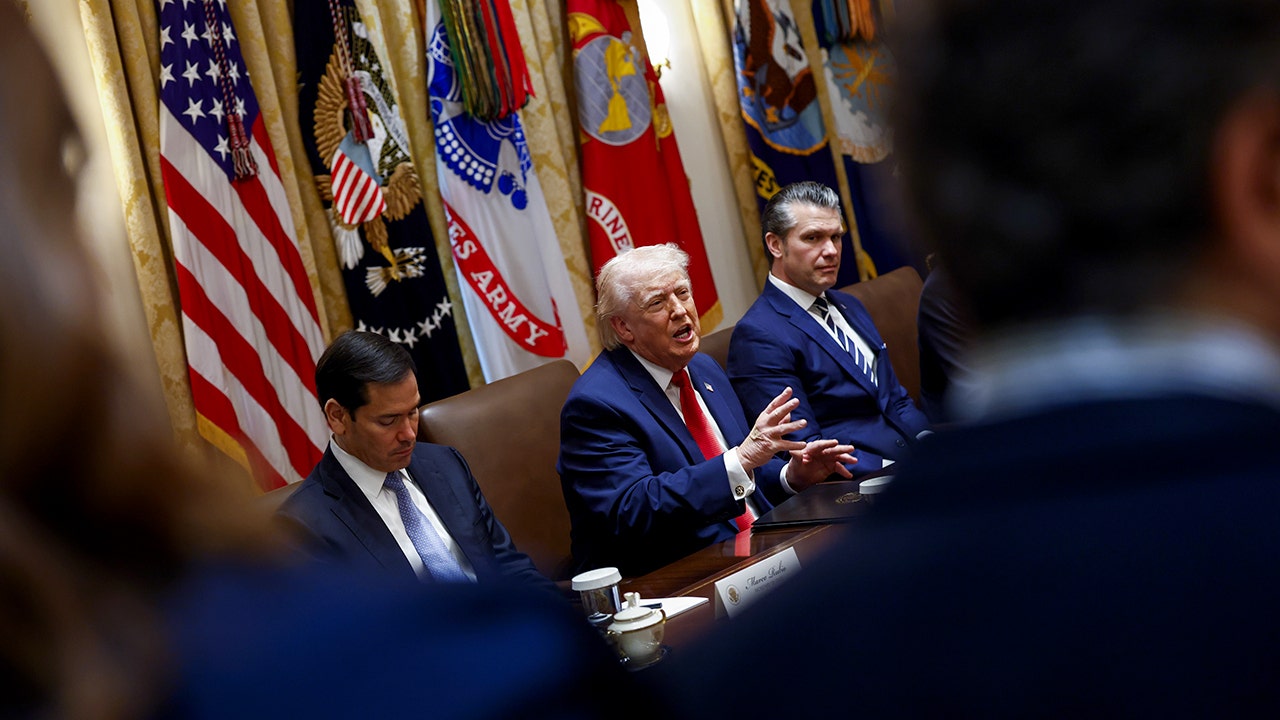





President Trump signed an executive order Tuesday aimed at stopping Wall Street firms from buying up single-family homes, a move he says will make homeownership more affordable for American families.
Trump indicated he’s stepping up antitrust enforcement against institutional investors and instructed federal agencies to draft new rules on big firms’ purchases of single-family homes in local markets.
The Justice Department and the Federal Trade Commission were told to scrutinize Wall Street purchases of single-family homes “for anti-competitive effects” — and to “prioritize enforcement of the antitrust laws … against coordinated vacancy and pricing strategies.”
The order, titled “Stopping Wall Street from Competing with Main Street Homebuyers,” also gives federal agencies 60 days to draft new restrictions or revise existing rules governing institutional purchases of single-family homes.
“To preserve the supply of single-family homes for American families and increase the paths to homeownership, it is the policy of my Administration that large institutional investors should not buy single-family homes that could otherwise be purchased by families,” Trump wrote in the order.
Wall Street giants like Blackstone, American Homes 4 Rent, Invitation Homes and Progress Residential are among the largest institutional players that could find themselves in the White House’s crosshairs in the wake of Trump’s executive order.
Together, the firms control tens of thousands of single-family rental homes across the country, particularly in fast-growing Sun Belt markets that have become a focal point of the political backlash against corporate landlords.
Trump likely lacks the legal authority to force those companies to sell homes or halt purchases, according to Wayne Winegarden, a senior fellow in business and economics at the Pacific Research Institute, told The Post.
But the administration could still try to pressure institutional investors through the threat of legal action, Winegarden said.
“[Trump] hasn’t really worried about the authority as much as he’s able to intimidate it,” the expert said, arguing that even weak legal threats can have teeth because “it’s expensive and problematic to deal with it” — making it “easier just to acquiesce.”
Winegarden said the most plausible approach would be threatening antitrust scrutiny or federal investigations, even absent clear evidence of wrongdoing.
“Maybe the easiest thing for [Trump] to do is threaten some sort of investigation,” he said, adding that the mere prospect of DOJ or FTC action could have a deterrent effect.
“That’s been the playbook,” Winegarden added. “So why wouldn’t he do that here?”
Matt Stoller, director of research at the American Economic Liberties Project, scoffed at the executive order.
“The EO will result in nothing,” he told The Post.
“DOJ Antitrust just settled on favorable terms to RealPage to enable price coordination in rental housing, so there’s no real interest in doing anything in this area,” Stoller continued, referring to the case that accused the tech firm of building algorithms that allowed landlords to illegally collude.
“Beyond that, the DOJ was gutted by DOGE and has no capacity, and the FTC’s budget just got cut by 11%,” he concluded. “Good luck bringing cases with no staff!”
Trump’s new executive order directed agencies to work with lawmakers to draft legislation that would codify restrictions on large institutional investors, signaling the White House wants the limits to outlast his term and survive future administrations.
Any bill would require congressional approval, setting up a potential fight on Capitol Hill over how far the federal government should go in curbing Wall Street’s role in the housing market.
An analysis by law and consulting firm CliftonLarsonAllen said a nationwide ban would require congressional action, writing: “A nationwide acquisition restriction requires statutory authority and cannot be implemented through executive action alone.”
“Congressional legislation would be necessary to establish the legal basis for any federal ban,” the law firm wrote.
Blackstone and other Wall Street giants bought thousands of single-family homes following the 2008 financial crisis, snapping up distressed properties and converting them into rentals.
Despite their high-profile role in the housing debate, large institutional investors own only a sliver of the nation’s single-family housing stock. Firms that own 100 or more homes control less than 1% of all single-family houses nationwide, according to data from the American Enterprise Institute.
Still, the issue has emerged as a hot-button topic as homeownership seems increasingly out of reach for Americans, with the median age of the first-time homebuyer reaching 40 in 2024, according to the National Association of Realtors.
Even within the rental market, large institutions account for just 2% to 3% of single-family rental homes.
That ownership, however, is highly concentrated geographically.
In fast-growing Sun Belt markets, institutional investors control large clusters of homes, giving them an outsized footprint in certain metro areas even as their national share remains small.
In 22 specific US counties, institutional investors own between 5% and 10% of the housing stock. Those counties are concentrated in metro areas including Dallas, Houston, Atlanta, Phoenix, Jacksonville, Fla.; Charlotte, NC; Tampa, Fla.; and Memphis, Tenn.
By contrast, investors of all types — including mom-and-pop landlords — own roughly 20% of single-family homes overall and accounted for about one-third of home purchases in the second quarter of last year.


