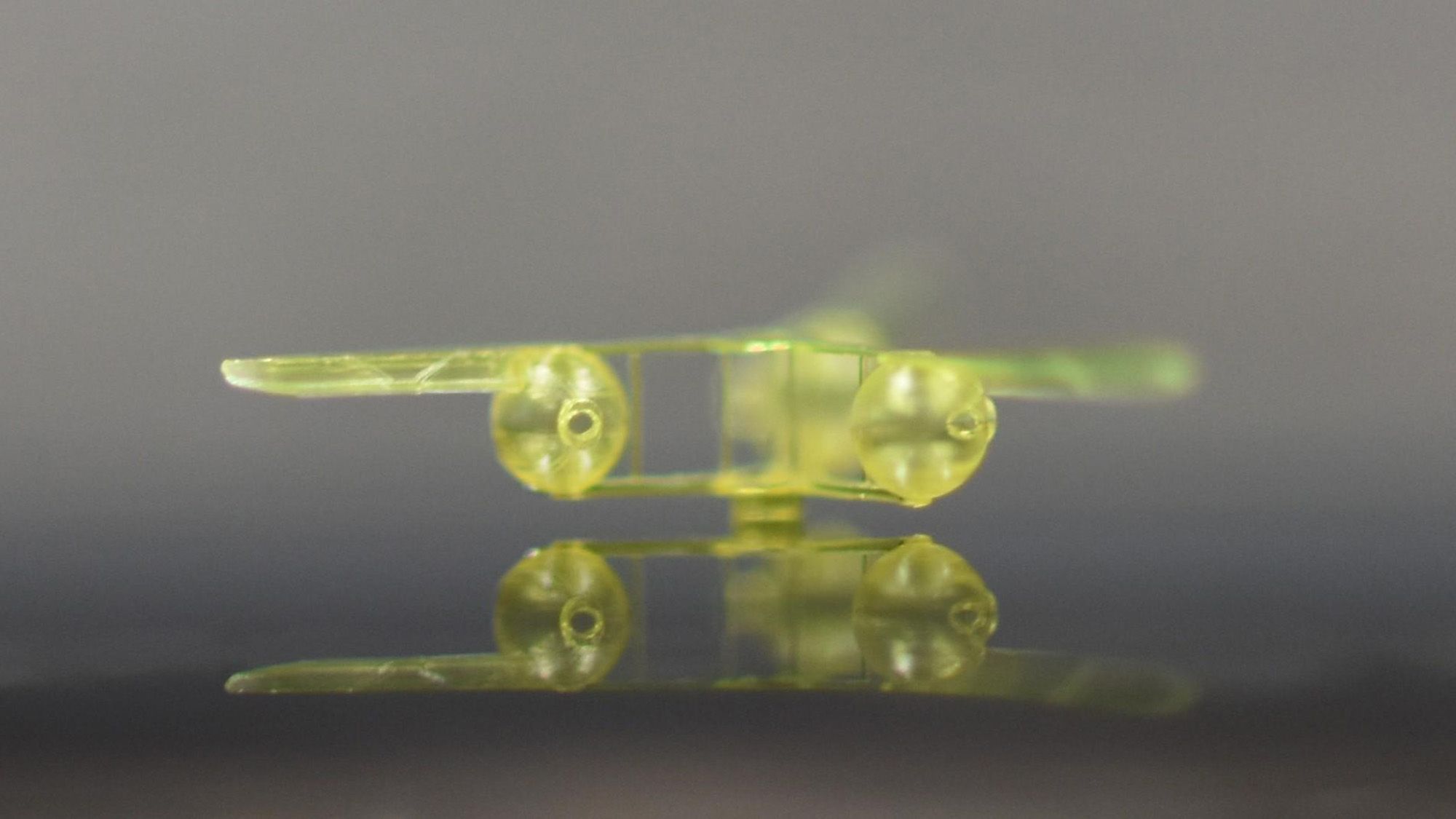








Of the four fundamental forces of nature, gravity is the one we experience most directly — it’s what keeps our feet on the ground and the sun in the sky. Yet we still can’t pin down its exact strength. Since the 1980s, scientists have made more than a dozen measurements to calculate the precise value of gravity, and many of those numbers contradict one another.
So why is it so hard to figure out how strong gravity is?
One problem is that gravity is weak. Gravity feels strong because we constantly feel the pull of Earth. But the force of gravity between any two objects in everyday life — or any two objects that can fit in an experimental lab — is extraordinarily weak.
Sign up for our newsletter
(Image credit: Marilyn Perkins / Future)
Sign up for our weekly Life’s Little Mysteries newsletter to get the latest mysteries before they appear online.
“It’s weak, and you have to measure this against the background of the Earth’s gravitational field,” Stephan Schlamminger, a physicist at the National Institute of Standards and Technology, told Live Science. “If we measure gravity, we have to use everyday objects, because these are the only ones where we know the mass. What you have to do in the lab is basically use two very controlled masses, bring them close together, and measure the force between them.”
In an April 2026 study, Schlamminger and colleagues replicated a precision experiment to determine the strength of gravity and calculated a value different from the previous result. They used 13 tons (12 metric tons) of mercury to run their experiment, but even then, “the change in the gravitational field was only a millionth of the change that we have here from local gravity,” he said.
The team’s measured value was 6.67387×10⁻¹¹ m3kg-1s-2, which was 0.0235% lower than the previous result — a small difference in everyday terms, but significant in the field of metrology.
Christian Rothleitner, a physicist at the German National Metrology Institute, co-authored a comprehensive review of all gravity measurements with Schlamminger in 2017 but was not involved in the new study.
“This small force has to be determined to six or more decimal places,” Rothleitner told Live Science in an email. “This is equivalent to trying to measure the weight of 7 human cells.”
Physics, engineering and psychology
One explanation for the discrepancy in values could be that all of the measurements are so imprecise that the true value lies somewhere within them. But each experiment reports a small margin of error, and those ranges don’t overlap.
Schlamminger thinks there are three possible reasons for this.
“I have it as a handy-dandy acronym: It’s PEP: P stands for physics, E stands for engineering, and the second P stands for psychology,” Schlamminger said. “It’s sorted by excitement.”
The least probable explanation, he said, is the physics one: Maybe there’s some element of physics that scientists don’t yet understand. Just as general relativity extended scientists’ understanding of gravity, there may be another realm of physics yet to be discovered.

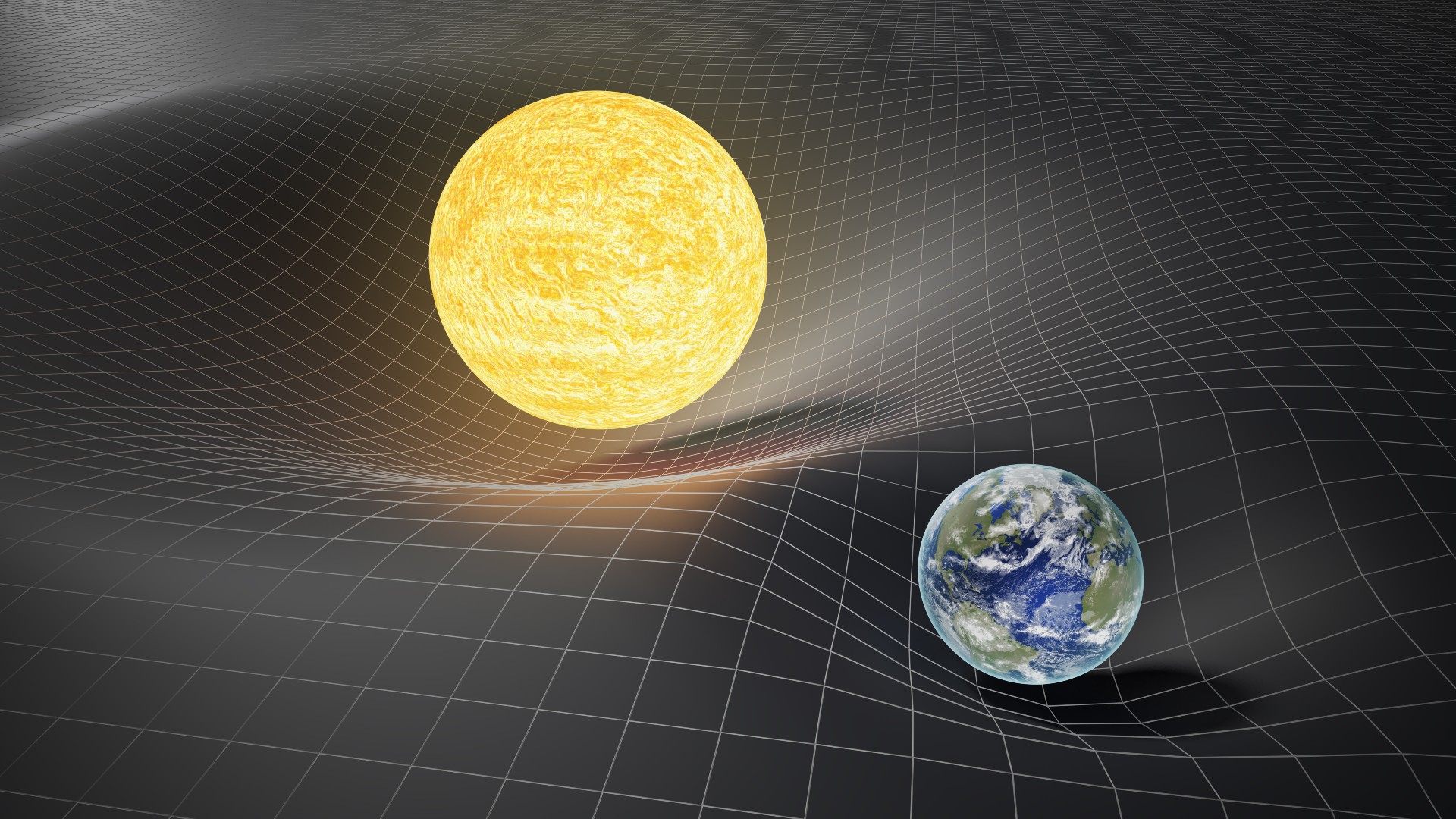
The fabric of spacetime is a key concept in the theory of general relativity, as this fabric can be warped by gravity.
(Image credit: vchal via Shutterstock)
“I think it’s a remote possibility, but we should not exclude it,” Schlamminger said.
Then, there’s the engineering explanation: Every experiment uses a slightly different setup, resulting in different values. Some use a torsion balance, a device that senses tiny forces by measuring the twisting of a small fiber. Others use pendulums or free-falling objects. Each approach has its own potential sources of error, and those mistakes are difficult to untangle from the gravitational signal.
“I personally do not believe that the reason lies in the physics, but in the measurement technology,” Rothleitner said.
Human error is another part of the engineering explanation. “Such an experiment requires expert knowledge in many areas of physics and measurement technology,” Rothleitner said. “You cannot be an expert in all those fields. This kind of measurement is on the cutting edge of measurement science.”
The most likely possibility, Schlamminger said, relates to psychology.
“There is a driver for these people who measure these numbers to give really, really small uncertainties” — that is, margins of error — “because it makes them famous,” Schlamminger said. “Because the pressure is there, the uncertainties may be a little bit too small, and that’s why they don’t agree with each other.”
In the end, though, a precise measurement of gravity may not matter. We know the product of G times Earth’s mass, and that’s enough for practical applications like launching rockets into space. That may be all we need for now.
“The value of Newton’s gravitational constant is rather of academic interest,” Rothleitner said. “If it were different, nations would have spent much more effort in determining it better.”
Schlamminger still finds it exciting, though. “We live in a society where we think everything is discovered,” he said. “But if you look, there’s still terra incognita. There are still problems, and the problems may be small, but they’re still problems we can solve and contribute to and find mesmerizing and intriguing. And this is one of those problems.”
TOPICS