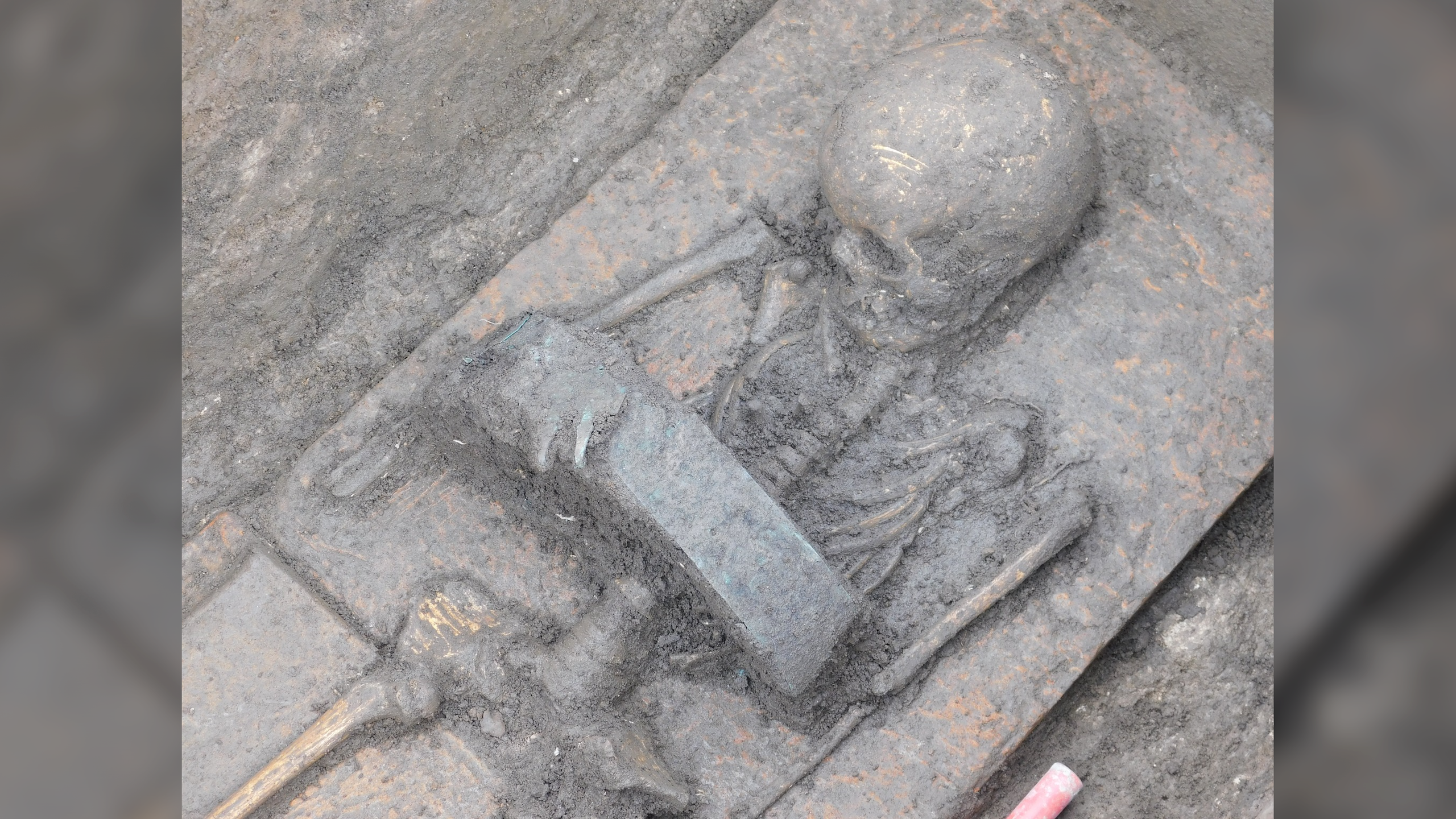





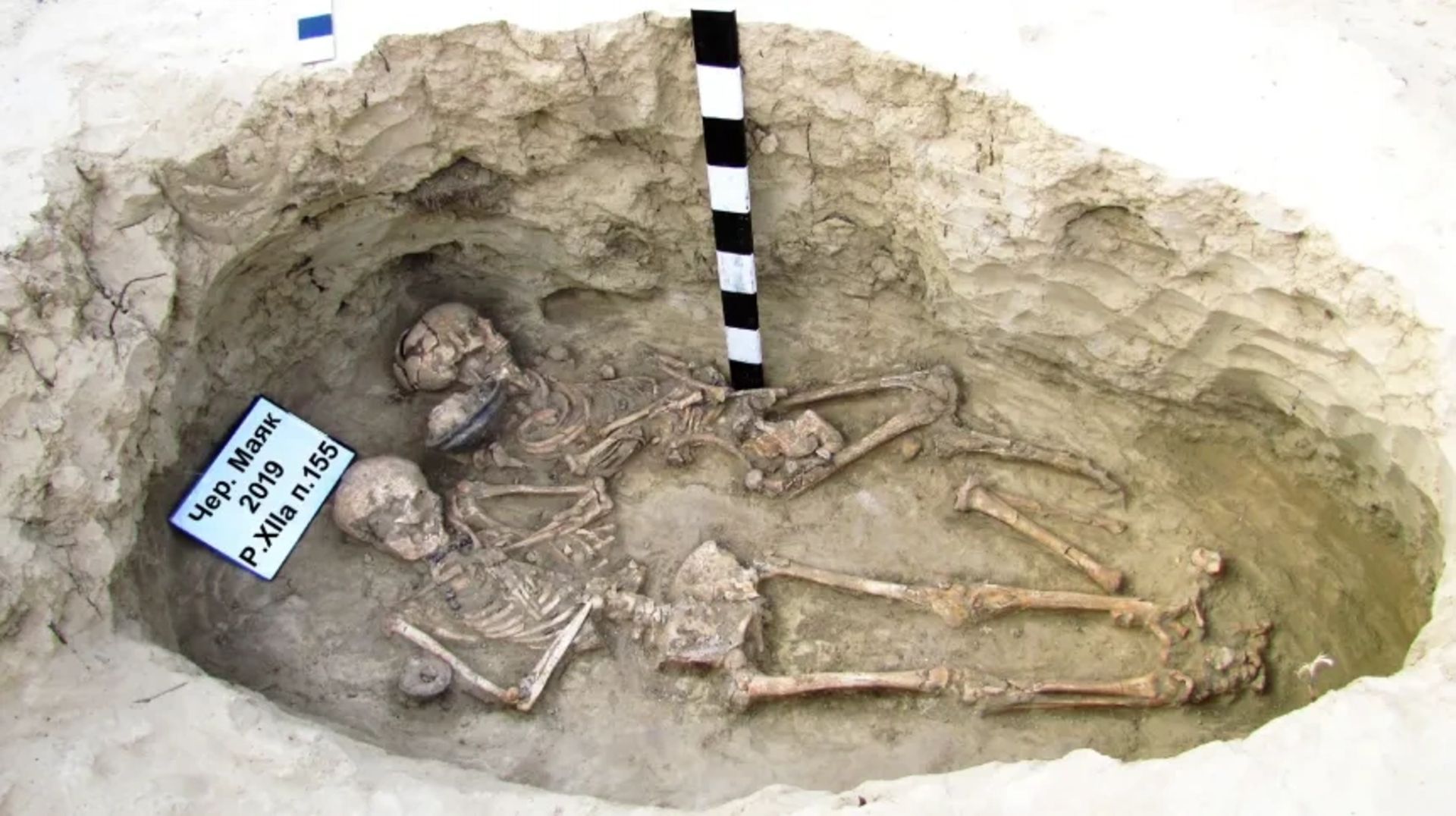
Archaeologists in Ukraine have discovered red lumps of cinnabar — a mineral form of the highly toxic chemical mercury sulfide — in a 1,900-year-old double burial of two Scythian women, according to a recent study.
The deep-red pigment, also called vermilion, has also been found in other prehistoric graves in Europe and may have been sprinkled on the newly dead to give them a reddish “flush” of life.
Article continues below
“We know that one crypt could function for up to 50 years in a row,” study first author Olena Dzneladze, an archaeologist at Ukraine’s National Academy of Sciences, told Live Science in an email. “We know for sure thanks to excavations that the Late Scythian crypts were opened and secondary and tertiary burials took place.”
The Scythians were a diverse but culturally related group of nomads who lived on the Eurasian Steppe stretching from Ukraine to China from about 800 B.C. to A.D. 300. The double burial with cinnabar dates to the first to early second century A.D., toward the end of the culture.
The traces of cinnabar were found in a single grave containing the remains of two women at Chervony Mayak, a Late Scythian burial ground in the south of the country beside the Dnieper River. One of the women was between 35 and 45 when she died, and the remains of a younger woman, between 18 and 20, were interred in the same grave at a later time. The women were buried with several grave goods, including beads, pottery and metal items.
The site was discovered in the 1970s, and red lumps have been found in some of the graves there since 2011. But the study by Dzneladze and her colleagues, published in 2025 in the journal Antiquity, is the first to identify the lumps as cinnabar, and it is the first time cinnabar has been scientifically identified in a Late Scythian grave.
Toxic pigment
Cinnabar is highly toxic to humans, although the authors of the new study said the people who used it in first-century Ukraine may not have known that.
In some prehistoric societies, cinnabar was used in the same way as the clay-like pigment ocher (iron oxide) for body paints, cave paintings and rituals. But whereas ocher is nontoxic, cinnabar causes mercury poisoning, especially when it is heated and its poisonous gases are inhaled. Mercury then builds up in the body and can cause tremors, breathing problems and even death, and the bones of prehistoric people who were frequently exposed to cinnabar have extremely high mercury levels.
At Chervony Mayak, cinnabar may also have had other uses, the researchers wrote, including as a cosmetic or slowing decay by resisting bacteria.
Traces of the mineral have been found in only three of the 177 graves at Chervony Mayak; Scythian burials elsewhere do not have the red mineral. However, the researchers think it may have been overlooked in other Late Scythian graves.
“Often in archaeological field reports and publications we read a small description that ‘red pigment,’ ‘a piece of ocher’ or ‘blush’ was found in the burial, [but] without clarification and analysis,” Dzneladze said. “These could be different substances.”
Cosmetic purpose?
All three graves containing cinnabar at Chervony Mayak hold women, which suggests the mineral also might have had a cosmetic purpose. Dzneladze said the grave goods in male and female Scythian graves were distinct, so “we can attribute it to the complex of the female set of grave goods.”
“The use of cinnabar also for cosmetic purposes should not be ruled out … Ocher and other mineral dyes were also found in [Late Scythian] female burials in pyxides [vessels], caskets and shells used for storing and diluting cosmetics,” she said.
Kaare Lund Rasmussen, a professor emeritus in the Department of Physics, Chemistry and Pharmacy at the University of Southern Denmark, wasn’t involved in the study but has researched cinnabar use in medieval Europe, where it was thought to be an effective medical treatment for leprosy and syphilis.
He told Live Science in an email that cinnabar had been found in earlier prehistoric burials in Europe, and so it made sense that the Late Scythian culture would also have made use of it, perhaps as a pigment.
He added that colorants like cinnabar and ocher had been found in Mesolithic period (Middle Stone Age) graves in Europe from up to 15,000 years ago, after the period of intense ice that covered large parts of northern Europe during the Last Glacial Maximum.
“In Denmark I remember a beautiful grave, a mother and her young child buried together, with the child lying on the wing of a swan — with red ochre spread over them,” he said.
Dzneladze, O., Sikoza, D., Symonenko, O., Polit, B., Czech-Błońska, R., Miśta-Jakubowska, E., & Siuda, R. (2025). Mysterious red: cinnabar from the Chervony Mayak burial ground, Ukraine. Antiquity, 99(406). https://doi.org/10.15184/aqy.2025.32