



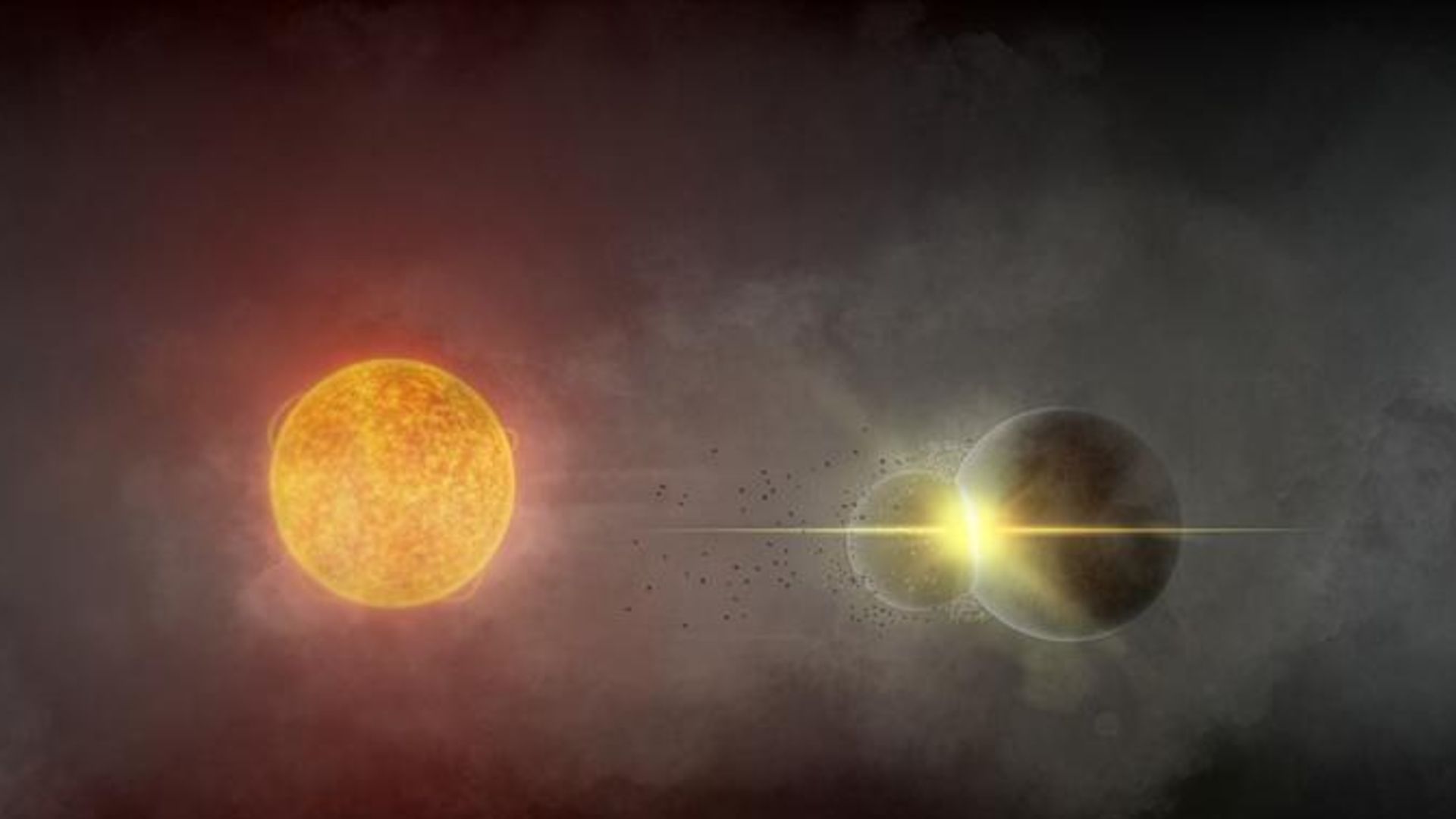
Astronomers think they’ve glimpsed one of the rarest sights in space: two planets smashing into each other around a distant star.
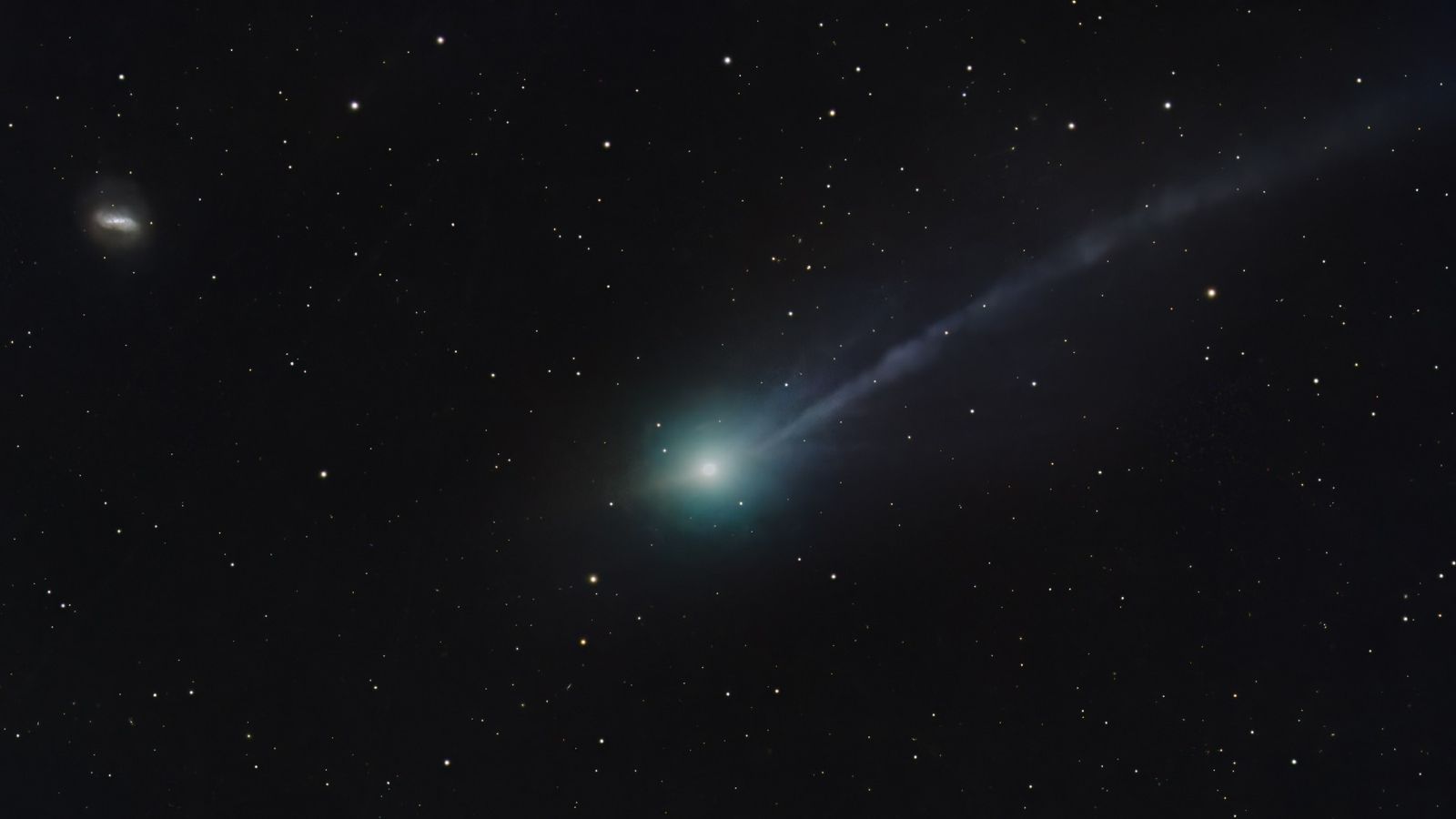
The collision appears to have unfolded roughly 11,000 light-years from Earth, around a sunlike star called Gaia20ehk, near the constellation Puppis (the “poop deck”). The researchers say the crash may echo the giant impact thought to have formed Earth and the moon billions of years ago, giving scientists a rare window into how celestial bodies take shape. The findings were published March 11 in The Astrophysical Journal Letters.
Article continues below
A star that suddenly “went completely bonkers”
Planetary collisions are thought to be common in young star systems, but they are hard to catch. The planets must have orbits that take them directly in front of their home star, so that their debris blocks part of the star’s light, which telescopes can detect and measure in both visible and infrared light.
Tzanidakis spotted the first clue while combing through telescope data, including observations made by NASA’s SPHEREx mission. In 2016, Gaia20ehk looked like an ordinary, stable star. But about five years later, its light dipped suddenly three times and things quickly turned chaotic.
“Right around 2021, it went completely bonkers,” Tzanidakis said. “I can’t emphasize enough that stars like our sun don’t do that. So when we saw this one, we were like ‘Hello, what’s going on here?'”
Gaia20ehk’s particular changes — short drops in brightness and then chaos — had never been observed before, creating a conundrum for the astronomers.
The first clue to what might be happening came from visible-light data, which showed that something was repeatedly passing in front of the star and blocking part of its light. But visible light alone could not show whether the culprit was just floating dust, a stellar outburst or something far more violent, such as a planet being torn apart by the gravity of a supermassive black hole.
To take a closer look, the team analyzed Gaia20ehk’s emission in the infrared spectrum. As the star’s visible light dipped and grew messy, its infrared signal surged, showing that while the system got dimmer, it was also getting hotter.
That “could mean that the material blocking the star is hot — so hot that it’s glowing in the infrared,” Tzanidakis said.
That finding suggested to the team that a collision between two planets, while rare to see, was most likely, as two planetary bodies could throw out hot dust and rock into an orbit that would align with their findings.
The researchers think the planets may not have collided in a single instant. The three early dips of Gaia20ehk could mark grazing encounters as the two bodies spiraled closer together.
“At first, they had a series of grazing impacts, which wouldn’t produce a lot of infrared energy,” Tzanidakis said. “Then, they had their big catastrophic collision, and the infrared really ramped up.”
“Andy’s unique work leverages decades of data to find things that are happening slowly — astronomy stories that play out over the course of a decade,” senior study author James Davenport, an assistant research professor of astronomy at the University of Washington, said in the statement. “Not many researchers are looking for phenomena in this way, which means that all kinds of discoveries are potentially up for grabs.”

The team hopes the powerful Simonyi Survey Telescope at the Vera C. Rubin Observatory could be used to discover other planetary collisions that may be difficult to spot. Davenport estimates that, using Rubin, astronomers could discover 100 new impacts over the next decade. Finding other planetary collisions could aid the search for possible habitable worlds that, like Earth, have a moon that helps shield them from asteroids, influences their tides and has other factors that make the world more welcoming.
In addition to being rare, the discovery could provide insight into the type of crash that made our moon. Astronomers said the debris cloud around Gaia20ehk sits at about one astronomical unit from its star — roughly the same distance as Earth orbits the sun — and that is one reason the event resembles the giant impact that struck Earth around 4.5 billion years ago.
If that comparison holds, the system could help researchers further test the theory that a planetary collision created our moon.
“How rare is the event that created the Earth and moon? That question is fundamental to astrobiology,” Davenport said. “Right now, we don’t know how common these dynamics are. But if we catch more of these collisions, we’ll start to figure it out.”
Tzanidakis, A., & Davenport, J. R. A. (2026). GaIa-GIC-1: an evolving Catastrophic planetesimal collision candidate. The Astrophysical Journal Letters, 1000(1), L5. https://doi.org/10.3847/2041-8213/ae3ddc