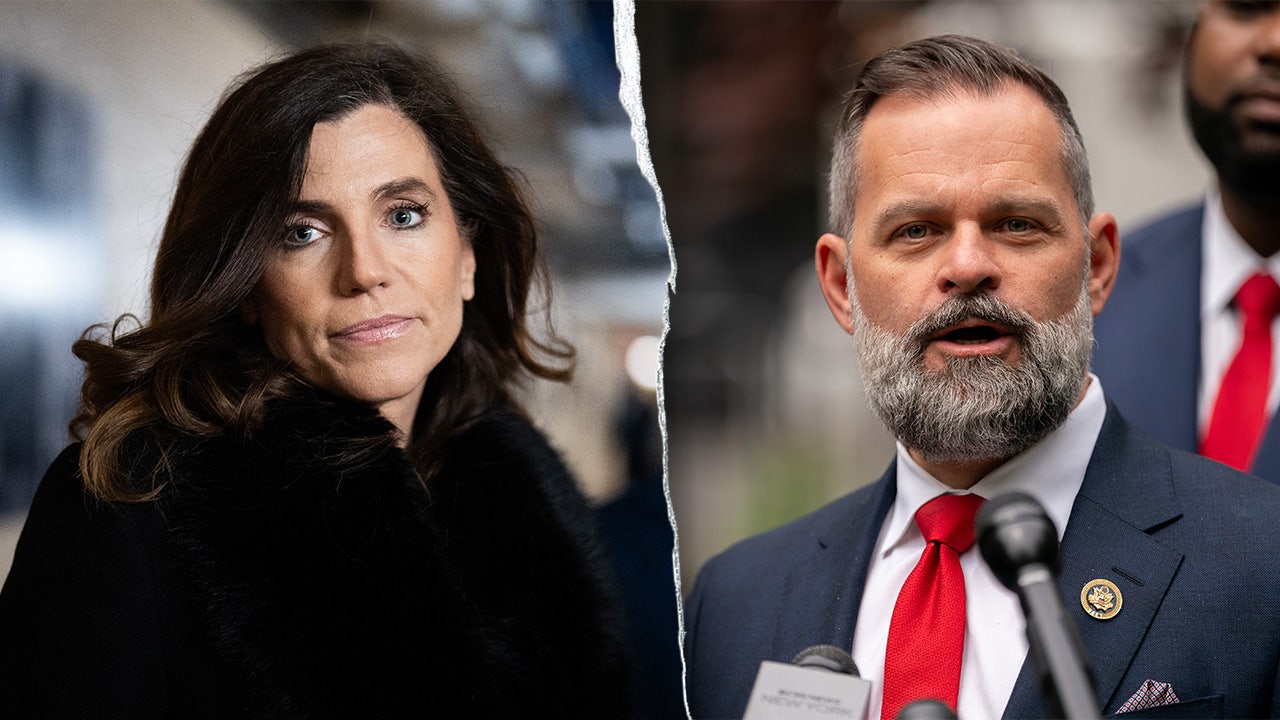




WASHINGTON — The House Ethics Committee published a list Monday of all its publicly disclosed sexual misconduct investigations into members stretching back to 1976.
The 28 investigations spanned from former Reps. Tony Gonzales (R-Texas) and Eric Swalwell (D-Calif.) — both of whom resigned from the House last week — to the late Rep. Wayne Hays (D-Ohio).
In total, fourteen were Democrats and 12 were Republicans. The late Rep. Alcee Hastings (D-Fla.) was twice investigated for pursuing a “sexual relationship with a staffer in 2014 and again in 2020.
Hastings died in 2021, and was succeeded by Rep. Sheila Cherfilus-McCormick (D-Fla.), who was recently faulted for 25 ethics violations amid a probe of her purportedly pilfering $5 million in federal COVID-19 relief funds.
A sex misconduct investigation from 1982 to 1983 involving House pages also concluded with the censuring of Reps. Gerry Studds (D-Mass.) and Dan Crane (R-Ill.), though neither were expelled.
Others like Rep. Matt Gaetz (R-Fla.), who was probed for “[s]exual misconduct with minor” and “solicitation of prostitution,” resigned before findings were publicly released.
The Ethics Committee no longer has jurisdiction over the Swalwell or Gonzales investigations after both left the House, though Rep. Cory Mills (R-Fla.) remains under a probe for “[s]exual misconduct and/or dating violence.”
An investigative subcommittee looking into the allegations was set up in November 2025, but President Trump still endorsed the Florida Republican in February.
“The fact Congress keeps protecting him says everything about who we are as an institution,” Rep. Nancy Mace (R-SC) said Monday, threatening an expulsion vote for Mills.
At least half of the probes occurred just over the past decade, during which the ethics panel said it “has adopted a more aggressive and robust approach to allegations of sexual misconduct.”
“The Committee has a long history of investigating allegations of sexual misconduct by Members of the House, ranging from criminal sexual activity to behavior implicating civil employment discrimination laws and more general standards of conduct,” the press release stated.
“The Committee has always made public its findings whenever allegations of sexual misconduct were substantiated.”
Pardoned former Rep. George Santos, who was accused of sexually harassing a staffer, and ex-Rep. Madison Cawthorn (R-NC), who was accused of an improper relationship with a staffer, all had no misconduct violations cited by the committee when public reports on the incidents were released.
The House expelled Santos for the sexual misconduct and campaign finance fraud in December 2023, making him only the sixth member to be removed in US history from the lower chamber.
Another listed member, former Guam Democratic Del. Michael F. Q. San Nicolas, was not found to have violated House ethics rules but was also investigated for sexual misconduct following a probe of an alleged sexual relationship with a staffer, the list shows.
Ex-Reps. Tom Reed, Katie Hill, Ruben Kihuen, Patrick Meehan, Blake Farenthold, Trent Franks and John Conyers all were investigated, but the Ethics Committee lost its “jurisdiction” over the pols when they left Congress before the sexual misconduct investigation was completed.
Reed (R-NY), Hill (D-Calif.), Farenthold (R-Texas), Franks (R-Ariz.) and Conyers (D-Mich.) all resigned before the end of their terms. Kihuen (D-Nev.) and Meehan (R-Pa.) didn’t seek re-election.
Then-Reps. Mark Foley, Gary Condit, Mel Reynolds, Barney Frank, Gus Savage, Jim Bates and Donald “Buz” Lukens were all investigated for sexual misconduct between 1989 and 2006.
Frank (D-Mass.) resigned without the Ethics Committee citing a violation in a public report.
Foley (R-Fla.), Savage (D-Ill.), Bates (D-Calif.) and Lukens (R-Ohio) were found to have multiple sex misconduct violations.
Savage didn’t resign but was defeated in the 1992 election after the misconduct came to light. He was succeeded by Reynolds (D-Ill.) who later resigned in October 1995 after being convicted for sexually assaulting a 16-year-old campaign aide.
Bates became the first member of Congress to receive sanctions for sex harassment in 1989 — but also didn’t resign.
Lukens resigned in October 1990 and served jail time the following year.
Condit (D-Calif.) admitted to an affair with a 23-year-old intern Chandra Levy after her disappearance in 2001. Her remains were found the following year, but the murder has remained unsolved.
The California Democrat was defeated in a Democratic primary race and left office in January 2003.
The timing of the list’s release also came with a call for action. The committee “strongly encourages anyone who may have experienced sexual misconduct by a House Member or staffer” to report it.
House Republicans have 217 members and Democrats have 213 members in the lower chamber, giving the GOP a razor-thin, two-vote majority that could be lost if more members face expulsion votes.
Separately, the House Oversight Committee has issued a subpoena to the Office of Congressional Workplace Rights to disclose “all awards and settlements” paid to sexual misconduct victims before 2018.
Those payments amount to around $450,000 for Section 201 violations of the Congressional Accountability Act, which covers sex harassment as well as other workplace-based discrimination.
None of the members’ names associated with those investigations have been publicly disclosed, but House and Senate workplace complaints that resulted in settlement payments have been publicized since 2019.
The annual reports show settlement figures involving sexual, racial and other workplace discrimination complaints, as well as those involving alleged discrimination over military service.
In 2020, Rep. Tom Rice’s office paid $45,000 for Section 201 and 208 violations, the latter of which deals with retaliation against staff.
The offices of former Rep. Don Young (R-Alaska) forked over $24,500 and Cawthorn paid $40,000 — both for 2022 violations related to workplace discrimination or sex misconduct.
In 2023, the office of Rep. Brad Schneider (D-Ill) paid $50,000 to settle a workplace discrimination and retaliation case, a rep for his office confirmed.
The office of Josh Harder (D-Calif.) paid $32,500 to settle a workplace- or sex-discrimination violation the same year, which also involved a Section 202 violation regarding family and medical leave protections.
Florida GOP Rep. Carlos Gimenez’s office paid $25,000 to settle a workplace discrimination or harassment violation in 2024.
The following year, the office of former Rep. Lori Chavez-DeRemer, who resigned as President Trump’s labor secretary on Monday, settled a whopping $98,650 violation under the sex- or workplace-based discrimination clause.