



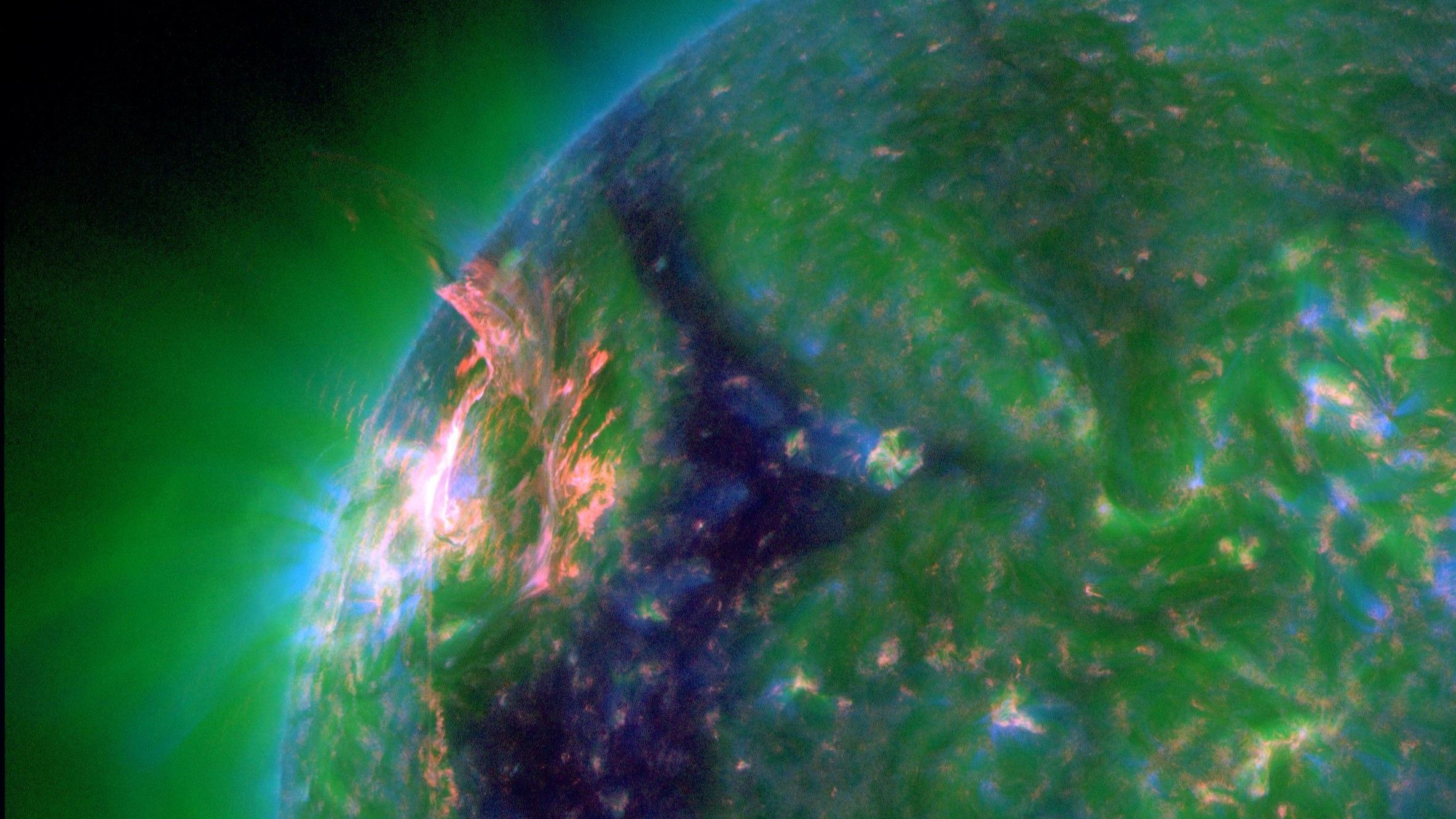
A solar eruption has blown a massive hole in the sun’s atmosphere, causing temporary radio blackouts and possibly triggering a northern lights display tomorrow.
Scientists recorded an M5.7-class solar flare on Sunday (May 10), which briefly disrupted high-frequency radio communications on the sunlit side of our planet, according to the National Oceanic and Atmospheric Administration’s (NOAA) Space Weather Prediction Center. M-class solar flares are the second strongest category of solar eruption, after X-class flares.
The eruption also produced a coronal mass ejection (CME) — a slower-moving cloud of solar plasma and radiation — that can trigger geomagnetic storms and aurora displays. There’s no guarantee that the CME will hit Earth, but we could take a glancing blow, according to the Space Weather Prediction Center.
“Modeling of the resulting CME indicates that a bulk of the material should pass well behind Earth’s orbit,” a spokesperson for the Space Weather Prediction Center wrote in an update published Monday (May 11). “That being said, a glancing blow and or shock arrival by late on 12 May into the early portions of the 13th … can not be ruled out.”
Will there be auroras?
A glancing blow could produce a minor G1 geomagnetic storm, according to the U.K.’s Met Office. The geomagnetic storm scale ranges from G1 to G5, with G5 being the most severe. However, G1 storms can still result in visible auroras in places like northern Michigan and Maine, weak power grid fluctuations and minor impacts on satellite operations and migratory animals, according to the Space Weather Prediction Center.
Our sun has been very active in recent years after reaching solar maximum — the peak of the sun’s roughly 11-year activity cycle. The solar maximum likely ended sometime in early 2025, so solar activity is, in theory, declining. Solar flares of a 5.7 magnitude aren’t uncommon in and around a solar maximum, when there are more sunspots to unleash solar flares and CMEs.
The sunspot that produced the solar flare, designated sunspot 4436, has been very active in recent days. Last week, the same sunspot ejected at least 5 CMEs while it was on the far side of the sun, Spaceweather.com reported. More explosions in the coming days could result in other CMEs striking Earth and more intense geomagnetic storms.
Auroras appear in the sky when charged particles from the sun hit Earth’s upper atmosphere, colliding with oxygen and nitrogen particles. These particles then glow different colors as they shed energy from the collision, according to NASA’s Jet Propulsion Laboratory. Oxygen gives off the greens and reds in the auroras, while nitrogen gives off the blue and purple colored light, according to NASA.