




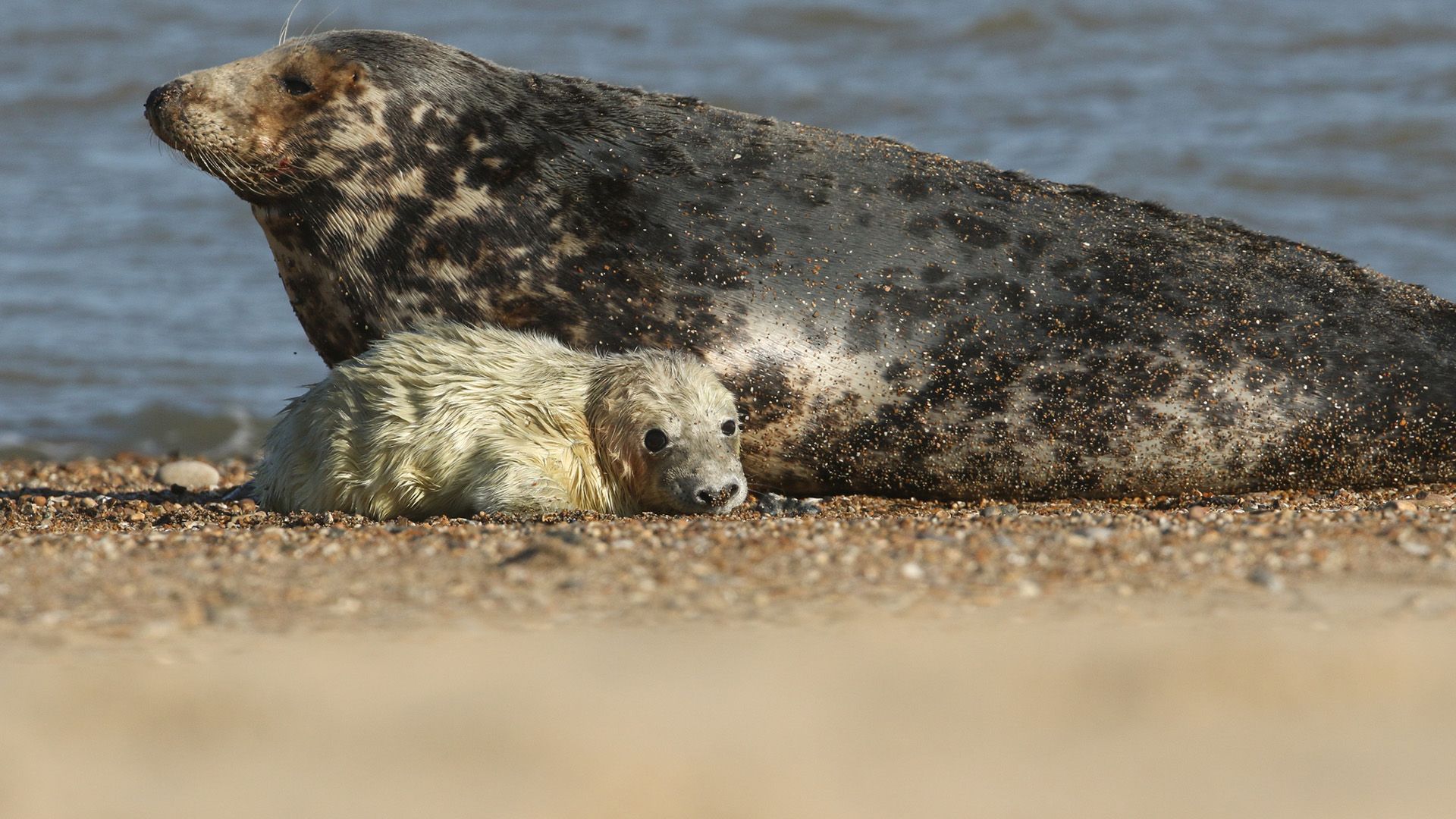
Sable Island, off the coast of Nova Scotia, is home to the world’s largest gray seal breeding colony — and the site of a gruesome, decades-old mystery that’s finally been solved.
Reports of traumatically injured seals have plagued Sable Island since at least 1980. Gray seal (Halichoerus grypus) pups were found with strange spiral-shaped lacerations that tore to the bone, starting at the seals’ mouths and winding down to their chests. The oddly shaped injuries led scientists to guess the culprit might be sharks or ship propellers. However, there was no direct evidence to confirm either of those theories.
Now, new research reveals the real corkscrew killers: cannibalistic male gray seals.
Species across the animal kingdom engage in cannibalistic behavior. Cannibalism was first documented in gray seals in Nova Scotia in 1992, and since then, there have been other cases of gray seals preying on pups of their own species.
In 2016, gray seal cannibalism was recorded in Scotland, with direct observations confirming this was the cause of corkscrew-shaped lacerations. Yet gray seal cannibalism still hadn’t been observed directly on Sable Island.
“Cannibalism so far has been frequently observed in grey seals,” Ursula Siebert, a wildlife researcher at the University of Veterinary Medicine Hannover in Germany who was not involved with the new research, told Live Science in an email. “There was a high potential that this behavior would also be detected [on Sable Island] after we understood the phenomenon.”
In 2024, the authors of the new study finally witnessed an adult male gray seal attacking a pup on Sable Island. They began to closely examine seal pups with the spiral-shaped injuries throughout the island, and found bite and claw marks on the animals’ skin and blubber that looked like the work of gray seals.
Image 1 of 2

An adult male gray seal attacks a pup on Sable Island, off the coast of Nova Scotia, Canada.
The new paper, published Feb. 4 in the journal Marine Mammal Science, reports these firsthand accounts of gray seal cannibalism on Sable Island. Reanalyzing drone footage from 2023 as well, the research team recorded instances of adult male gray seals feeding on gray seal pups from 2023 through 2025.
Overall, the researchers found 765 seal pups with corkscrew markings during the 2024 breeding season. On a single day in 2025, they found 359 pups that had died from these injuries. However, this may not necessarily indicate that there was a spike in attacks but rather that scientists improved their searches for these pups.
“We were certainly relieved to have an answer to the cause of these deaths,” Damian Lidgard, a biologist at Fisheries and Oceans Canada and co-author of the new study, told Live Science in an email. For years, the cause was assumed to be shark predation, Lidgard added, but without any observations of sharks causing these deaths at Sable Island. With instances of male gray seal cannibalism elsewhere, the researchers were not surprised to discover the cause, he said.
Image 1 of 2


A seal carcass shows the corkscrew pattern of attack from cannibalism.
The researchers don’t necessarily think the behavior is a cause for alarm. “The most recent estimate of grey seal pup production on Sable Island is about 75,000,” Lidgard said. “Given that the number of pup deaths from male grey seals is estimated at under 1,000, there is no significant impact of cannibalism on the seal population on Sable Island.”
However, understanding the cause of seal pup deaths is important for the management and conservation of the island.
Although cannibalistic behavior has only been recorded in male gray seals on Sable Island, Lidgard said, it is possible that male gray seals are also targeting harbor seal (Phoca vitulina) pups that live on Sable Island, since this has been observed in Europe.
“Grey seals not only practice cannibalism, but also kill other marine mammals such as harbour seals,” Siebert said, “[so] it can become a threat to those populations.”
“Harbour seal pup production on Sable Island is very small,” with populations in decline in recent decades, Lidgard noted, so this is potentially concerning.
The researchers added that the cause behind the cannibalism remains unknown.
“We are not sure why this is occurring on Sable or in other locations,” Lidgard said. “This may be a natural behaviour of grey seal males (as observed in other species) that has only recently been observed and documented. It might be a learned behaviour from an individual but that is unlikely given that it occurs on Sable and in the UK which are genetically/behaviourally isolated. I could keep providing hypotheses but really we don’t understand the cause.”
Langley, I., Lidgard, D., Varkey, P., Sanchez, M., Rivard, M., & Heyer, C. E. D. (2026). Gray Seal cannibalism at the largest colony in the world, Sable Island. Marine Mammal Science, 42(2). https://doi.org/10.1111/mms.70138
Get the world’s most fascinating discoveries delivered straight to your inbox.