





Inca boys and girls chosen for human sacrifice trekked through Inca communities for thousands of miles on sacred pilgrimages before their ritual deaths, often near high peaks in the Andes Mountains, a new analysis of their mummies reveals.
The research also looks again at the manners of their deaths and found that none of three children in the Inca ritual, known as Capacocha, died in the ways that scientists previously thought.
“Capacocha was not limited to the final act of offering at the mountain,” study first author Verónica Silva-Pinto, an archaeologist at Diego Portales University in Santiago, Chile, told Live Science in an email. “It was an extended ritual process that began months earlier and involved mobility, dietary changes, the participation of different communities, and the creation of sacred landscapes.”

But some other experts, while welcoming the study, are cautious about some of its details.
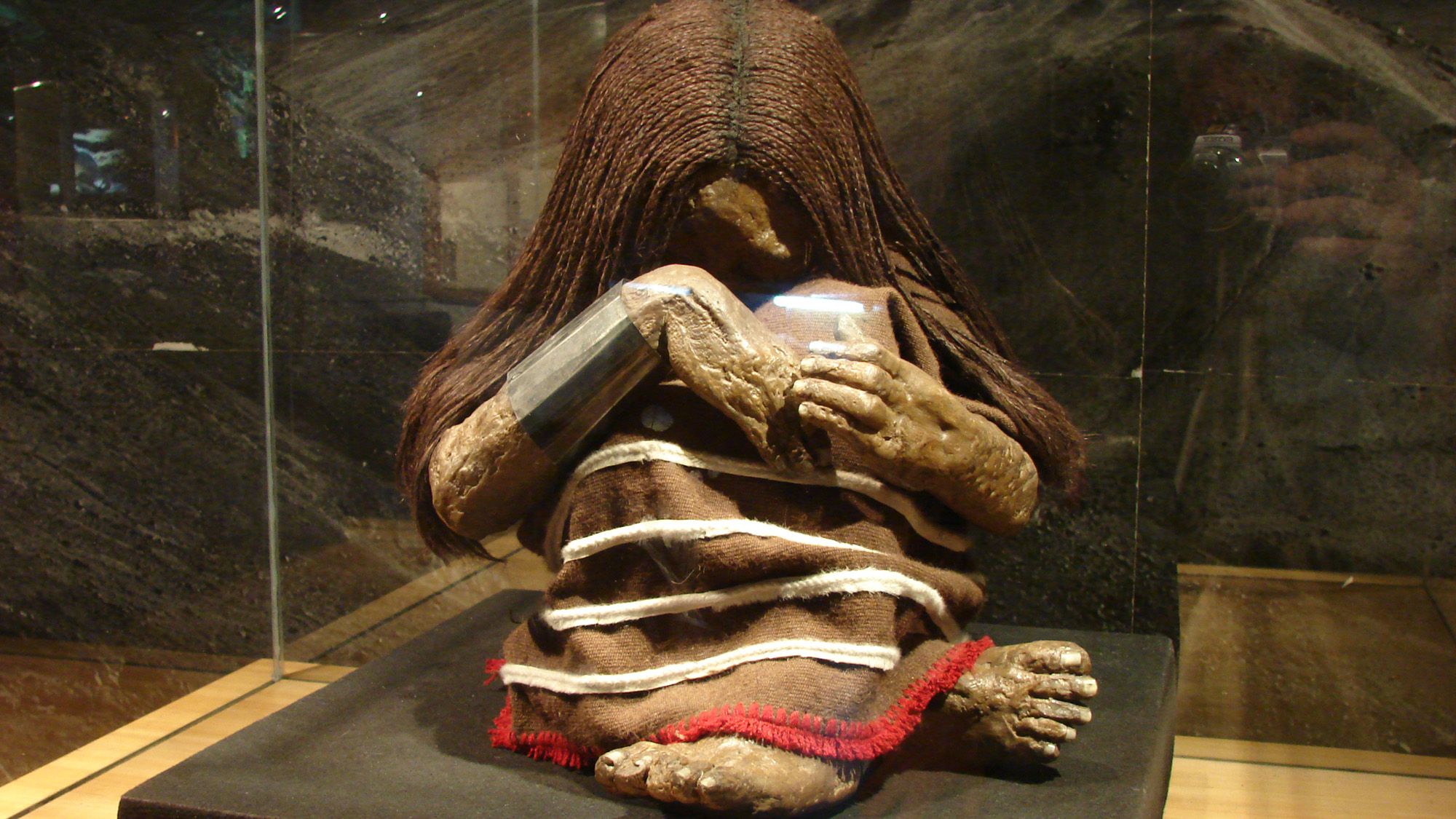
The new study is based on new examinations of three Capacocha mummies from two sites: The “Niño de El Plomo” or El Plomo Boy, who was about 8 or 9 years old in the 15th century when he was sacrificed near the 17,700 foot (5,400 meter) summit of Cerro El Plomo, now in central Chile; and two girls, one about age 9 and the other about 18, who were sacrificed about 30 years earlier near the top of what’s now Cerro Esmeralda in northern Chile’s Atacama Desert.

An aerial view of Cerro El Plomo in the Andes of Chile, where El Plomo Boy was sacrificed in about 1480.
(Image credit: dreamextreme via Getty Images)
It was long thought that the El Plomo boy had died from hypothermia, or exposure to freezing temperatures, on the high peak, and that the Cerro Esmeralda girls were killed by strangulation. But the new study, published July 15 in the journal Science Advances, rejects those ideas.
Human sacrifice
Archaeologists found the El Plomo Boy in 1954 and the two Cerro Esmeralda girls in 1976. The new study applies modern archaeological techniques to them for the first time.
Get the world’s most fascinating discoveries delivered straight to your inbox.
It “demonstrates that previously investigated contexts can continue to provide crucial information when revisited using new technologies, minimally invasive methods, and an ethical perspective,” Silva-Pinto said.
Their examinations with CT scans and microscopy revealed that El Plomo Boy had been killed with blunt force trauma to the head — an injury that wasn’t apparent to the initial investigators. The two Cerro Esmeralda girls, meanwhile, were previously thought to have been strangled because of marks on their necks. But the new study found that the marks were probably caused by their clothing after death, and that the hyoid bones of their throats were not fractured or displaced, which happens in most strangulations. The cause of the girls’ deaths should now be considered “indeterminate,” the researchers said.

A new study finds that El Plomo Boy — whose mummy is shown here being weighed — didn’t die from exposure to the cold, but from blunt force trauma to the head.
(Image credit: FPG via Getty Images)
Silva-Pinto said the forensic examination should be considered within the Andean worldview, which didn’t see death as the end of existence.
“Death was not necessarily understood as an absolute end, but rather as a transformation or passage into the realm of divinities, ancestors, and sacred forces,” she said. “The individuals who were offered acquired a new ritual status and could become mediators between communities, mountains, divinities, and the state.”
Sacred pilgrimage
The researchers carried out chemical studies on tiny samples of hair from the mummies by looking at isotopes, or different versions of the same element that have varying numbers of neutrons in their nuclei. The isotopes from food and water people consume are incorporated into their hair, shedding light on where they’ve lived. The team also examined samples of fractured bones for radiocarbon dating.
The hair isotopes showed that the children had moved over long distances between “ecologically distinct regions.” The researchers estimated that El Plomo Boy traveled between 1,615 and 1,740 miles (2,600 and 2,800 kilometers) over his last nine months, probably starting from the Inca capital Cuzco, at the heart of the Inca Empire. The Cerro Esmeralda girls probably traveled between 560 and 745 miles (900 and 1,200 km) in their final three months.
Silva-Pinto said the pilgrimages connected outlying regions with the high mountains and other sites where the ceremonies culminated. “Along the routes, local communities would have received the pilgrims and participated in ceremonies involving the sharing of food and beverages,” she said. The routes thereby became sacred landscapes, and the central Inca state used this to consolidate its presence in incorporated territories, she said.
The radiocarbon dates for the mummies showed they were all sacrificed in the 15th century: the Cerro Esmeralda girls in about 1450 and El Plomo Boy in about 1480. “The chronology shows that these were not isolated events, but rather a practice carried out at different moments,” Silva-Pinto said.
Bioarchaeologist Dagmara Socha from the University of Warsaw in Poland, who studies the Capacocha mummies but who was not involved in this particular examination, cautioned that the conclusions drawn from the isotope analysis might be flawed. “Isotopic analyses alone do not allow us to reconstruct the potential route taken during the journey,” she told Live Science in an email. “In several cases, the observed isotopic changes were not statistically significant and may also reflect seasonal variation in diet.”
The study is “interesting and potentially valuable, but some of the interpretations go beyond what can be reliably concluded from the available evidence,” she told Live Science in an email.
Archaeologist Pablo Mignone of Argentina’s Institute for Research in Social Sciences and Humanities, who was also not involved, said the paper’s interpretive framing could be questioned. “The paper leans on a fairly centralized, top-down narrative: children brought to Cuzco and then dispatched as instruments of ‘biopolitical conquest,'” he told Live Science in an email.
But earlier studies showed that Capacocha individuals sometimes started their trek in Inca regions, not only at the capital: ”’Cuzco as the sole engine of conquest’ is an interpretive choice that neither this study nor the broader body of comparative evidence on Capacocha unequivocally supports,” Mignone said.
Silva-Pinto, V., Sepúlveda, M., Gayo, E. M., Mendez-Quiros, P., Castro, M., Menéndez, L. P., Rojas-Costa, G. M., Cerón, M. L., Wilson, A. S., Catalán, V., Silva, C., Stecher, X., Soffia, P., & Salazar-García, D. C. (2026). Pilgrimage to sacrifice: Mechanisms, causes, and time of death of the Western Andean Capacocha of the Southern Tawantinsuyu. Science Advances, 12(29), eadz9055. https://doi.org/10.1126/sciadv.adz9055
How much do you know about the first people to reach the Americas? Find out with our First Americans quiz!