




Every total solar eclipse travels from west to east, because the moon and Earth move in the same direction — counterclockwise, or from west to east. Earth rotates eastward once every 24 hours, and the moon also travels eastward as it orbits our planet. Because the moon’s shadow moves across Earth faster than the planet rotates beneath it, the path of totality (the route of the moon’s umbra, the darkest part of its inner shadow) always sweeps from west to east.
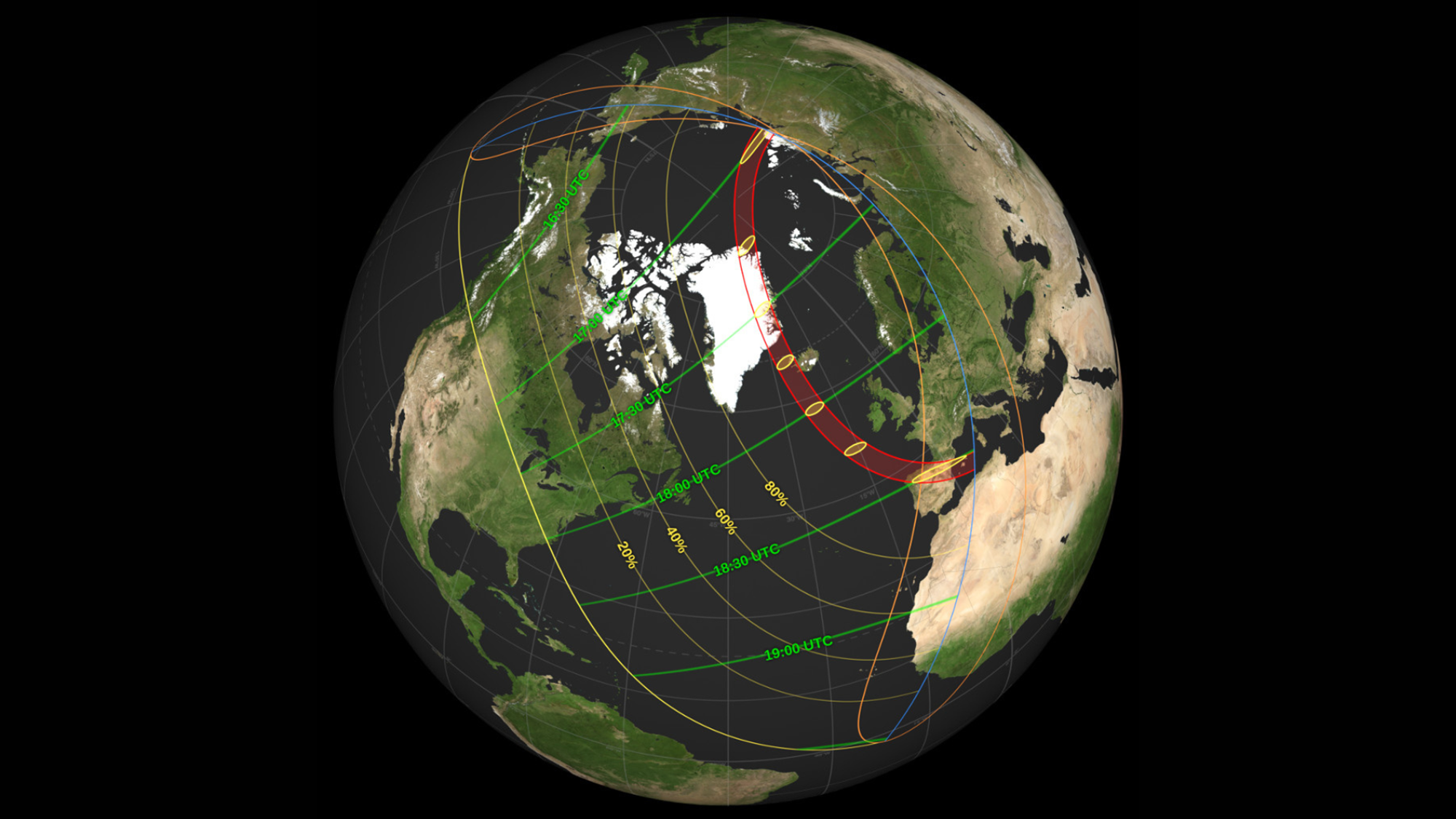
But if you’ve looked at maps of the Aug. 12, 2026, total solar eclipse, you may have noticed something puzzling. At first glance, the eclipse appears to do the exact opposite. The path seems to begin in far northern Siberia, near the North Pole, before heading toward eastern Greenland, making it look as though the moon’s shadow were traveling from east to west. It then appears to curve over western Iceland and northern Spain. So what’s going on?
The apparent reversal from Siberia to Greenland is an illusion. It’s created by geometry, but it’s also a result of viewing the eclipse on a flat map instead of on a globe. The moon’s shadow follows a smooth arc across Earth’s curved surface and never changes direction, as shown by this animation. This eclipse passes so close to the North Pole that the distortion caused by map projections makes the track appear to bend back on itself, when in reality, the shadow is simply sweeping over the top of the world.
An animation of the shadow path for the Aug. 12, 2026, total solar eclipse, from the point of view of the moon.
(Image credit: Michael Zeiler at EclipseAtlas.com/Fred Espenak at EclipseWise.com)
“The path of this eclipse also has a strong north-south component, the combined effect of Earth’s rotation and the tilt of both Earth’s axis and the Moon’s orbit,” experts at NASA’s Scientific Visualization Studio explained. “Combined with Earth’s rotation, the umbra’s eastern motion during the first half of its travel is effectively canceled out.”
This causes the shadow to sweep over the Arctic in a broad curve, instead of following the more familiar west-to-east path. On a flat map, that curved route can make it look as though the eclipse briefly reverses direction, even though it never actually does.
The moon’s shadow has two parts — the narrow umbra, where observers experience totality, and the much broader penumbra, where only a partial eclipse is visible. The widths of these shadows depend on the moon’s distance from Earth, while their speed is influenced by the moon’s orbit, Earth’s rotation and the geometry of the eclipse.
If you are among the millions of people who will be in the moon’s penumbra on Aug. 12, make sure to always wear a pair of certified solar eclipse glasses (or use a solar filter on your telescope or binoculars) to view the partial eclipse. It is never safe to look directly at the sun, except during the moment of totality, when the sun is 100% covered.
Get the world’s most fascinating discoveries delivered straight to your inbox.
If you aren’t in the right spot for the total solar eclipse, fear not. A near-total lunar eclipse will be visible over most of North America just two weeks later, and there are plenty of other summer skywatching highlights to watch for.