


A dog-sized carnivore and mammal ancestor that lived around 236 million years ago seems to have given birth to live young, a new study suggests. This means the tactic of keeping young developing inside the mother — known as viviparity — may have emerged in the mammalian lineage 90 million to 95 million years earlier than scientists previously thought, researchers noted in the study.
“This is the first time that we have evidence on how these mammalian ancestors reproduced,” said first author Leandro Gaetano, a paleontologist at Argentina’s National Scientific and Technical Research Council. His team reported the findings Aug. 13 in the journal Frontiers in Mammal Science.
Mammals, along with their extinct ancestors and close relatives, belong to the Cynodontia clade, which first appeared about 260 million years ago, in the Late Permian period. But after the Great Dying extinction event 252 million years ago, which heralded the start of the Triassic, the cynodonts flourished.
Latest Videos FromLive Science
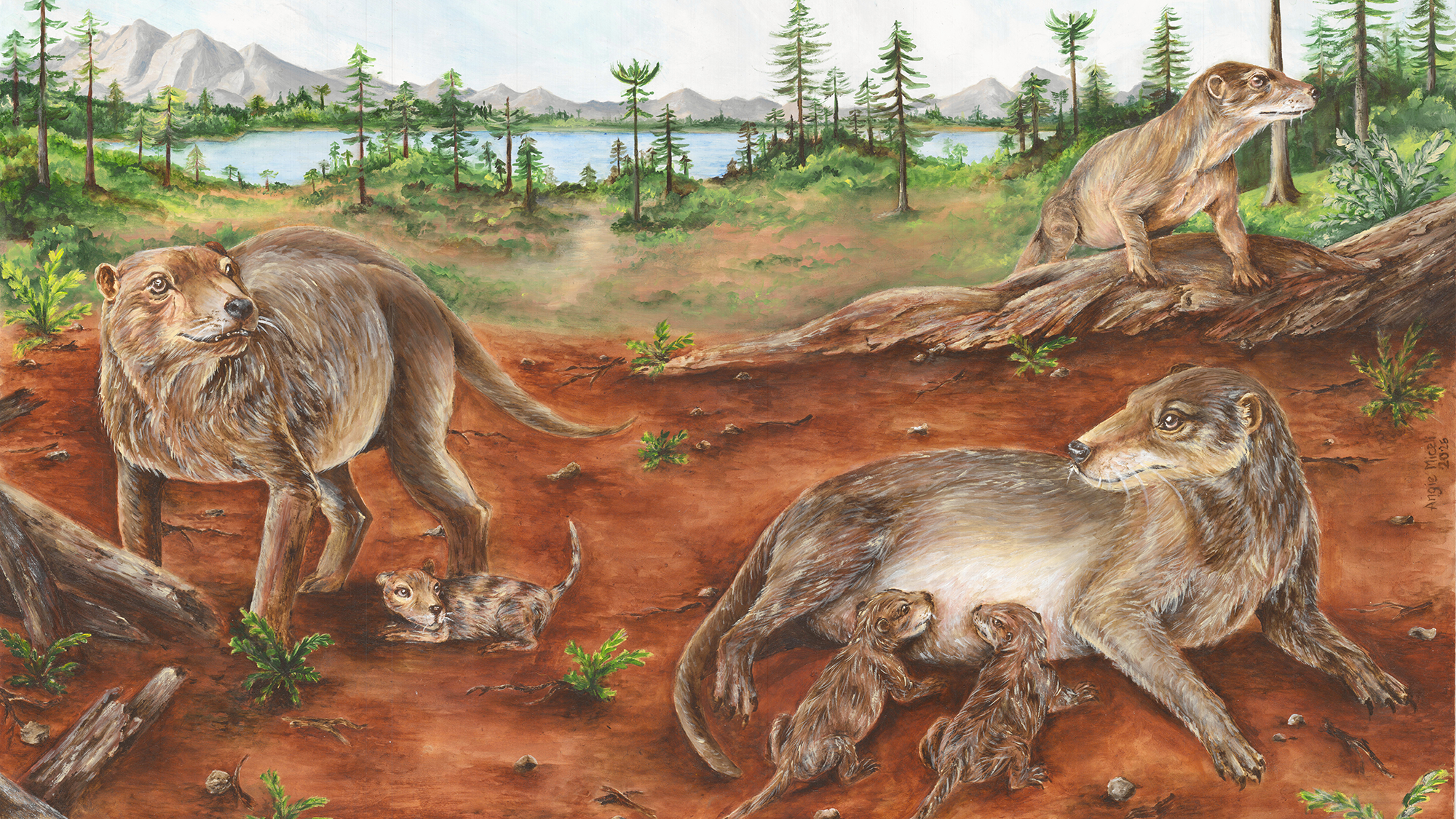
Gaetano and his colleagues spotted a curious growth mark in a fossilized bone of Chiniquodon theotonicusis, a carnivorous, dog-sized cynodont that lived some 236 million years ago in what is now northwestern Argentina.
Data from living species suggested the mark was a growth ring of disorganized bone material known as neonatal line, which forms when growth rapidly accelerates just after birth or hatching. These marks are common in the bones of living terrestrial animals, Gaetano said.
“When you are in an egg or in your mom’s belly, you have a small space and you grow very slowly,” he told Live Science. “When you hatch or are born, you have a lot of space and you start growing very, very quickly.”
To try to discern how the youngster emerged, the team measured the neonatal line and overall size of adult C. theotonicusis leg and arm bones to estimate that the individual weighed about 26 pounds (12 kilograms) when it died and about 3.7 pounds (1.7 kg) when it was born — about 14% of its adult mass.
Get the world’s most fascinating discoveries delivered straight to your inbox.
Then, the team compared these values to those of 1,869 mammal species, 2,619 nonavian reptiles and 782 birds alive today. Zooming in on those of comparable weight, the team found that the reptiles — including snakes, turtles and crocodilians — that weigh between 17.6 and 32 pounds (8 to 14.5 kg) a produce hatchlings that are just 0.1% to 0.6% of their adult mass.
The skull of the Chiniquodon theotonicus individual that was used for this study.
(Image credit: Leandro Gaetano)
Birds that weigh between 17.6 and 47 pounds (8 to 21.5 kg) as adults, like some cranes or vultures, produce hatchlings of about 1.3% to 4.5% of their adult mass.
But in mammals that weigh 17.6 to 33 pounds (8 to 15 kg) as adults, some babies can hit around 20% of their adult mass, much closer to the figure for C. theotonicusis. The bay duiker antelope (Cephalophus dorsalis), for example, gives birth to young that weigh about as much as the newborn C. theotonicus. This similarity in the relationship between newborn and adult mass suggests that like these antelope, C. theotonicus gave birth to living young, said Gaetano.
“It’s not the smoking gun, but it does suggest they are giving birth to live young,” said Emily Rayfield, a paleobiologist at the University of Bristol in the U.K. who wasn’t involved in the study.
How is giving birth to live young helpful?
Giving birth to live young may have been advantageous at the time. “The Triassic was a very difficult time to be alive,” Gaetano said. It was after a huge extinction event, and as ecosystems restructured and animals filled empty niches, there was huge competition for resources and strong predation pressure amid very arid conditions, so embryos of viviparous species may have been better protected than those of egg-laying species, he noted.
An egg can’t move away from a predator, but a young animal can, which is a “huge advantage,” said Anne Weil, a vertebrate paleontologist at Oklahoma State University who wasn’t involved in the study.
She told Live Science that she wasn’t surprised to see viviparity in C. theotonicus, given the range of reproductive behavior in living vertebrates. For example, there are both egg-laying and live-bearing fish and reptiles living today. There are also nonplacental mammals that lay eggs, like the duck-billed platypus (Ornithorhynchus anatinus) and the echidna (Tachyglossidae); others, like kangaroos, produce extremely small newborns and then harbor them in belly pouches.
Until a few years ago, birthing live young was often considered a relatively modern evolutionary acquisition within the mammalian lineage, developing from egg-laying, perhaps via the intermediate step of the reproductive tactics still used by mammals with pouches. However, evidence has mounted against this in recent years and C. theotonicus lived and seemed to have given birth to live young before the ancestors of marsupials even split from the ancestors of placental mammals.
“This could be evidence of a general switch from laying eggs to giving birth to live young early in the mammalian lineage, but we need more evidence,” Gaetano said.
Rayfield agreed that more research is needed to make firm conclusions. “My take on it is that live birth appeared earlier than we thought, but we still need a lot more evidence to really nail it,” she told Live Science.
According to Gaetano, the bigger picture is that many characteristics that are thought to be particular features of mammals are, in fact, older. “We usually think of mammalian ancestors as small, reptile-looking creatures,” he said. “But we are finding a lot of different pieces of evidence that are pointing to these guys being more similar to present-day mammals than we thought.”
Aside from the newfound hint of live bearing, these include suggestions of whiskers in Probainognathus, a carnivorous cynodont that lived about 230 million years ago; and indications of hair and lactation in Prozostrodontia, another cynodont that lived about 240 million years ago.