




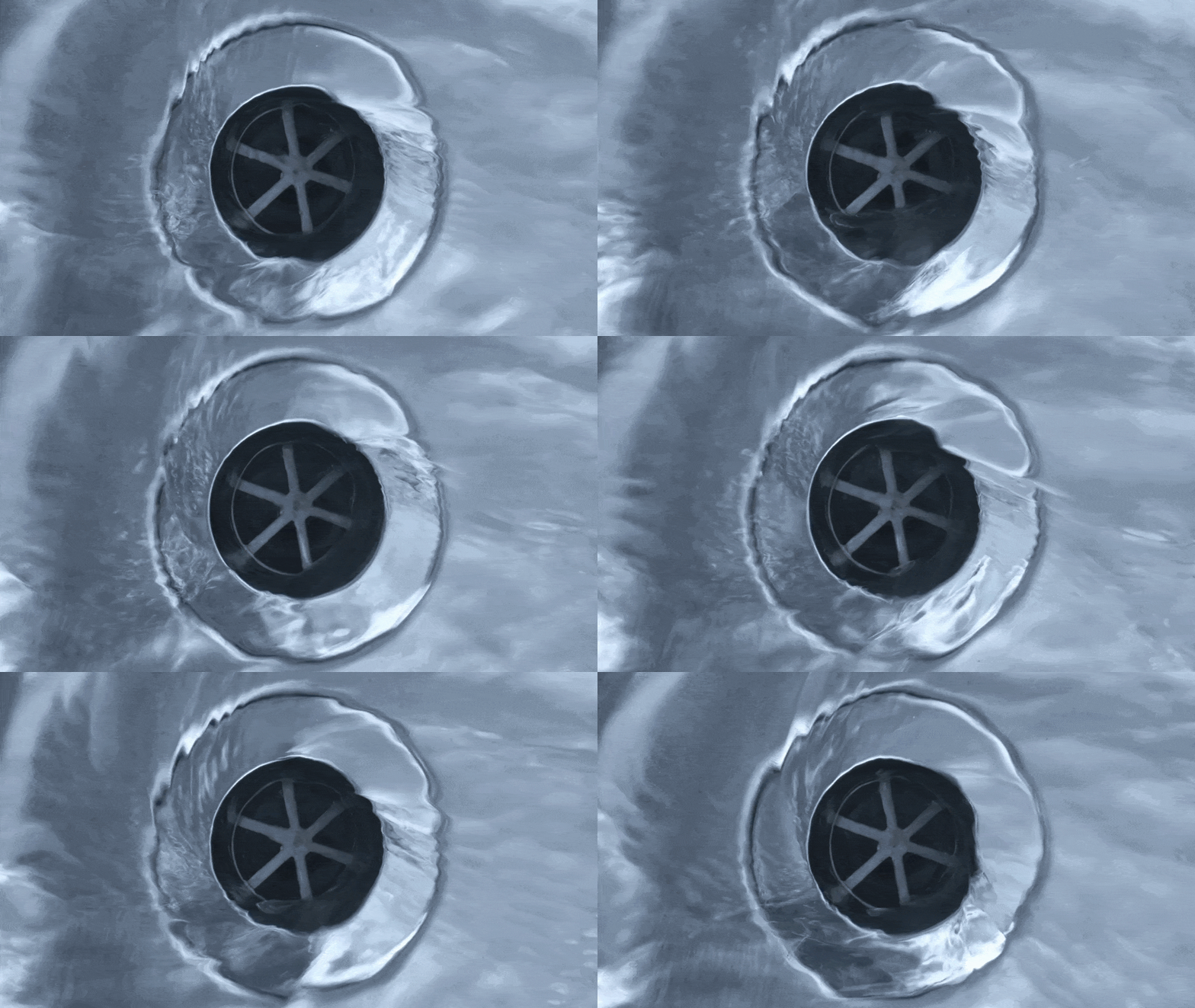
There’s a commonly cited idea that water in a drain swirls in opposite directions in the Northern and Southern hemispheres. But is there any truth to it? When you pull the plug from a bathtub, does the water circle one way in New York and the other way in Sydney?
Although the idea is based on a real scientific principle, you probably won’t see it play out in a small drain in your house, experts told Live Science.
The Coriolis effect
The idea that water spins in opposite directions in the Northern and Southern hemispheres stems from a phenomenon known as the Coriolis effect. When something, including air or water, moves across Earth as it rotates on its axis, that substance appears to curve because the ground beneath it is rotating at different speeds in different places. Points close to the equator move faster than points near the poles because they have a bigger circle to travel in the same 24 hours.
Latest Videos FromLive Science
Over the immense distances covered by weather systems and ocean currents, that small deflection can accumulate and become important. The key words here are “immense distances.” The Coriolis effect is weak, so it needs enough time and space to produce a noticeable change. Storms and weather patterns can persist for days and stretch across hundreds of miles. But water in a sink, bathtub or toilet has only seconds to move before disappearing down the drain.
“You always need to think about the right timescales and length scales,” Susanne Horn, a professor of numerical and mathematical fluid dynamics at Coventry University in the U.K., told Live Science.
Sign up for our newsletter
(Image credit: Marilyn Perkins / Future)
Sign up for our weekly Life’s Little Mysteries newsletter to get the latest mysteries before they appear online.
At your bathroom’s scale, seemingly trivial details take control. The water may already be rotating slightly because of how it entered the basin, how somebody moved in the bath or how the plug was removed. The sink and drain are unlikely to be perfectly symmetrical, which can also play a part, and the design of a toilet deliberately guides its water. All of these factors are more influential on your basin than the Coriolis effect is. (In other words, that episode of “The Simpsons”, which features Bart investigating drainage direction in Australia versus the U.S., got it wrong.)
Consequently, the same sink can drain clockwise on one occasion and counterclockwise on another, depending on the variation of these variables on any given day; the direction depends principally on how the water was introduced and the geometry of the container and drain, according to the Library of Congress.
So, although the Coriolis effect behind the claim is real, the water in a bathroom drain is normally overwhelmed by much stronger influences.

A digitally enhanced satellite view of hurricane Dorian from 2019 shows which way the clouds swirl thanks to the Coriolis effect.
(Image credit: Roberto Machado Noa via Getty Images)
How to see the Coriolis effect in action
To make Earth’s rotation — and, thus, the Coriolis effect — matter in a drainage experiment, Horn said, “there are essentially two tricks: let it drain very slowly, or make it much bigger.”
Fluid dynamicists describe this using the Rossby number, which compares a flow’s inertia with the influence of the planet’s rotation. A small Rossby number indicates the Coriolis effect is important; a large one means the flow is moving too quickly or across too short of a distance, for Earth’s rotation to have much influence. A typical household drain falls firmly into the latter category. In Horn’s words, it “doesn’t feel rotation.”
Still, there are ways to see the Coriolis effect in action. In a meticulously designed experiment researchers suppressed those larger disturbances to give the Coriolis effect enough time to emerge.
In the 1962 experiment, described in the journal Nature, an MIT researcher used a large, carefully prepared tank that removed residual movements in the water before it drained. The water eventually developed the counterclockwise rotation predicted for the Northern Hemisphere.
Three years later, in another study published in Nature, researchers at the University of Sydney published a Southern Hemisphere counterpart. After taking similarly stringent precautions against outside disturbances, they observed the predicted clockwise rotation. The two experiments demonstrated that Earth’s rotation could select the direction of a draining vortex — but only under extremely well-controlled conditions. In other words, the Coriolis effect appears only once you’ve removed practically every other variable.
That is very different from saying every sink or toilet flows in the same direction according to which hemisphere they’re in. In normal plumbing, the drain’s shape, the water’s starting motion and the way it is released are all far more influential.
“Just ask yourself whether what you’re looking at happens slower than Earth’s rotation and for long enough, only then does the Coriolis force really start to matter,” Horn said.
TOPICS