



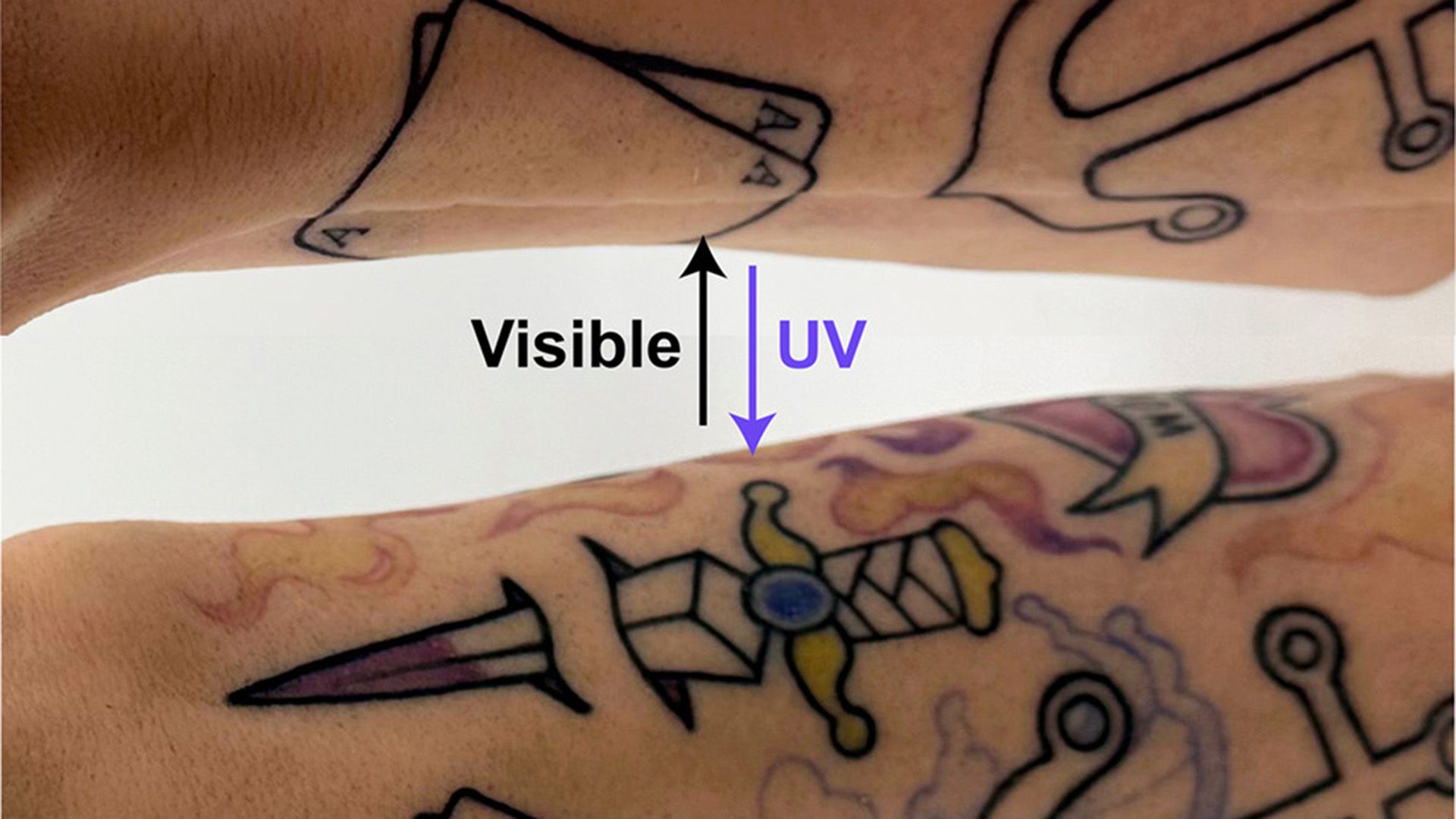
The new tattoo ink is activated under UV light.
(Image credit: Matter & Light, Bruns et al.)
Researchers have developed a new type of tattoo ink that can be switched on and off with light, allowing colors and images embedded in the skin to be changed and even “erased” without having to go through the painful tattoo-removal process.
The system, which is being commercialized under the name PhotoTat, could eventually give people a way to conceal or change permanent body art. It could also have more practical applications, including medical tattoos that are visible only when a doctor needs to see them, researchers reported in a study published Friday (Oct. 9) in the journal Matter & Light.
“This is a tattoo that you can have, and whenever you decide you don’t want it to be showing anymore, or you just don’t want it there, you just turn it off,” said study co-author Carson Bruns, an associate professor of biomedical engineering at the University of Colorado at Boulder. “And that’s it. You don’t have to turn it on again.”
Working like a light switch
PhotoTat contains three primary color inks — blue, magenta and yellow — made with photochromic dyes, which are light-sensitive compounds that can change color with different wavelengths of light. These dyes are encapsulated in nanoparticles of polymethyl methacrylate (PMMA) — a medical-grade, glass-like plastic that is already used in medical implants and dermal fillers.
The dyes change their molecular structure when exposed to specific wavelengths of light. A 365-nanometer ultraviolet (UV) LED can activate pigments in around two to three seconds, Bruns said. Once activated, the colors can persist for hours to days under typical indoor lighting. But once the wearer exposes their skin to the bright outdoor sun, the colors disappear in seconds, erased by the intense light.
That makes the tattoo unique, as the pigment itself remains in the skin but the tattoo’s appearance changes. Bruns and his team found that all three PhotoTat channels remained switchable in the skin for between 1.4 and 2.2 years.
Tattooing yourself for science
The three colors enable someone to activate different portions of a tattoo using different wavelengths of light. That means the magenta part of the tattoo might be turned on with green light, while the yellow pigment would be activated by blue light. This allows the wearer to customize their design and coloration to whatever they want at the moment — from a purple cherry to a yellow group of hearts.
Get the world’s most fascinating discoveries delivered straight to your inbox.
That feature makes PhotoTat appealing for “people who love tattoos and have lots of tattoos, but just want something kind of fun and playful to add,” Bruns told Live Science.
Bruns has tested each iteration of PhotoTat’s inks on his own skin. His art is arranged in a series of tattooed scales, with different ink formations in individual scales.
“I gave myself these scales on purpose because they’re each sort of a container for an experiment,” Bruns said. The result, he joked, resembles a “magical mermaid trick,” with some scales appearing out of nowhere and others changing color when activated.
The technology can also be combined with conventional tattoo ink. A permanent black ink design, for example, could contain hidden PhotoTat elements that appear only when activated.
The new tattoos could be appealing to people who want tattoos but are hesitant about their permanence, as well as to people who love their tattoos but occasionally need to conceal them because of work, social expectations or family, Bruns said.
“It’s going to be on for most of the time, but just for this one moment, I’m going to turn it off for you grandma, for example,” Bruns said.
Medical tattoos
Bruns thinks the tattoos could be helpful in a medical setting, too. Patients undergoing radiation therapy, for example, sometimes receive permanent tattoos that help doctors precisely align radiation beams. While useful, those marks remain after the treatment, reminding the patient of their experience. These would make such markings invisible if a patient wants them to be.
PhotoTat could potentially allow similar markings to be switched on during surgery and hidden afterward.
Bruns has spent several years developing other smart tattoos for medical applications, including a dosimeter-type tattoo that measures the amount of UV radiation a wearer experiences, along with a tattoo that changes color when the wearer is exposed to dangerous gamma radiation.

A cancer patient receives radiation treatment, guided by laser lines and a tattoo on their skin.
(Image credit: The Washington Post via Getty Images)
“It’s not for you and me, but if you’re like an astronaut or a nuclear engineer, they have to wear these dosimeters,” Bruns said. “So, we have like a dosimeter tattoo that sort of puts that in your skin.”
So far, Bruns and a fellow tattoo artist, have only commercialized the purple PhotoTat ink, after running the ink through a series of third-party medical tests.
The tests showed the purple is safe for use, and available to order, but it isn’t cheap at $100 for a small bottle. Bruns hopes as more research is done, he can bring the other colors to market and lower the production cost, so the technology is more accessible.
Bruns, Carson J., Stockton, Mollie., Gardner, Emily., Kwon, Hyejin. “Programmable pigments: Multicolor photochromic nanoparticle inks for rewritable intradermal smart tattoos.” Matter & Light. 1. https://doi.org/10.1016/j.matlit.2026.100119