





Follow us
Add us as a preferred source on Google
Subscribe to our newsletter
Researchers in Japan have developed a new technology that could enable electric vehicles (EVs) to charge “simply by parking”.
Wireless charging is still relatively nascent in the EV market, but scientists hope that integrating more wireless charging devices into roads and parking spaces will move the EV industry away from bulky plug-in infrastructure. It uses the same wireless power transfer technology found in modern smartphones and consumer electronics: a transmitter coil inside in a ground pad generates an oscillating magnetic field, which induces an electric current in a receiver coil underneath the vehicle. This current recharges the EV’s battery cells.
However, small misalignments between the two coils can affect how quickly and efficiently the battery recharges. This new system uses short-range radio signals to determine the position of the vehicle’s magnetic charging coil relative to the charging device in the ground, including its distance and angle. This helps the EV and its driver get into the optimal position for efficient charging.
Latest Videos FromLive Science
The technology could be particularly useful for driverless “robotaxis” and other autonomous vehicles that need to be able to recharge quickly and efficiently without human assistance, the researchers said. They detailed their findings in a study published Aug. 26 in the IEEE Open Journal of Vehicular Technology.
“We hope this research will lead to a future where EVs charge simply by parking, much like smartphones placed on wireless chargers,” Ryotaro Hada, first author of the study and a master’s student at the University of Osaka’s Graduate School of Information Science and Technology, said in a statement.
Borrowing from digital car keys
Existing methods for aligning an EV’s charging coil with a wireless charging pad use magnetic sensors or cameras. Magnetic systems work best when the coil is close to the pad, while cameras can struggle in rain, poor lighting or when dirt obscures the pad, the researchers explained.
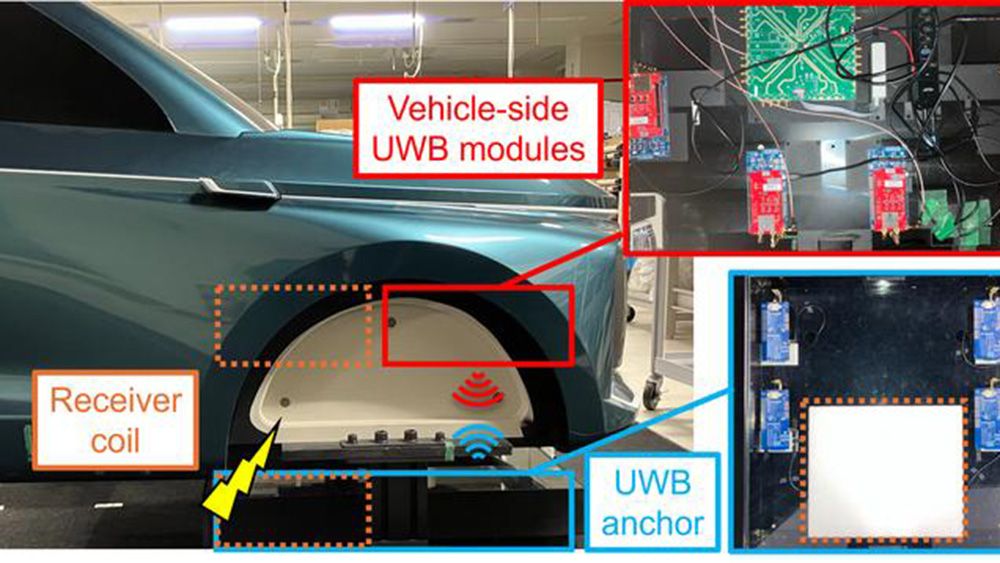
This new system uses four ultra-wideband radio devices mounted around the vehicle’s charging coil to communicate with four antennas around the charging pad.
Get the world’s most fascinating discoveries delivered straight to your inbox.
By measuring how long radio waves take to travel between the ultra-wideband devices and the antennas, as well as detecting tiny differences in how the signals arrive at each of the vehicle’s sensors, the system can pinpoint the position and angle of the EV’s charging coil relative to the ground pad.
The same technology is used in some digital car keys. They use short radio pulses to detect when the driver is close by, allowing the driver to unlock their vehicle without requiring a physical key.
In laboratory experiments using a scaled-down vehicle model, the system worked out where the vehicle’s charging coil was to within 0.09 inches (2.32 millimeters) of its actual position and which direction it was facing to within 0.25 degrees. Correcting for distortions in the radio signals reduced the positioning error by around fivefold, the team said.
The researchers noted that the system still needs to be tested outdoors, on full-size EVs and under real charging conditions.