



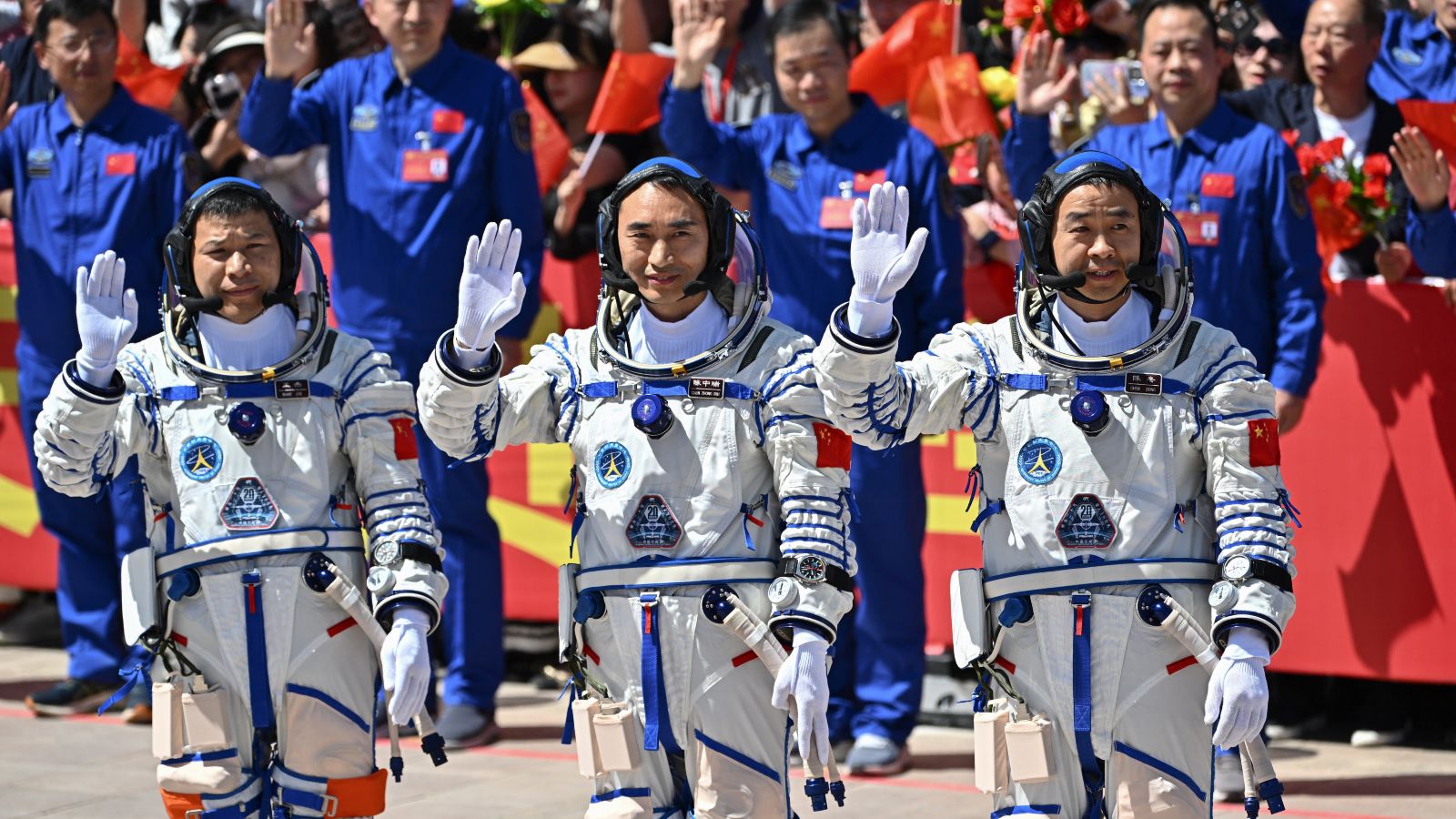
Chinese astronauts have described what happened when they were nearly stranded in space last year after a suspected piece of space junk struck their return capsule.
Chen Dong, Chen Zhongrui and Wang Jie, the crew of the ill-fated Shenzhou-20 mission, were preparing to leave China’s Tiangong space station and return to Earth on Nov. 5, 2025. During a routine check, the astronauts spotted something unusual, beginning what has since been described as China’s first spaceflight emergency.
Watch On
“My first thought was whether a small leaf had somehow stuck to the outside of the window,” Chen said in the interview, aired by China Central Television (CCTV). “But then I quickly realized that couldn’t happen because we were in space. How could there possibly be a fallen leaf there?”
Chen determined that the leaf-shaped mark was the result of cracks to the window, some of which he said “had penetrated through.” His crew then worked with the Shenzhou-21 relief crew and ground teams on Earth to check and confirm the condition of the window. The taikonauts (Chinese astronauts) have previously described taking a methodical approach to what could have been a perilous event.
“When we learned of the situation, we had discussions and reached a common understanding,” astronaut Chen Zhongrui told CCTV in a press briefing on Jan.17. “At the same time, the ground teams communicated with us promptly, and we soon calmed down.”
The taikonauts arrived at the Tiangong (Mandarin for “heavenly palace”) space station on April 24, 2025. Their original departure date of Nov. 5 was pushed back after the crack was discovered, but they were able to travel home 9 days later in the Shenzhou-21 spacecraft that had delivered their relief crew.
The three taikonauts safely touched down in northern China’s Inner Mongolia Autonomous Region on Nov. 14. The crew spent 204 days in orbit, which was a record for a taikonaut crew, though far from the record for longest time humans have spent in space (437 days).
The quantity of space junk in Earth’s orbit is increasing. This junk, which includes things like rocket boosters and other discarded space travel objects, has the potential to collide with uncrewed and crewed spacecraft and thus puts astronauts at risk. Various methods have been proposed to deal with the growing space debris problem — including the development of sci-fi-inspired tractor beams and junk-capturing spacecraft. But so far, no potential solutions are ready to be deployed at scale.