





The patient: A 20-year-old man in China
The symptoms: The patient had gotten a red cross tattooed on his neck, just below his voice box. But three months later, the ink vanished.
Article continues below
The patient went to the hospital about five months after his tattoo appointment. He was prescribed antibiotics and topical corticosteroids, but his symptoms did not improve.
What happened next: When doctors physically examined the patient, they identified hard and swollen lymph nodes on both sides of his neck, just below his jaw. They also examined a large necrotic ulcer on the middle of the base of his neck, finding that the crusted mass had spread to the deeper layers of his skin.
MRI showed the lump on each side of the man’s neck was approximately 1.6 by 1.2 inches (4 by 3 centimeters), while a central mass below the large necrotic ulcer was 1.9 by 1.4 inches (4.9 by 3.5 cm). An enhanced CT scan revealed blood clots in the two jugular veins closest to the midline of the neck.
The doctors then used fine needles to take biopsies of the necrotic ulcer, which revealed dead cells, immune cells and scar tissue. This did not point to what triggered the necrosis. But because the medical team was concerned by the scan results and the pace at which the man’s condition was progressing, the patient was immediately sent to surgery, the doctors wrote in a report of the case.
The team removed the ulcer and masses and tied off the clotted jugular veins to prevent blood flow. The patient’s neck was then reconstructed using tissue from his thigh.
The diagnosis: The team ran immunohistochemical tests on the biopsy samples, in which they used antibodies to check for specific antigens, or immune-response-triggering substances. The results were negative for both Epstein-Barr virus, the germ that causes mono, and tuberculosis, but a type of cell that forms benign tumors was detected.
“These findings collectively supported a diagnosis of necrotizing granulomatous lymphadenitis,” the doctors wrote. “Granulomatous” refers to a condition in which clusters of immune cells form a wall around persistent infections or foreign materials.
Image 1 of 2
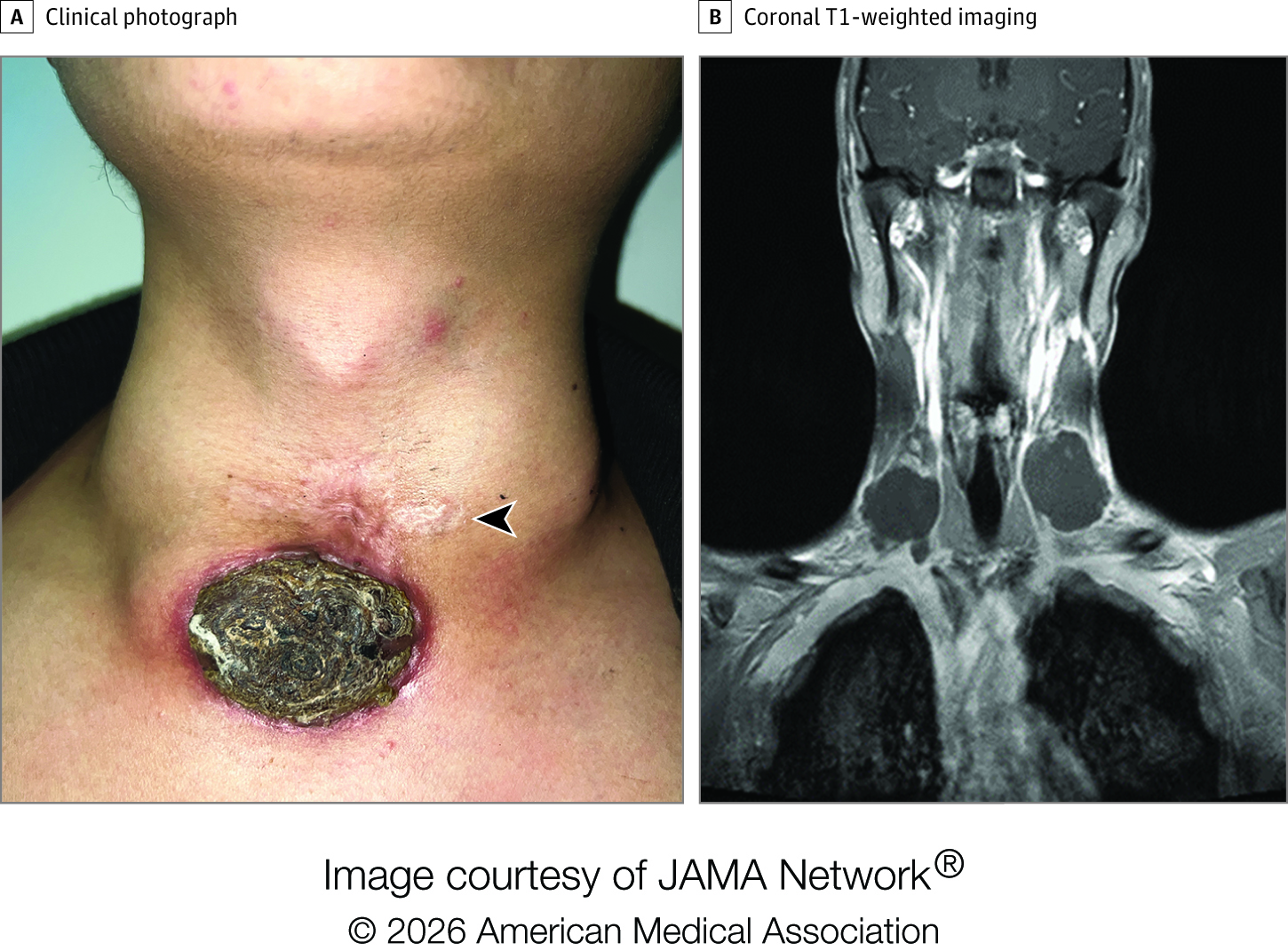
Necrotizing granulomatous lymphadenitis is an immune response mounted against a bodily injury — in this case, the man’s cross tattoo. The doctors also noted in their report that heavy metals, such as mercury and cadmium, and red organic dyes in tattoo pigments can sometimes trigger delayed immune responses. However, none of the vanished tattoo pigment was detected in the surgically removed lesions, so they couldn’t examine its contents directly.
The treatment: Following surgery and a bout of short-term hormone therapy, the man made a full recovery, the doctors reported. (They did not specify the type of hormone treatment he was given or why it was necessary.)
What makes the case unique: Tattoos can come with potential health risks, such as allergic reactions and skin infections. In a study of 226 people who had reactions to tattoos, granulomatous reactions were relatively common, making up 48% of the inflammatory responses reported.
The doctors noted that this man’s case is only the second known reported case of necrosis following a tattoo. In the other known case, the patient experienced necrobiosis lipoidica, a rare inflammatory skin condition in which the collagen in the skin degrades, and early granuloma annulare, characterized by a raised, ring-shaped rash.
The man’s necrotic ulcer was also particularly aggressive, the doctors noted, and it was unusual in how deep into the skin it had spread.
The doctors suggested three potential causes for the man’s severe necrosis. First, the chronic inflammation and otherwise-heightened immune response triggered by the tattoo could have raised his risk of blood clotting. Alternatively, the enlarged lymph nodes on the sides of his neck may have compressed the jugular veins and thus slowed blood flow. A final possible explanation is that the walls of his veins began to erode due to the chronic inflammation.
In all, “this report expands the spectrum of tattoo-associated pathology,” the doctors wrote in the report. Given that this is the second known case, though, it’s likely a very rare outcome.
For more intriguing medical cases, check out our Diagnostic Dilemma archives.
This article is for informational purposes only and is not meant to offer medical advice.