

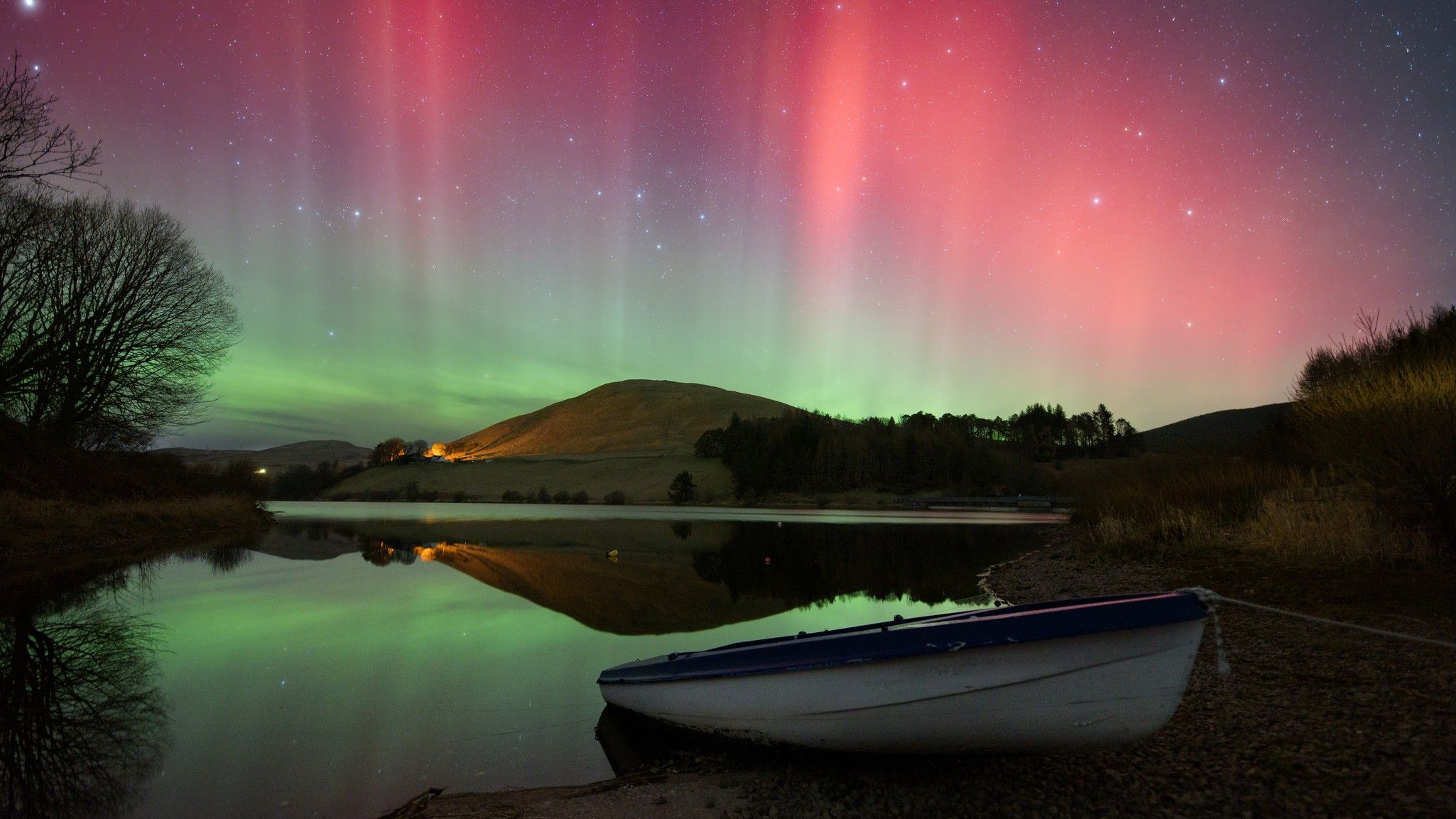
This month could be the best time to spot the northern lights for nearly a decade, as the combination of the “equinox effect” and supercharged solar activity will make auroras more likely. However, precisely where and when they will appear is still up in the air.
At 10:46 a.m. EDT (14:46 UTC) on Friday, March 20, the sun will cross the celestial equator, marking the spring equinox in the Northern Hemisphere and the fall equinox in the Southern Hemisphere.
The equinox effect
This “equinox effect,” which doubles the chance of auroral activity around the spring and fall equinoxes, was first explained by scientists Christopher Russell and Robert McPherron in a 1973 paper in the Journal of Geophysical Research.
They argued that auroras were more likely in March and September because the south-pointing magnetic fields in the solar wind cancel out Earth’s north-pointing magnetic field, making it easier for the solar wind to stream along magnetic-field lines. Effectively, the door swings open, which allows in more of the charged particles that collide with oxygen and nitrogen atoms in the upper atmosphere to cause auroras.
March’s equinox comes as solar maximum — the peak of the sun’s 11-year solar activity cycle — is drawing to a close. During solar maximum, the sun’s magnetism is at full power. NASA, the National Oceanic and Atmospheric Administration (NOAA), and the International Solar Cycle Prediction Panel reported that the sun had likely reached solar maximum in October 2024, but they added that it would not be possible to confirm that for months or years.
The sun’s magnetic intensity is calculated by counting sunspots — cooler regions on the sun caused by a concentration of magnetic-field lines — on its surface. The number of sunspots is now trending downward, with the U.K. Met Office stating in January that activity appears to be declining. That means fewer solar flares and, crucially, fewer coronal mass ejections — clouds of charged particles that can travel toward Earth to produce auroras.
According to NOAA‘s Space Weather Prediction Center, Solar Cycle 26 is expected to begin sometime between January 2029 and December 2032, with solar activity likely to remain low during that time.
Will there be a noticeable equinox effect this March? The conditions could produce the best auroras until the mid-2030s, but that doesn’t mean we should expect to see them at more southerly latitudes in the Northern Hemisphere.
In the end, everything depends on solar activity, and that’s hard to predict in advance. While early February produced the single most active sunspot of the current solar cycle — resulting in auroras at much lower latitudes than usual — that monster spot has since vanished. Unfortunately, there’s no way to know whether a new one will emerge to take its place in time for the equinox.