



QUICK FACTS
Where is it? Lake Skadar, Montenegro and Albania [42.201087364, 19.303135741]
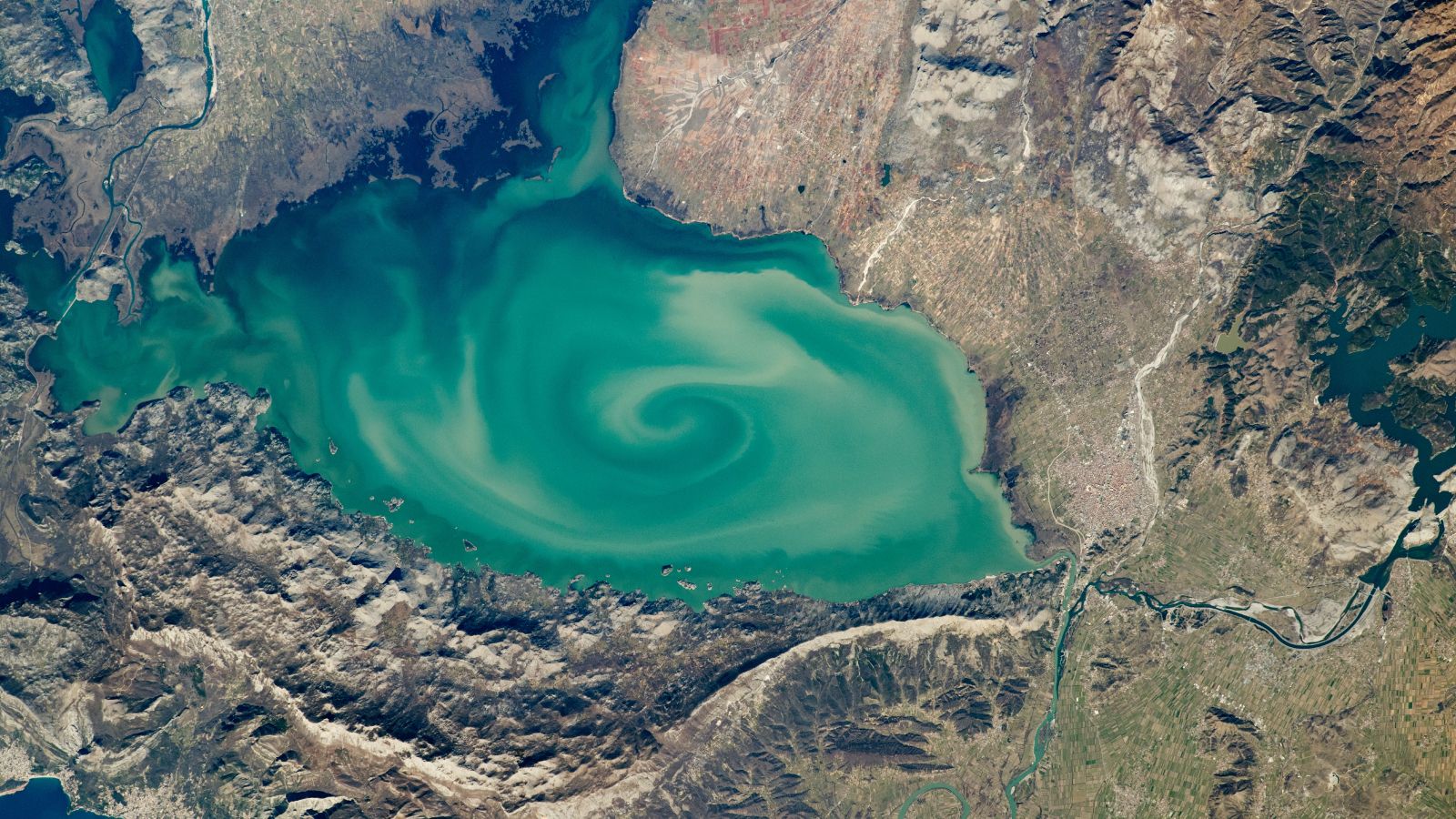
What’s in the photo? A giant, milky-green swirl on the lake’s surface
Who took the photo? An unnamed astronaut on board the International Space Station
When was it taken? Feb. 21, 2020
This eye-catching astronaut photo shows a cloud of sediment swirling into a giant, milky-green vortex in one of Europe’s largest lakes.
Lake Skadar (also known as Shkodër, Shkodra or Scutari) is the largest lake in Southern Europe, with a surface area between 140 and 200 square miles (360 to 520 square kilometers), depending on the time of year. It is situated on the border between Montenegro, which surrounds the western half of the lake (left in the photo), and Albania, which encircles the lake’s eastern shore. The body of water is split 65% to 35% in Montenegro’s favor.
The lake’s main water source is the Morača River, to the northwest, and its biggest outlets are the Bojana and Drin rivers, which start at the lake’s easternmost point and eventually drain into the Adriatic Sea, which is partially visible in the bottom left of the photo. Skadar’s southern shore is also hugged by a lofty mountain range, known as the Dinaric Alps.
During late winter and early spring, the lake’s water level rises, and it usually fills with a milky-green substance that often gets whipped into a vortex by a combination of wind-driven surface currents and the natural flow of water between the lake’s major inlets and outlets.
The swirling material looks very similar to blooming algae, but it is actually made of sediments — predominantly limestone and dolomite — that wash into the lake from the Dinaric Alps and other nearby mountains as the snow melts.
Lake Skadar formed millions of years ago and was once connected to the Adriatic Sea (visible in the background of this image).
(Image credit: Wikimedia)
Skadar is a karst lake, meaning it was once a cave system that flooded and eventually collapsed, likely because the caves were made from the same easily erodible rocks that now swirl on the lake’s surface, according to NASA’s Earth Observatory. The lake is a “cryptodepression” because most of the lake’s floor is below sea level.
The lake originally formed during the Cenozoic Era (66 million years ago to the present), according to the International Lake Environment Committee Foundation’s World Lake Database. It is home to several small islands, some of which can be seen in the photo along the lake’s southern shore. These include Beška, which is home to a pair of 600-year-old churches, and Grmožur, where the remains of a 19th-century fortification loom above the lake’s surface.
Get the world’s most fascinating discoveries delivered straight to your inbox.
The shipwreck of a paddle steamboat, named Skanderbeg, lies along the lake’s western shore. Local partisans sank the vessel in 1942 after Italian soldiers commandeered it during the Axis occupation of Yugoslavia in World War II. When the lake’s water levels are at their lowest, part of the shipwreck rises above the surface.
Skadar Lake is a biodiversity hotspot and has protected wildlife status on both sides of the Montenegro-Albania border. It is a particularly important site for birds; more than 280 avian species call it home, including the Dalmatian pelican (Pelecanus crispus) and several endemic species, according to BirdLife International.
The lake also hosts around 50 freshwater snail species — more than any other lake on Earth, according to a 2013 study.

A 2024 satellite photo shows an unusually active bloom of toxic cyanobacteria swirling in the water of Nevada’s Pyramid Lake.

This 2018 satellite photo shows an unknown substance swirling across the Gulf of Gdańsk in Poland. Scientists were shocked to later discover what it really was.

A 2016 astronaut photo shows surprising plumes of milky material swirling in the waters of Turkey’s Lake Van, the largest alkaline lake on Earth.