NEWYou can now listen to Fox News articles!
Supreme Court Justice Neil Gorsuch spoke out against rising threats targeting judges, breaking his silence on violence against the judiciary in a sit-down interview with Fox News Digital.
Gorsuch’s remarks come amid heightened security concerns for members of the Supreme Court after the 2022 leak of the court’s decision in Dobbs v. Jackson Women’s Health Organization, which sparked protests outside justices’ homes and intensified fears about their safety, particularly after the attempted assassination of Justice Brett Kavanaugh.
Gorsuch emphasized that the current environment — marked by increasingly heated public discourse and breaches of court confidentiality — poses broader risks to the institution.
“We have to be able to hear one another,” Gorsuch said. “And violence is never the answer.”
JUSTICE GORSUCH HIGHLIGHTS HUMANITY, HISTORY IN CHILDREN’S BOOK CELEBRATING AMERICA’S 250TH ANNIVERSARY
Supreme Court justices pose for their official group portrait at the East Conference Room of the Supreme Court building in Washington, D.C. (Alex Wong/Getty Images)
His remarks come as members of the federal judiciary have faced heightened security risks in recent years, including an assassination attempt targeting Kavanaugh during the lead-up to the Dobbs decision, when the court overturned Roe v. Wade and ended the federal constitutional right to abortion.
On June 8, 2022, Nicholas John Roske, a transgender individual from Simi Valley, California, traveled to Kavanaugh’s Maryland home with a gun and ammunition in a checked suitcase. Authorities later found a gun, tactical knife, zip ties, duct tape, a hammer, crowbar, lock-pick tools and other items in Roske’s belongings, according to the Department of Justice.
After seeing deputy U.S. Marshals outside the home, Roske walked away and called 911, telling a dispatcher about having homicidal and suicidal thoughts and had come from California to kill a Supreme Court justice.
Before the incident, Roske searched online for information about how to harm people — one search read “Does twisting or dragging a knife cause more damage” — and expressed a desire to affect the outcome of the Dobbs decision. Roske was sentenced to eight years in prison and a lifetime of supervised release for the assassination attempt.
Though Gorsuch stopped short of weighing in directly on specific incidents, he stressed to Fox News Digital that maintaining civil discourse and institutional boundaries are critical to preserving the Supreme Court’s role and the independence of the federal judiciary.
“There’s a balance between transparency and [the] confidentiality in our work, right?” Gorsuch said. “I mean, it’s wonderful, I think, that we have the opportunity for people to listen in to our own arguments. You can listen to every word uttered in arguments from the bench today, in real time.
“At the same time, we also have to be able to talk with one another privately and discuss our views candidly around the conference table.”
Gorsuch suggested these breaches of confidentiality — including the high-profile Dobbs leak, and more recent leaks of confidential Supreme Court memos exchanged by justices in 2016 — risk further eroding public trust in the judiciary.
JUSTICE BARRETT TEASES NEW MEMOIR IN ABRUPT CONFERENCE EXIT
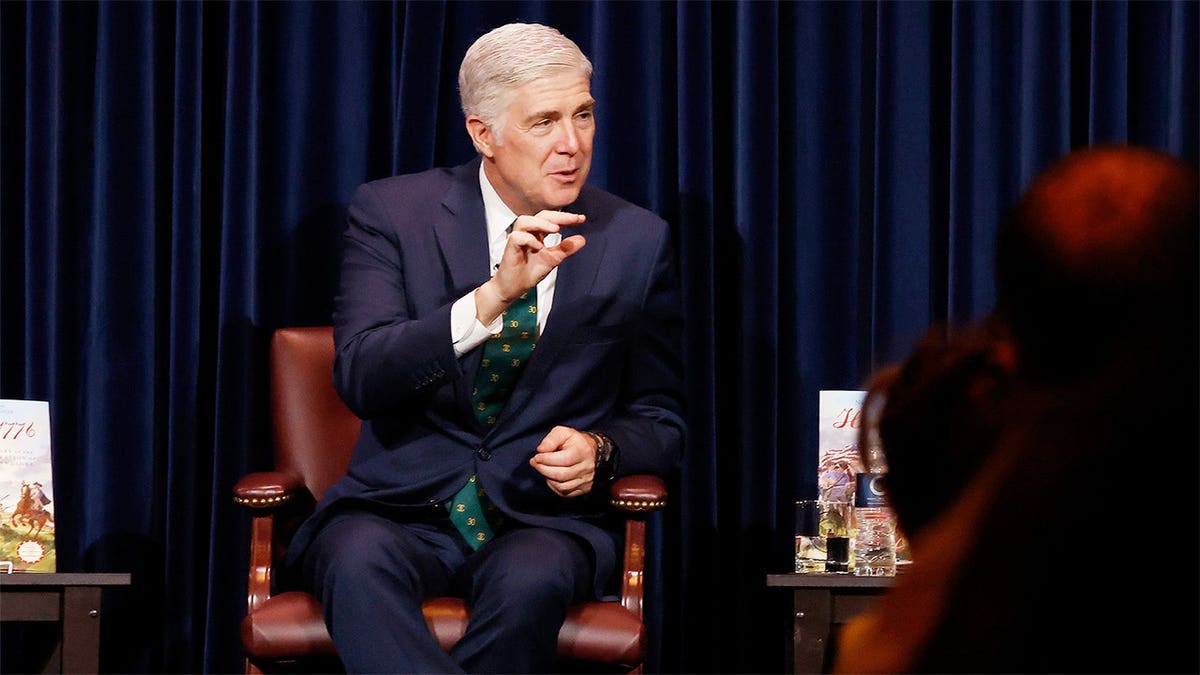
U.S. Supreme Court Justice Neil Gorsuch speaks at the Reagan Library on May 5, 2026, in Simi Valley, Calif. (Getty Images)
“You think about how robust our system is, where everybody, all factions come into making laws,” Gorsuch said. “That makes our decisions wiser than you are ever gonna get in a dictatorship or a monarchy or an oligarchy. They’re much more fragile, aren’t they?”
At the same time, Gorsuch underscored that maintaining boundaries for the court’s internal deliberations is critical, particularly after high-profile leaks.
“There’s a balance between transparency on the one hand … and confidentiality in our deliberations,” he said. “You can read every word I think about a case at the end of the day. … But do we need some confidentiality? Of course.”
He warned that losing that balance could undermine both trust in the court and the ability of justices to engage in candid debate behind closed doors, a practice he noted dates back to the nation’s founding.
“The framers thought it was very important that they lock the doors when they were discussing the Constitution,” Gorsuch said, adding that James Madison later believed there “would have been no Constitution” without that privacy.
Gorsuch tied those concerns to the broader constitutional principle of judicial independence, arguing the judiciary’s role depends on its insulation from political pressure and public backlash.
“Why do we have an independent judiciary?” Gorsuch said. “The framers did not want [judges beholden to political forces]. … They said you have to have independent judges so that when you come to court, no matter how unpopular you are, you’re going to get fair, neutral application of the law.”
JUSTICE BARRETT OPENS UP ABOUT ‘AWKWARD’ START ON SCOTUS, SHADOW DOCKET AND MORE IN FORTHCOMING MEMOIR
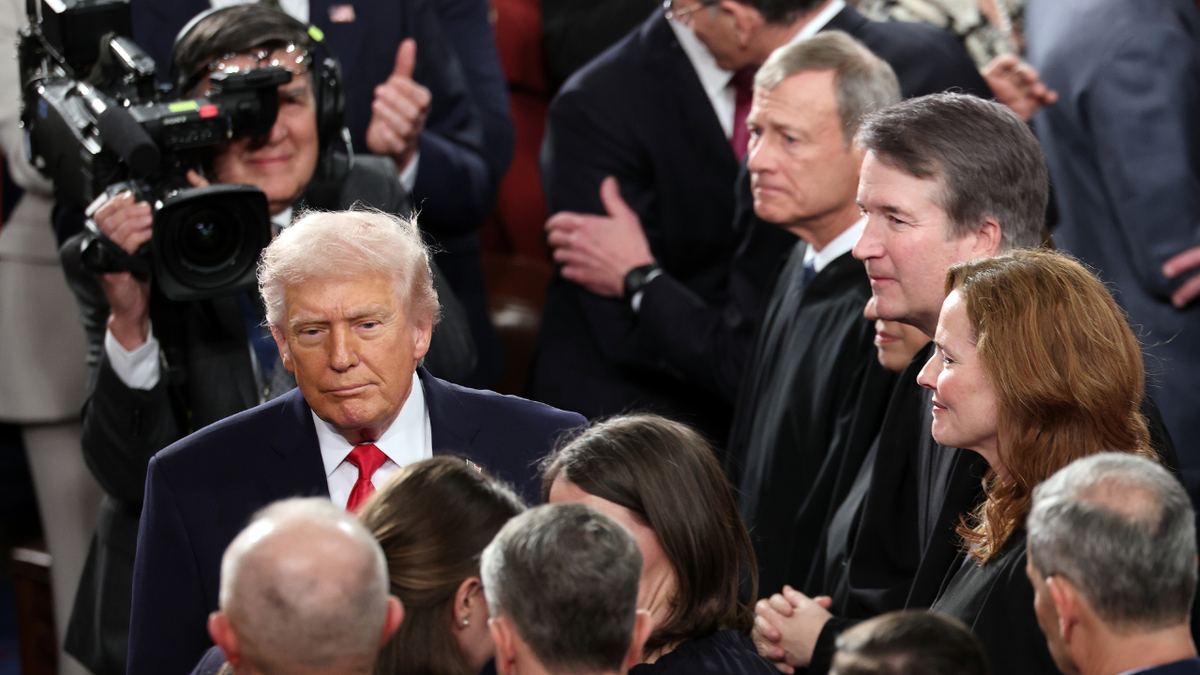
President Donald Trump walks past Supreme Court justices as he arrives at the U.S. Capitol to deliver his 2026 State of the Union address. (Win McNamee/Getty Images)
Despite ideological differences among the justices, Gorsuch said there remains a shared respect for the Constitution, a dynamic he suggested is essential in an era of growing polarization.
“When I sit around the table with my colleagues, and we disagree, the one thing I know is that the person across from me loves this country … as much as I do,” he said.
Still, Gorsuch made clear that the tone of public debate — and the rejection of violence — will ultimately shape whether that system endures.
CLICK HERE TO GET THE FOX NEWS APP
“We can debate, we can disagree,” he said. “But we have to be able to do it in a way that respects one another.”
Ashley Oliver and Jake Gibson contributed to this report.