

Archaeologists in Egypt have discovered a 1,700-year-old limestone tomb with a rare poem inscribed on it in ancient Greek, likely from a son lamenting his father’s death.
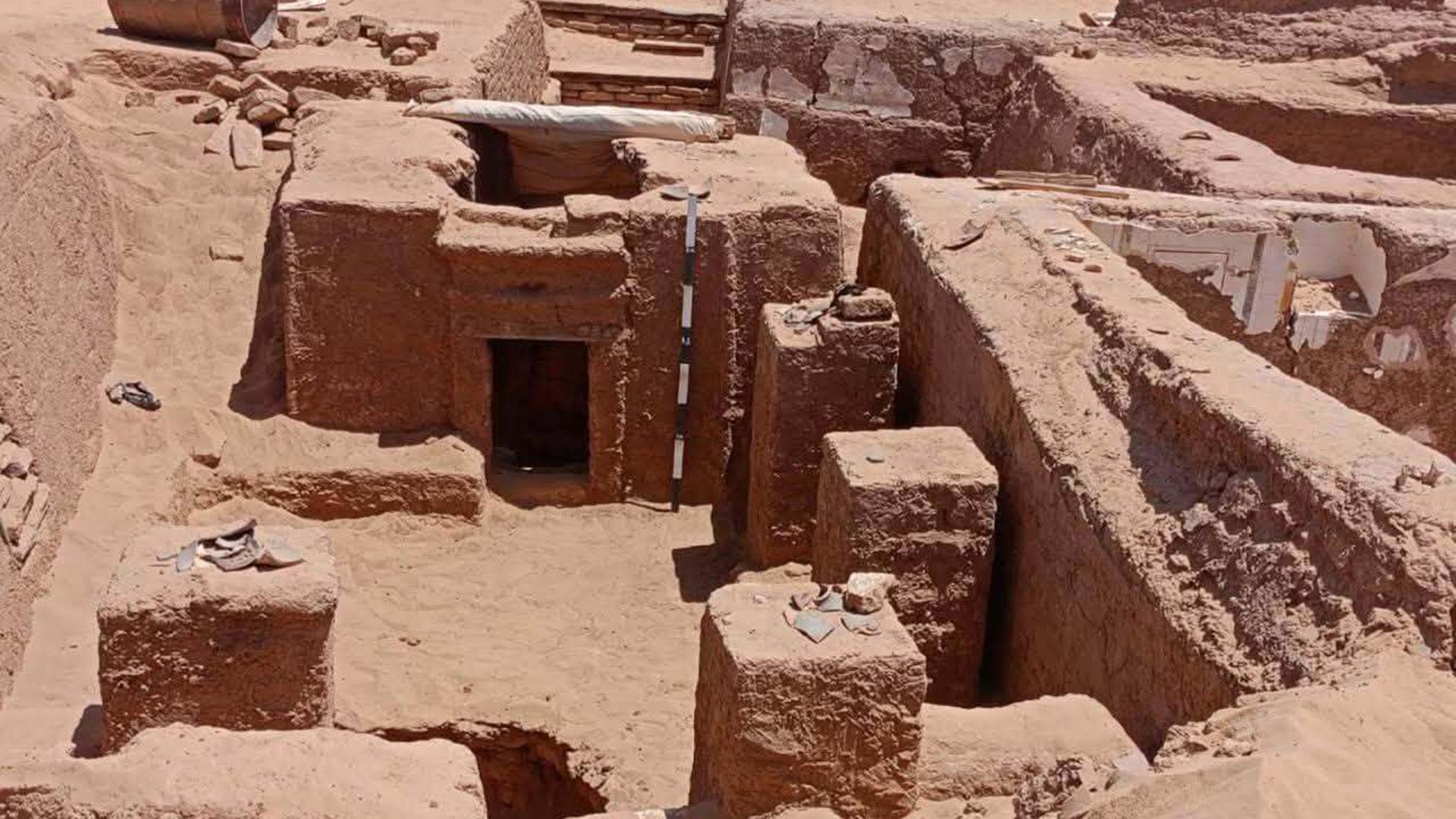
The tomb, which has a pyramid-shaped roof, dates to the fourth century, when the Roman Empire controlled Egypt. A team found it in the Dakhla Oasis, near ancient Mothis (modern-day Mut), a prominent city in the oasis.
Built for a husband and wife, the tomb has a stone plaque containing a 19-line poem written in ancient Greek, representatives of the Egyptian Ministry of Tourism and Antiquities said in a translated statement. The deceased man was named Pisechtes and may have been a judge. However, the statement didn’t mention the discovery of any human remains at the site.
Latest Videos FromLive Science
The tomb was built for a husband and wife and is about 1,700 years old.
(Image credit: Courtesy of the Egyptian Ministry of Tourism and Antiquities)
The tomb also has hieroglyphic inscriptions that record spells meant to protect the deceased. Some of the inscriptions mention parts of the “Amduat,” a text that tells the story of the sun god’s journey through the underworld.
Archaeologists also discovered an offering table, a purification basin, pottery and at least one coin that depicts the Roman emperor Constantine the Great, who ruled the Roman Empire from A.D. 306 to 337. Constantine famously legalized Christianity and converted to the religion shortly before his death. There do not seem to be any Christian decorations or texts inside the tomb.
Fourteen steps lead down to the tomb entrance, which is decorated with a variety of images, including a winged sun disk, an image of the god Osiris and two cobras, according to the statement.
“Listen, father!”

Hieroglyphs near the tomb entrance contain spells protecting the deceased.
(Image credit: Courtesy of the Egyptian Ministry of Tourism and Antiquities)
The inscribed stone plaque contains a lament for the deceased written in ancient Greek. Angelos Chaniotis, a researcher at the Institute for Advanced Study in New Jersey who was not involved in the excavation, said this “is a highly literary and original epigram” with grammar similar to that of Homer’s famous epics.
In the short poem, the deceased is praised for his kindness and wisdom and called an “advisor in life.” In the last lines, Pisechtes’ son Sarapion “addresses his father, ‘Listen father!’, and asks him to accept the funerary libations and offerings of lamenting children,” Chaniotis told Live Science in an email.
“An interesting feature of the inscription is the use of diacritical marks” such as accents, Chaniotis said. “This is an indication of the high level of education of the author of the epigram.”
The tomb may have been reused at a later time, according to the statement, since a mud-brick shrine above the tomb entrance was likely erected after Pisechtes and his wife were buried.
Live Science contacted the archaeological team but had not heard back by the time of publication.
Are you a fan of mummies and hieroglyphs? Find out with our ancient Egypt quiz!