




Physicists have successfully transported antimatter by truck for the first time — a milestone that allows them to study the elusive material with unprecedented precision and could eventually help to explain how matter came to dominate the universe.
The short, tightly controlled journey around the campus of the European Organization for Nuclear Research (CERN) in Geneva demonstrated that antimatter, one of the most fragile substances known to science, can be moved without being destroyed. That capability allows scientists to transport antimatter to quieter labs across Europe, where ultrasensitive experiments are less affected by interference than they are at CERN.
What’s the matter with antimatter?
According to current theories, the Big Bang should have produced equal amounts of matter and antimatter. If that were the case, the two would have annihilated each other completely, leaving behind a dark, empty universe. Instead, the observable universe is puzzlingly, overwhelmingly made of matter, and physicists believe that any measurable difference between matter and antimatter could offer a crucial clue to resolving that mystery.
CERN has been producing antimatter for decades through high-energy particle collisions at its “antimatter factory.” But the same powerful equipment used to create the particles also generates tiny magnetic fluctuations that can disrupt the extremely precise measurements scientists are trying to make. Relocating antimatter to more stable environments could help, but transporting it is notoriously difficult.
When antimatter comes into contact with ordinary matter, both are instantly destroyed in a burst of energy. To prevent that, scientists confine antimatter particles using carefully tuned electric and magnetic fields in a near-perfect vacuum — conditions that are challenging to maintain even in a stationary laboratory, let alone in a moving vehicle.
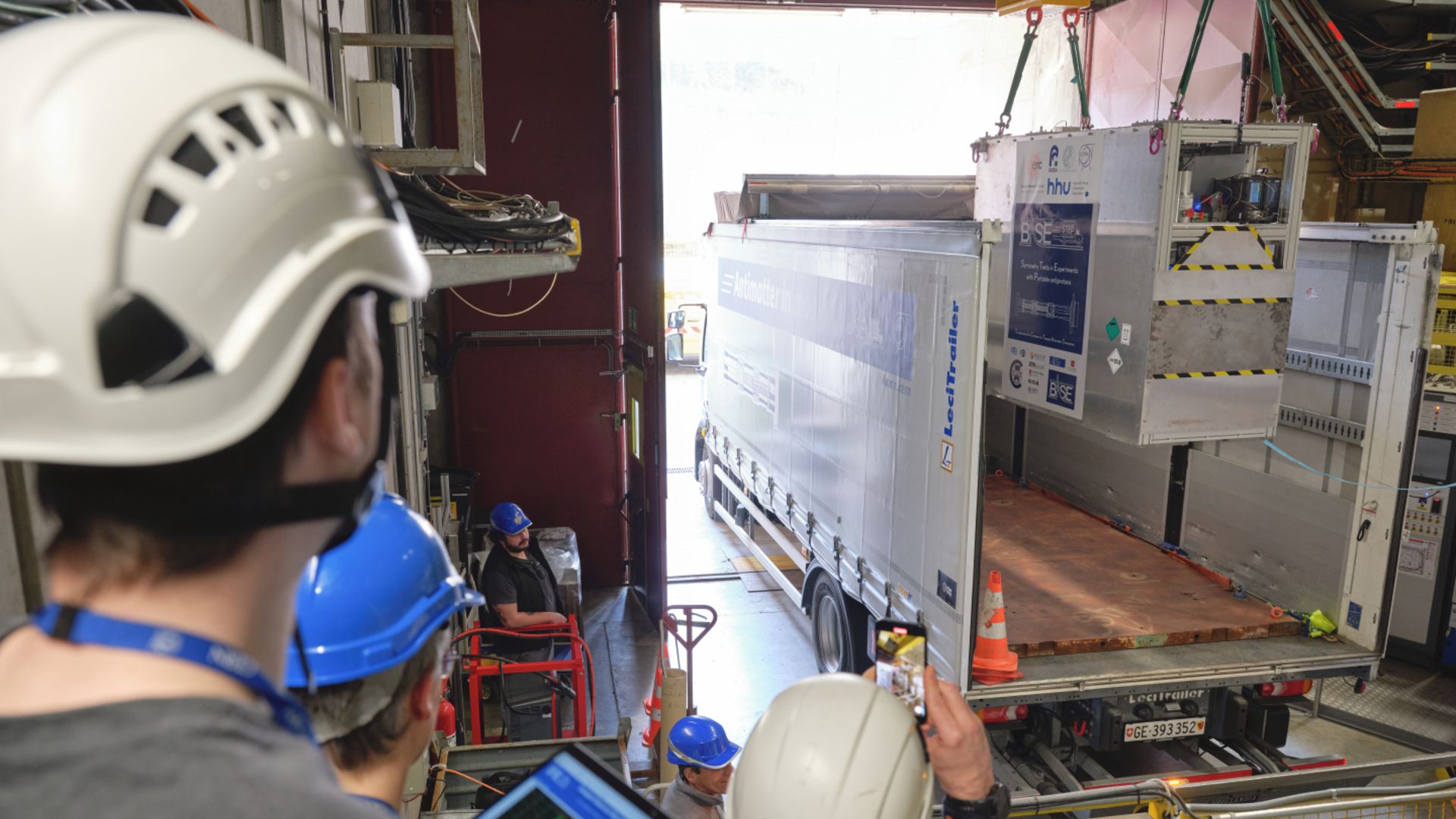
To test whether transport was feasible, Ulmer and his team loaded 92 antiprotons, the antimatter counterparts of protons, into a portable trap and drove them about 5 miles (8 kilometers) around CERN’s campus.
Inside the device, the particles were suspended in a near-perfect vacuum and held in place by electric and magnetic fields, preventing them from touching the container walls. The team monitored the particles throughout the trip and reported that they remained stable despite road vibrations and motion, according to a CERN statement.
Even in a worst-case scenario, the experiment posed little risk. The amount of antimatter involved was extremely small, and its annihilation would have released only a negligible amount of energy. According to CERN, even all the antimatter ever produced at the facility would generate only enough energy to power a single light bulb for just a few minutes.
Beyond the Standard Model
The successful test does not immediately change how antimatter is studied, but it demonstrates that transporting it is technically feasible. That, in turn, opens the possibility of moving antiprotons to quieter laboratories across Europe, such as the Heinrich Heine University Düsseldorf in Germany, located about eight hours by road from CERN, where quieter conditions could enable more precise measurements.
Such measurements could help scientists detect even the faintest differences between matter and antimatter. If those differences exist, they could point to why matter came to dominate the universe, offer clues to physics beyond the Standard Model, and ultimately explain why anything — from stars, to planets, to people — exists at all.
“We are at the beginning of an exciting scientific journey that will allow us to further deepen our understanding of antimatter,” Gautier Hamel de Monchenault, CERN’s director for research and computing, said in the statement.