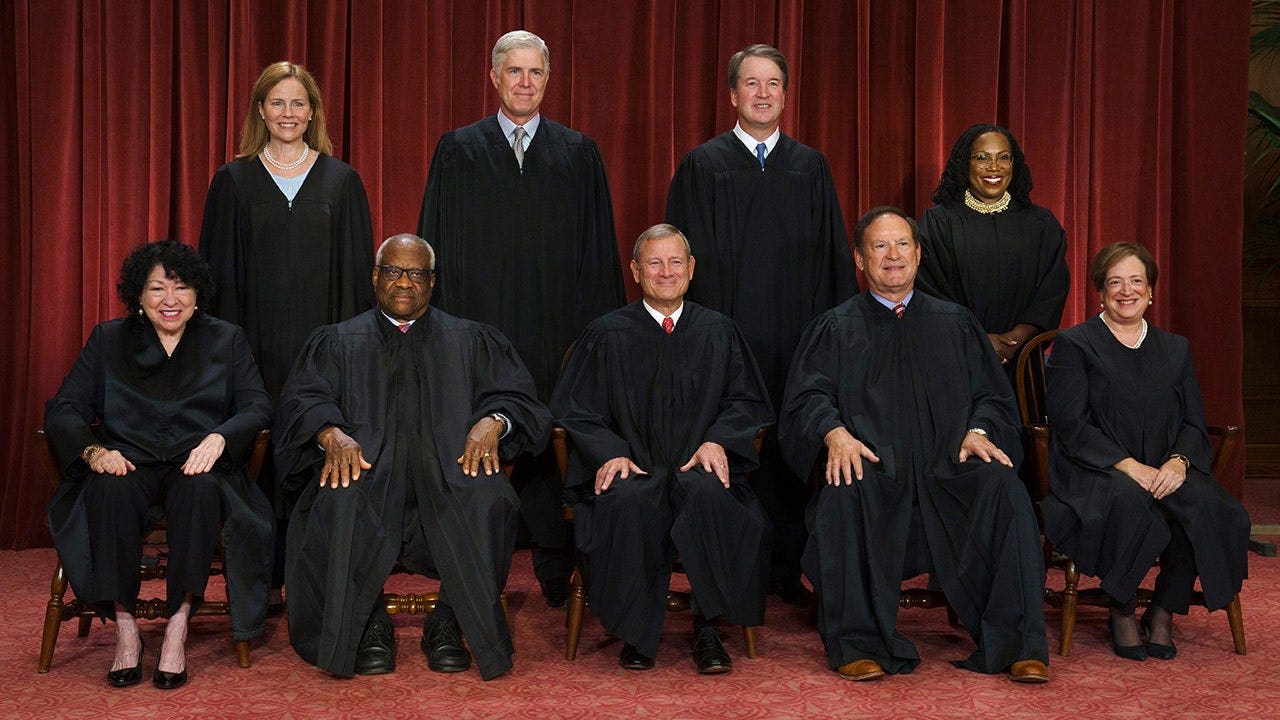
The Supreme Court ruled Friday that the Trump administration can check Social Security numbers, citizenship status and other data to determine eligibility to vote in the Nov. 3 midterm elections, reversing a lower court order and handing the White House a temporary victory on one of President Trump’s pet issues.
In an unsigned per curiam opinion, the court’s six conservative justices said that the Department of Homeland Security (DHS) could use the Systematic Alien Verification for Entitlements (SAVE) system “to conduct individualized inquiries” (emphasis original), warning that it was already too late in the 2026 cycle for state and local officials to conduct mass purges of their voter rolls.
A June ruling by DC US District Judge Sparkle L. Sooknanan had barred DHS from using SAVE, a 40-year-old database created to prevent government benefits from going to noncitizens — and revamped in response to President Trump’s March 2025 executive order meant to ensure only Americans vote in national elections.
DHS had added natural-born citizens to the register and allowed bulk searches of the database using names, birthdays and Social Security numbers rather than special identification numbers issued by the agency.
Sooknanan had written in a 75-page opinion that “Congress put protections in place to prevent precisely this type of centralized data bank” and accused the administration of having “haphazardly combined and repurposed the private information of millions of Americans, including citizenship data that they knew to be unreliable,” allowing states to “actively remov[e] United States citizens from voter rolls based on inaccurate information.”
The court’s majority disagreed, writing: “[T]he Federal Government has an obligation to respond to requests from state and local election officials seeking to verify the citizenship of voters. [Sooknanan’s order] prevents the Federal Government from using the program it believes is best suited to the task.”
At least 25 states have voluntarily used SAVE to check their voter rolls since April 2025. At least 67 million registrations, mainly in red states, have been scanned through the program, but critics worry valid voters could be wrongly purged.
“The harm caused by burdening or disenfranchising even a few lawful voters outweighs the nonexistent harm that the Government experiences when it is prevented from taking an action that it likely lacks the authority to take,” liberal Justice Ketanji Brown Jackson wrote in her dissent, joined by fellow liberals Elena Kagan and Sonia Sotomayor.
The League of Women Voters, the Electronic Privacy Information Center and five unnamed US citizens had sued DHS, the Justice Department and the Social Security Administration (SSA), charging the revamped SAVE program violated Americans’ privacy and voting rights.
In an amicus brief, officials in Travis County, Texas, which covers the state capital of Austin, reported that they investigated 97 voters flagged by SAVE and found that at least 11 of them were US citizens. The county urged the Supreme Court to reject the administration’s appeal, while the state of Texas submitted its own brief defending the database.
Even though the use of the SAVE program has been blocked for months, the administration said in court filings that DHS officials have continued using SSA data “in certain cases to verify information and help determine whether illegal voting may have occurred.”
DHS in August launched its own investigation to find noncitizen voters on state rolls, according to a federal whistleblower statement that alleged the effort is rushed, filled with errors and potentially violates state laws. DHS has insisted that probe is being conducted “diligently and professionally.”
With Post wires