


Some people see numbers as always having certain colors — for example, they see the number 5 as red. A new study reveals that their eyes react as if they see those colors in the real world.
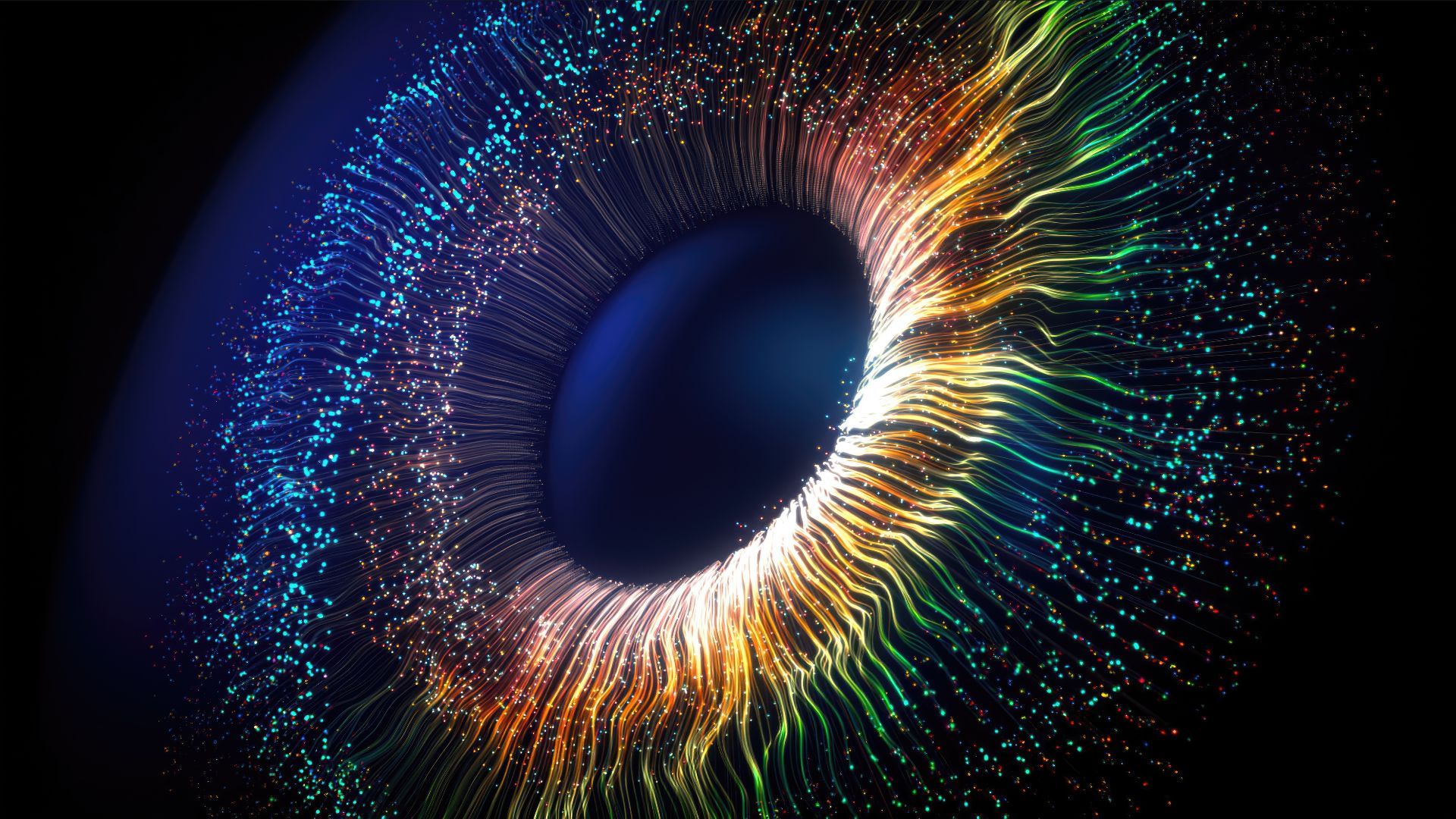
The study found that people with synesthesia — a neurological condition in which the senses blend together — don’t just experience these colors in their minds. Instead, they show real, measurable differences in their pupils, as if they were seeing the colors in real life. The findings, posted March 6 in the journal eLife, suggest that in people with synesthesia, the brain processes internally generated colors and real visual input in a similar way, the study authors say.
“This eLife study builds on [earlier] findings by showing that the pupil responds in a similar way to perception, constricting for brighter synaesthetic colours and dilating for darker ones, even though the actual stimulus is always the same (grey),” Rebecca Keogh, a research fellow at Macquarie University in Australia who has expertise in pupillary responses but was not involved in the study, told Live Science in an email.
Article continues below
Measuring an internal experience
There are many forms of synesthesia. For example, people with grapheme-color synesthesia see letters or numbers as specific colors, while others may perceive sounds as colors or words as tastes. Scientists estimate that at least 4% of people worldwide have some form of synesthesia.
Because synesthetic experiences are unique to each individual, researchers have long struggled to measure them objectively. In the new study, scientists tested whether pupil size could provide a physical sign of colors perceived internally.
Based on these findings, it follows that if synaesthetic colours are perceptual in nature, they should also produce a pupillary light response.
Rebecca Keogh, research fellow at Macquarie University
Dr. Krishnankutty ”Krish” Sathian, a cognitive neurologist and neuroscientist at the Penn State College of Medicine who was not involved in the study, said the findings provide convincing evidence that the colors that people with synesthesia report seeing when they look at gray letters or numbers are linked to real physiological changes in their eyes.
“This work could lead to better, more objective ways to identify synesthesia, using physiological measures rather than relying solely on self-report,” Keogh said.
Pupil size automatically changes depending on brightness: Pupils constrict in bright light to protect the retina from light-induced damage and dilate in darkness to capture more light onto the retina. This reflex is especially noticeable in cats, whose pupils can expand and contract dramatically. In humans, the same response occurs, but it’s more subtle, with the pupil typically changing by only a few millimeters. In rare cases, people can change their pupil size voluntarily.
Earlier research by Keogh and colleagues showed that the same effect happens when people imagine visual images. “Our pupils are smaller when we imagine bright images than when we imagine dark ones,” she explained. “Based on these findings, it follows that if synaesthetic colours are perceptual in nature, they should also produce a pupillary light response.”
To test this idea, researchers at Utrecht University and the University of Amsterdam recruited 16 people with grapheme-color synesthesia to look at gray numbers on a screen while an eye tracker measured their pupil size. Each participant reported the hue, saturation and lightness of each color that appeared in their mind. The team also recruited two control groups, each with 16 people who didn’t have synesthesia. One of the control groups was asked to actively think of a color for each number on the screen, while the other control cohort viewed the numbers passively, without making any color associations.
The people with synesthesia showed clear patterns in their pupil response: Their pupils constricted when they viewed digits linked to brighter synesthetic colors and dilated when the associated colors were darker. For example, most of them viewed zero as a light color, such as white or light gray, whereas nine was more likely to trigger associations with a range of colors, including dark blue, black or brown. Neither control group produced striking color associations or experienced the same changes in pupil size as the people with synesthesia did.
In the second part of the experiment, people with synesthesia viewed colored disks matching the colors they had reported earlier. Their pupil responses were very similar to those seen when they looked at the gray digits, suggesting that the brain treated internally generated colors much like real ones.
The findings demonstrate that the people with synesthesia use the same brain networks used to perceive colors in their mind as they do when they see real colors, the researchers concluded.
Keogh agreed. The results “would not be expected if synaesthesia were purely associative”, Keogh said, adding that it “supports the idea that these experiences have a perceptual, image-like quality.”
It is not yet clear how well these findings generalize to other forms of synesthesia
Rebecca Keogh, research fellow at Macquarie University
The timing of the participants’ pupil responses was also illuminating. The pupil’s response to consciously imagined colors typically takes longer than the response to real colors. In the study, synesthetic colors caused pupils to adjust about half a second later than real colors, but the delay was shorter than expected if the participants with synesthesia deliberately imagined the colors. This is evidence that synesthetic color perception is an involuntary process rather than conscious one, the study authors said.
People who did not have synesthesia, by contrast, showed greater pupil dilation than both the people with synesthesia and those who were not asked to imagine a color with each number. The latter experienced no changes in pupil size. Previous research has shown that pupil dilation increases during demanding cognitive tasks, making it a reliable measure of effort. This indicates that those without synesthesia who were asked to associate the numbers with colors were deliberately creating color associations, which takes mental work.
The pupil-size differences in each group suggest that synestheses experience color automatically, Sathian said.
However, “one limitation is that the study focuses on a specific type of synesthesia: grapheme-color,” Keogh said. “So it is not yet clear how well these findings generalize to other forms of synesthesia.”