



Antarctica’s “Doomsday Glacier” is about to lose an ice shelf that protects it from warming ocean waters, which could have devastating long-term consequences for hundreds of millions of people affected by rising sea levels.
The already-melting Thwaites Glacier is nicknamed the “Doomsday Glacier” because if it totally collapses, global sea levels would rise by 26 inches (65 centimeters) and flood coastal communities. Rising sea levels are already threatening the residents of major cities in the U.S. and throughout the world, including New York, Boston, San Francisco and Miami.
Researchers don’t expect the Florida-size glacier to collapse anytime soon, but Thwaites’ eastern ice shelf is breaking away, which will likely accelerate the glacier’s demise. The ice shelf has acted as a floating support structure, or buttress, slowing the flow of ice from the glacier, which is grounded on the Antarctic continent.
The shelf’s breakup is “very likely to happen sometime this year,” said Robert Larter, a marine geophysicist at the British Antarctic Survey (BAS), who announced that the BAS had already written the ice shelf’s “obituary.”
To discuss what the loss of the ice shelf spells for the glacier and coastal communities, Live Science spoke with Larter, who runs the U.K. arm of the science coordination office at the International Thwaites Glacier Collaboration (ITGC), where U.S and U.K. research agencies have investigated the glacier’s complex and rapidly changing environment. Here’s what he had to say.
Patrick Pester: What is happening to Thwaites Glacier?
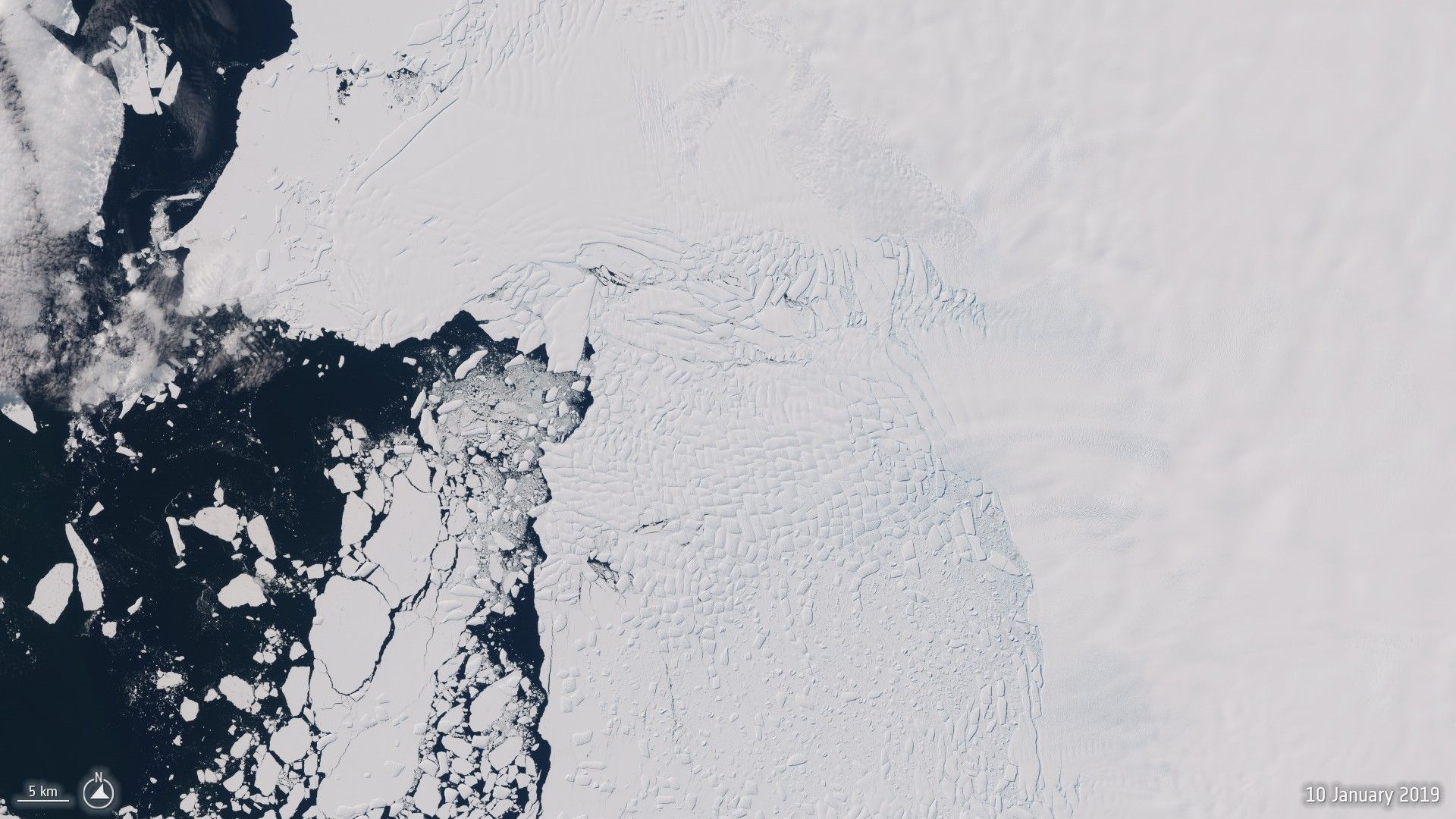
Robert Larter: The last bit of ice shelf in front of the glacier is poised to disintegrate. We don’t know quite how this ice shelf is going to break up, but it’s definitely going to go. It’s tearing away from the glacier at the moment, and its internal structure is getting more and more fragile. You can see the fractures and rifts growing in sequences of satellite images.
Get the world’s most fascinating discoveries delivered straight to your inbox.
PP: What happens when the shelf breaks free?
RL: That is the big question. What we have seen over the last few years, as the ice shelf’s structure becomes weaker, is that an area of the grounded ice has started to flow faster — an area where glacier ice is flowing into the ice shelf. So this shows that it was doing something to restrain the flow of the ice.
PP: Are warming oceans to blame for the undermining of the shelf?
Robert Larter is a marine geophysicist at the British Antarctic Survey who runs the U.K. arm of the science coordination office at the International Thwaites Glacier Collaboration.
(Image credit: Robert Larter)
RL: Yes, we’re pretty sure of that. It’s clear that it is warm ocean water that has done the damage, and there was a change in the delivery of this water sometime in the middle of the 20th century that has set off the current phase of ice loss and grounding zone retreats.
It’s more the circulation of the water than the warming. The source of the water is several hundred meters deep in the Southern Ocean. There is a huge body of relatively warm water at depth in the Southern Ocean, and it’s when this gets onto the continental shelf and gets to the front of the glaciers that it starts to do the damage.
PP: And is it humans’ fault?
RL: There is a lot of work going on to try to establish that. But yeah, indications are that it is caused by human-forced climate change.
So, the circulation in the Southern Ocean is mainly driven by surface winds, and what we know has happened is that there have been changes in the wind patterns that drive this Southern Ocean circulation. There is an active scientific debate about exactly how this works, but it seems pretty clear that in some way, the changes to the Southern Hemisphere westerly winds are what is driving warm water onto the continent. And those wind changes are part of the wider pattern of climate change that we’re seeing.
PP: Do you think the “Doomsday Glacier” nickname is appropriate?
RL: I mean, it’s got us a lot of media attention. Initially, we resisted it. We didn’t want to adopt that name because it kind of prejudges the conclusions of what we were trying to establish. But the collaboration started in 2018 — so eight years ago — and in light of the eight years of research results that are now coming in, I increasingly think it is appropriate. I think, overall, our results point to that, eventually, the Thwaites Glacier will be lost.
The time frame is still the big open research question. Most of us who are working on it are convinced that the retreat is not going to stop, but there is still a lot to work on to predict more accurately how long that is going to take. There’s a whole range of ice sheet computer models that give a range of predictions. So I don’t think anybody can state with a very high confidence what the rate of ice loss will be over the next century or two.
PP: What’s the human and environmental impact of this accelerated ice loss around the world?
RL: This is a difficult thing to communicate because we’re still at the level of talking of sea level rise changes of a few millimeters a year. So the current overall rate is 4 or 4 and a half millimeters [0.16 to 0.18 inches] a year of global mean sea level rise, and if you add an extra millimeter, it’s difficult to get people excited about that.
But really, the important thing that we need to get across is that a small rise in sea level has a really disproportionate effect when you look forward a decade or two to the risks of coastal flooding in many areas. You don’t need a lot of sea level rise, just a meter or two, to turn your once-a-century coastal flooding event into a once-a-decade or even an annual event.
So, although we’re talking millimeters a year, centimeters a decade, maybe a few tens of centimeters over a century — and that’s if it doesn’t accelerate — those sorts of rates of sea level rise within a few decades are going to present us with major problems. They’re presenting coastal cities with major infrastructure decisions about how they manage their defense, which is why we need to do that research to get a better idea of how fast Antarctica, Greenland, etc., are going to contribute to global sea level.

Thwaites Glacier is located in West Antarctica.
(Image credit: Photo by Yasin Demirci/Anadolu via Getty Images)
PP: Is there anything else you’d like to add that we haven’t covered?
RL: I think it’s incredibly important to explain what an ice shelf is and to make clear that an ice shelf is not the glacier. And in fact, what we’re talking about here in terms of some of the ice shelves around Antarctica, it’s a relatively small ice shelf. The glacier is a couple of orders of magnitude larger in area than the ice shelf, but it is going to be a significant, very visible change that you can see in satellite images.
As this ice shelf does break up, which I think is very likely to happen sometime within this year, we’re going to see this ice shelf really move away and maybe totally fragment. That’s going to be quite a spectacular event when you look at the sequence of satellite images. And then it’s going to be very interesting to see how the glacier responds to that.
It is increasingly looking like “Doomsday Glacier” is a good name. The glacier is doomed. And the rate at which we’re losing it is going to increase, I think, but it’s not going to happen in the next few decades.
PP: That’s good. In the broader scheme of climate and environmental news, that’s something, I suppose.
RL: Yeah, but if we’re right that it’s doomed, we’re committed to that much sea level rise. Even if we get to net zero [emissions] at 2050, this glacier is going to go. It is going to add 65 centimeters [26 inches] to sea level rise, which is a large commitment and will be something that’s difficult to deal with in many places around the world.
And probably, loss of this glacier destabilizes other marine-based parts of the West Antarctic Ice Sheet, because the problem and the reason that this area is so unstable is that virtually the whole glacier is sitting on a bed that’s a long way below sea level, and so are the neighboring glaciers.
So this instability is not going to stop when you’ve removed Thwaites Glacier. There’s probably a total commitment in the West Antarctic Ice Sheet of more than 3 meters [9.8 feet] to sea level. It won’t be our generation that has to deal with that.
Editor’s note: This interview has been edited and condensed for clarity.