



NEWYou can now listen to Fox News articles!
President Donald Trump says he’s attending the NATO summit in Ankara, Turkey, for one reason: Turkish President Recep Tayyip Erdoğan.
“I’m going because of Erdoğan,” Trump told reporters June 24, calling the Turkish leader “a friend” and “a respected leader” while signaling that closer defense cooperation between Washington and Ankara could be on the horizon.
The summit will begin Tuesday in Ankara, Turkey.
The remarks underscore a striking shift in the relationship between Washington and Turkey. Just a few years ago, after Turkey took delivery of Russia’s S-400 air defense system in 2019, Washington expelled it from the multinational F-35 fighter program and, the following year, imposed sanctions on Turkey’s defense procurement agency, cementing its reputation as one of NATO’s most difficult allies.
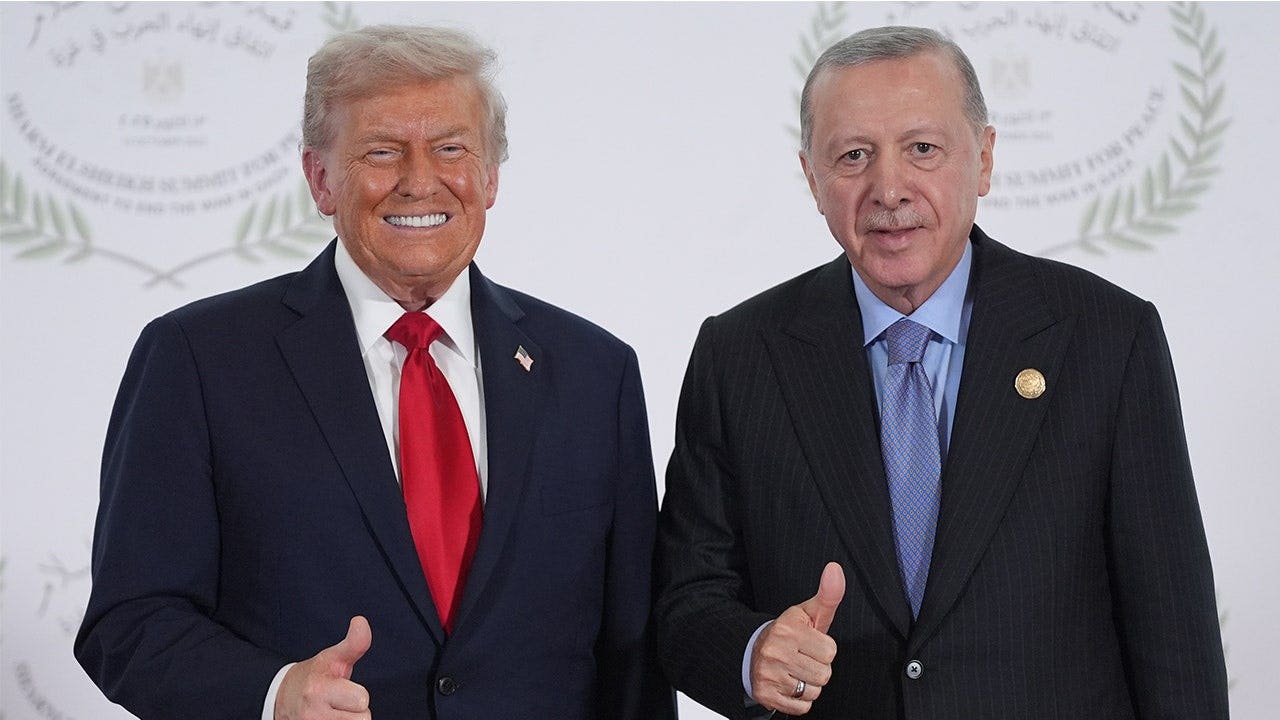
President Donald Trump greets Turkey’s President Recep Tayyip Erdogan during a summit to support ending the more than two-year Israel-Hamas war in Gaza after a breakthrough ceasefire deal, Monday, Oct. 13, 2025, in Sharm El Sheikh, Egypt. (Evan Vucci AP Photo/ Pool)
TRUMP’S TURKEY ARMS SALE PROPOSAL SPARKS CONGRESSIONAL QUESTIONS BEFORE NATO SUMMIT
Today, despite many of those disputes remaining unresolved, Turkey has become increasingly difficult for the alliance to sideline as NATO confronts Russia, instability across the Middle East and an increasingly contested Black Sea, analysts and former officials say.
“Turkey is crucial to the Trump administration,” former U.S. Ambassador to Turkey James Jeffrey, who served as Trump’s special representative for Syria during his first term, told Fox News Digital.
“President Trump has a great relationship with President Erdoğan of Turkey, who has been an incredible partner in the region,” White House spokesperson Anna Kelly told Fox News Digital in a statement, adding that Trump would have a bilateral meeting with Erdoğan at the NATO Summit.
Jeffrey said Trump’s affinity for Erdoğan is genuine but reflects more than personal chemistry.
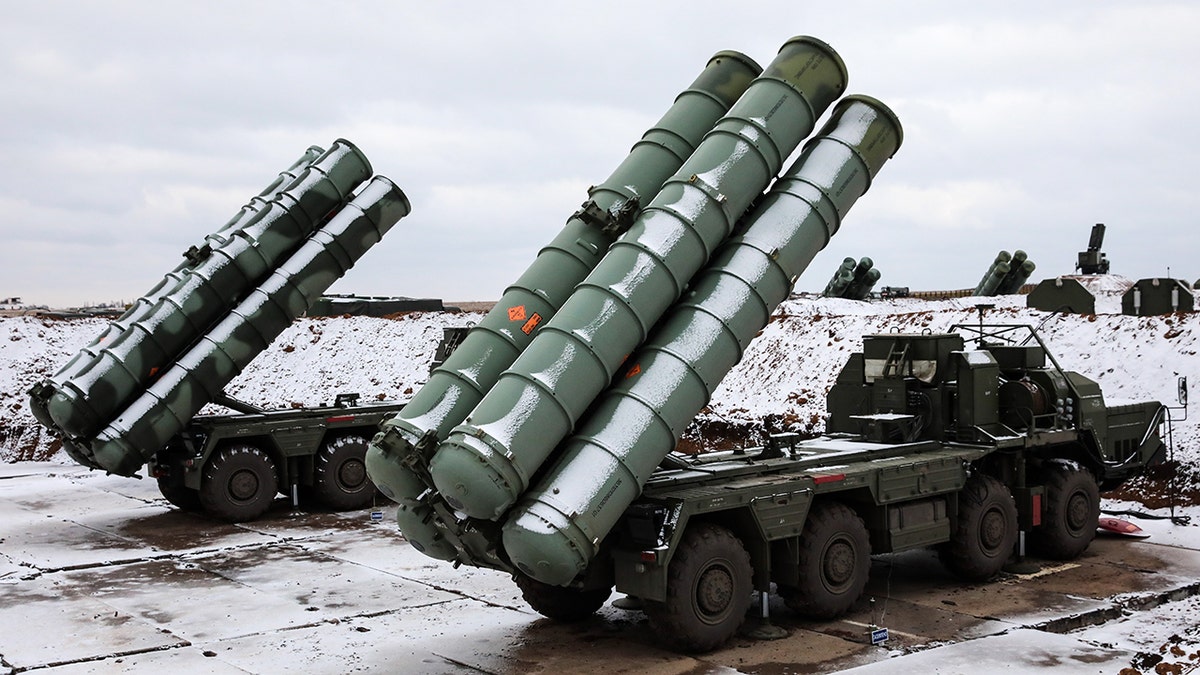
CRIMEA, RUSSIA – NOVEMBER 29, 2018: S-400 Triumf surface-to-air missile systems as an anti-aircraft military unit of the Russian Air Force and the Russian Southern Military District enters combat duty near the Crimean town of Dzhankoy twelve miles away from the Ukrainian border. Sergei Malgavko/TASS (Photo by Sergei MalgavkoTASS via Getty Images)
TRUMP’S PERSONAL FEUDS WITH ALLIES FROM ITALY TO ISRAEL REVEAL HOW PERSONALITY DRIVES HIS FOREIGN POLICY
“The first reason, which is unique to Trump, is he really likes Erdoğan, and Erdoğan likes him,” Jeffrey said. “It’s the idea of a tough guy who is decisive.”
But Jeffrey argued the strategic rationale extends well beyond the relationship between the two leaders, describing Turkey as “essential to maintaining the U.S. perimeter around Eurasia” because of its military strength, geographic position and willingness to project power.
NATO is returning to the fundamentals of collective defense after decades focused largely on counterterrorism, said Hudson Institute think tank Senior Fellow Can Kasapoğlu Kasapoğlu, placing renewed pressure on allies to bring significant military capability to the table.
“When the alliance is back to its Cold War default, the question of what you are bringing to the table is getting more important,” he said.
“The nations bringing hard-power capability to NATO are going to get VIP treatment.”
NATO agreed to a defense spending target of 5% of GDP for all allies in 2025, after years of Trump complaining that European allies and their weak defense spending were “ripping off” the U.S.
Both Trump’s attacks on NATO and the Russian war on Ukraine changed the calculus.
Turkey fields NATO’s second-largest military after the United States. It controls the Bosporus and Dardanelles, borders Syria, Iraq and Iran, and has built one of NATO’s largest defense industries.
“There is no real security for NATO without full integration of Turkey,” Rich Outzen, a former State Department advisor and nonresident senior fellow at the Atlantic Council, said during a recent NATO summit preview.
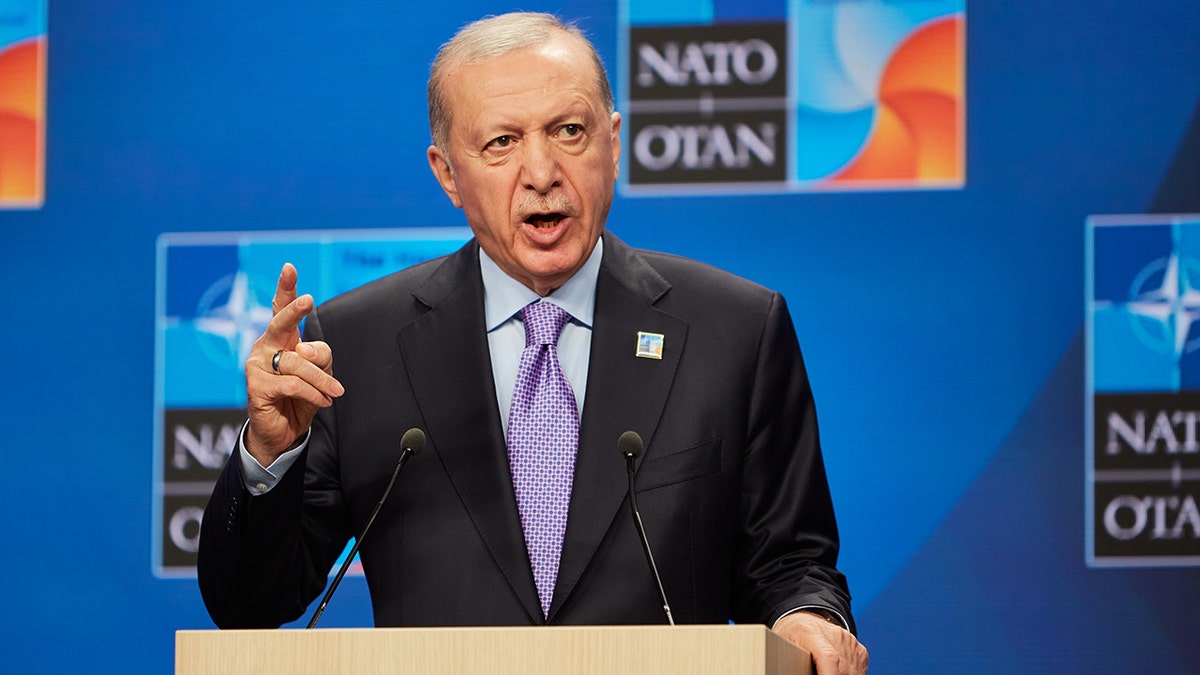
President of Turkey Recep Tayyip Erdogan gives a press conference at the NATO summit on June 25, 2025 in The Hague, Netherlands. This year’s NATO summit, which brings together heads of state and government from across the military alliance, is being held in the Netherlands for the first time. Among other matters, members are to approve a new defense investment plan that raises target for defense spending to 5% of GDP. (Pierre Crom/Getty Images)
Russia’s invasion of Ukraine, instability across the Middle East and the collapse of Bashar al-Assad’s regime in Syria have only heightened Turkey’s strategic value, analysts say.
Jeffrey argued Turkey “has been essential to Ukraine staying in the fight,” citing Ankara’s enforcement of the 1936 Montreux Convention, which prevented additional Russian naval reinforcements from entering the Black Sea, its early provision of Bayraktar drones to Kyiv and its role as an intermediary between Ukraine and Russia.
“You can’t contain Russia in the Black Sea without Turkey,” Jeffrey said.
The collapse of Bashar al-Assad’s regime also has brought Washington and Turkey into closer strategic alignment after years of disagreements over Syria.
Jeffrey argued Turkey played a central role in backing the opposition that ultimately toppled Assad, dealing a major blow to both Iran and Russia.
“One of Iran’s big losses in the past three years has been Syria—and that’s all Erdogan,” he said.
Not everyone is convinced Turkey’s growing strategic value should outweigh those concerns.
Critics argue Turkey’s foreign policy has increasingly diverged from that of many NATO allies under Erdoğan. They point to Turkey’s vocal support for Hamas following the Oct. 7, 2023, attacks on Israel, its continued possession of the Russian-made S-400 air defense system, and its efforts to deepen ties with non-Western blocs such as BRICS and the Shanghai Cooperation Organization, organizations in which China and Russia play leading roles.
“Turkey is the only member country inside of NATO that has applied for membership in entities such as the Shanghai Cooperation Organization and BRICS,” Sinan Ciddi, senior fellow at the Foundation for Defense of Democracies, said during a press briefing Wednesday. He also argued Turkey is unique within the alliance in openly supporting Hamas while seeking expanded access to advanced U.S. defense technology.
Erdoğan repeatedly has defended Hamas and rejected efforts to classify the group as a terrorist organization, putting Turkey at odds with Washington and many other NATO allies. Critics argue that position complicates efforts to deepen U.S.-Turkey defense ties — despite Trump’s personal affection for the Turkish leader.
“The only thing that really stands in the way against Erdoğan’s wishes is essentially the United States Congress,” Ciddi said.
The Trump administration faced congressional pushback, largely from Democrats, over its decision to move forward with a $700 million arms sale to Turkey.
The administration already has faced congressional pushback over the proposed $700 million arms sale.
Rep. Gregory Meeks, the top Democrat on the House Foreign Affairs Committee, accused the State Department of failing to justify the decision or adequately address concerns about Turkey’s continued possession of the Russian-made S-400 system.
The Turkish embassy could not immediately be reached for comment.
CLICK HERE TO DOWNLOAD THE FOX NEWS APP
Jeffrey said the proposed $700 million sale of F110 fighter engines is a more manageable issue than restoring Turkey to the F-35 program, arguing the latter remains constrained by the S-400 because operating the Russian air defense system alongside America’s most advanced stealth fighter could compromise sensitive technology.
“The F-35 is a different issue,” Jeffrey said, arguing that operating the Russian-made S-400 alongside America’s fifth-generation fighter presents a technical — not merely political — problem because it could expose sensitive U.S. technology.