




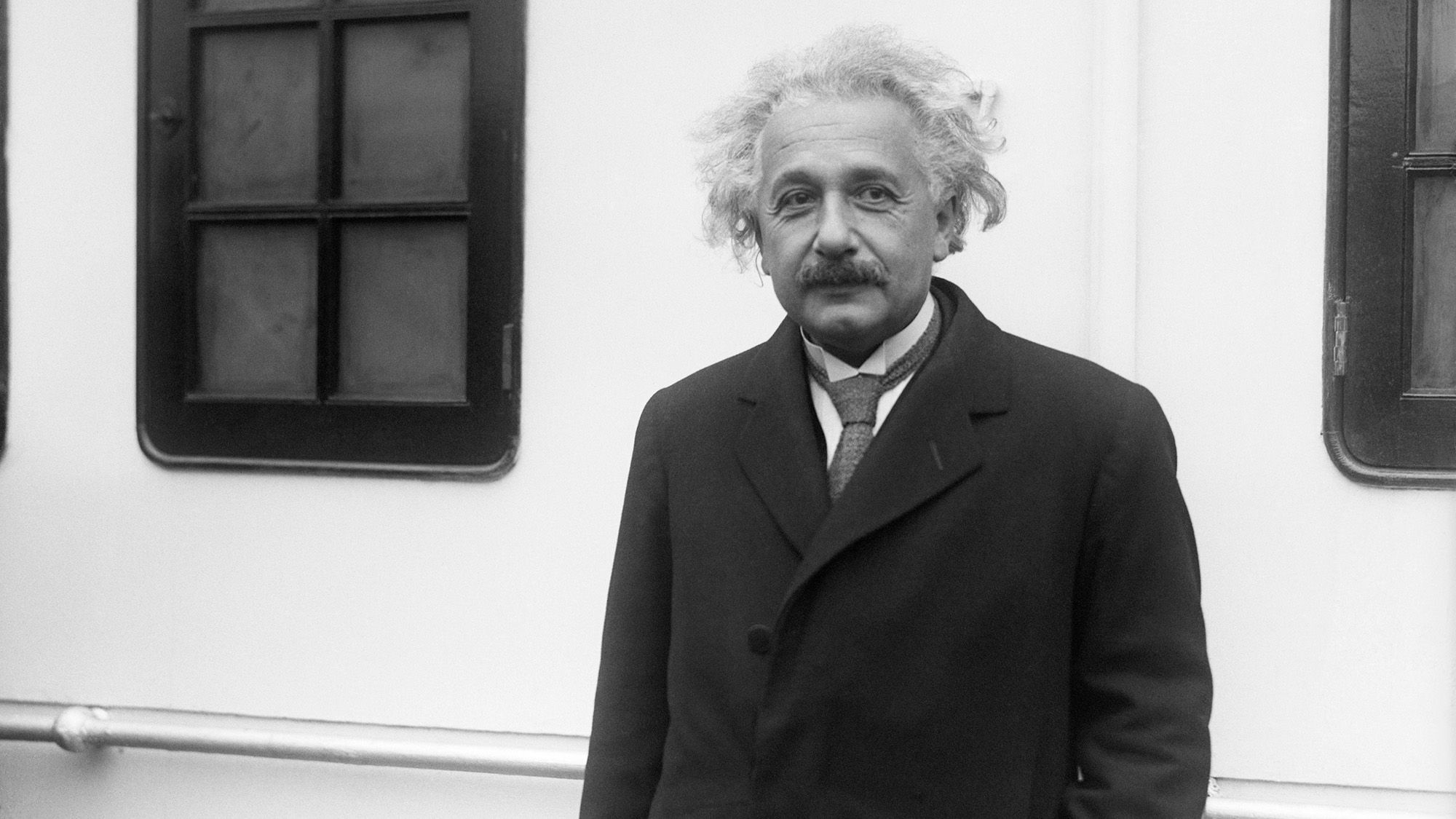
Albert Einstein gave us the theory of relativity, explained the photoelectric effect and predicted the existence of gravitational waves. He revolutionized our understanding of space, time and gravity.
In fact, he is so famous for his brilliance that “Einstein” is synonymous with “genius.” But being a genius doesn’t mean you’re infallible. So was Einstein wrong about anything?
“For sure, he was wrong about tons of things,” Nicolás Yunes, a theoretical physicist at the University of Illinois Urbana-Champaign, told Live Science. “We remember him for the things he was right about, for the most part, because the things he was right about shocked the scientific world and eventually those ripples affected everyone on Earth.”
Sign up for our newsletter
(Image credit: Marilyn Perkins / Future)
Sign up for our weekly Life’s Little Mysteries newsletter to get the latest mysteries before they appear online.
For example, one of his most famous predictions was marred by a mathematical mistake. In 1916, Einstein correctly realized that the acceleration of matter could produce ripples in space-time that we now call gravitational waves. But when he and the physicist Nathan Rosen described these waves using mathematics, they ran into a problem: Any solution to the equations of general relativity that would allow for gravitational waves “blew up,” Yunes said. “They had these singularities … these divergences. And solutions that diverge and explode like that, they can’t be physical representations of reality.”
As a result, Einstein changed his mind and decided that gravitational waves couldn’t exist. He wrote up his results and submitted them to the journal Physical Review, which had recently begun sending papers to outside experts for peer review. An anonymous reviewer caught an error in Einstein’s math, and when Einstein learned about it, he was so furious that he withdrew the paper and submitted it to a different journal.
But the reviewer had spotted a real error: Einstein’s mathematical infinities were a coordinate artifact. Much like Earth’s lines of longitude seem to converge to a “singularity” at the North Pole even though nothing unusual is happening there on the ground, Einstein’s math could have been fixed by using a different set of coordinates.
Without Einstein’s knowledge, the reviewer befriended and demonstrated the error to Einstein’s assistant, who explained it to Einstein. Einstein corrected the error and republished the paper with the opposite conclusion, showing that gravitational waves do, in fact, exist.

Einstein originally thought that gravitational waves existed, then changed his mind when the math didn’t work out. However, an anonymous peer reviewer named Howard Percy Robertson managed to secretly help Einstein fix his mathematical errors.
(Image credit: MARK GARLICK/SCIENCE PHOTO LIBRARY via Getty Images)
Calculating “impossible infinities”
Remarkably, Einstein stumbled on the same error twice — at least, it seemed that way. When examining the mathematics around black holes, he once again calculated impossible infinities — this time, at the edge of a black hole. And once again, he concluded that this must mean the object couldn’t exist.
“Einstein remained skeptical of the existence of black holes,” John D. Norton, a professor in the Department of History and Philosophy of Science at the University of Pittsburgh, told Live Science in an email. “He was resolute in his judgment that there would be a singularity in space-time already at the event horizon of a black hole, which is now merely regarded as marking the point of no return for those falling into a black hole.”
But this time, Einstein was not convinced that he made a mistake. Norton argues this wasn’t just stubbornness; it reflected a philosophical belief in how Einstein thought mathematics and physics should relate to each other.
“He was unmoved by alternative analyses that found his mathematical infinities to be merely artifacts of the particular mathematical methods he preferred,” Norton said.

Einstein was skeptical of the existence of black holes (pictured here in a 3D render) because his math showed a breakdown in space-time at a black hole’s edge.
(Image credit: Cavan Images / Luca Pierro via Getty Images)
Einstein and quantum mechanics
Einstein’s resistance to quantum mechanics is probably his most famous wrong turn. His central objection was to a phenomenon called quantum entanglement: the idea that two particles can be linked in such a way that measuring one instantly affects the other, no matter the distance between them. In a 1947 letter to his colleague Max Born, he wrote, “I cannot seriously believe in it because the theory cannot be reconciled with the idea that physics should represent a reality in time and space, free from spooky actions at a distance.”
Einstein thought this instantaneous phenomenon seemed to violate special relativity, which says that nothing can travel faster than light. As a result, he believed quantum mechanics must be incomplete and that there was some deeper, unknown description of reality that would restore order.
“He died not liking quantum mechanics,” Yunes said. It wasn’t until 1964, almost a decade after Einstein’s death, that John Bell proved entanglement was real.
“Today, a lot of the technology that we have relies on quantum mechanics, and so we know it’s correct,” Yunes said. “But it’s still incompatible with general relativity, with [Einstein’s] classical theory.”
“It’s possible that general relativity is wrong,” Yunes said. “It’s also possible that quantum mechanics is not the right description when you’re talking about systems that are very strongly gravitating and you’re looking at Planck-scale-type dynamics,” which are incredibly small scales at which quantum effects dominate. For instance, the center of a black hole, which is both compressed to the quantum scale but also sits inside the most intense gravitational field in the universe, is a place where general relativity predicts a singularity that quantum mechanics has no way to describe.
But many of Einstein’s mistakes still moved science forward. “General relativity is a good example,” Norton said. “Einstein based it on the idea that he was generalizing the principle of relativity to acceleration and on what he soon called Mach’s principle. Neither proved compatible with his final general theory of relativity.”
Einstein’s mistakes might come as a surprise to others, but they didn’t to him. Once, when writing a book with his collaborator Leopold Infeld, Infeld told him he was taking special care with it because Einstein’s name would appear on it. Einstein laughed and said, “There are incorrect papers under my name, too.”
See how much you know about Albert Einstein with our Einstein quiz!
TOPICS