




The risk of malaria influenced where prehistoric people lived in sub-Saharan Africa, a new study suggests.
The research is the first to link early human habitation with the deadly disease and contrasts with early assumptions that prehistoric people migrated to different regions mainly for agricultural reasons.
“For a long time, it was thought that infectious diseases only really became a problem with the advent of farming, and this was particularly true of malaria,” study co-author Eleanor Scerri, an archaeological scientist at the Max Panck Institute of Geoanthropology in Germany, told Live Science in an email.
But the study by Scerri and her colleagues, published April 22 in the journal Science Advances, suggests that humans have avoided settling in areas with a high risk of malaria for more than 70,000 years.
“Our work shows that we can no longer ignore diseases in the deep human past,” she said. “They don’t just have a small effect, they have — in the case of malaria, at least — transformative impacts that have helped to shape who humans are today.”
Malaria risks
The study authors used data from earlier studies to reconstruct the climate of sub-Saharan Africa over the past 74,000 years in intervals of between 1,000 and 2,000 years.
Then, they calculated a “malaria stability index” for each area at every step, based on modern epidemiological data and the likelihood that an area contained habitats for the Anopheles genus of mosquito. The bites of female Anopheles mosquitoes transmit the parasite Plasmodium falciparum to humans, which causes malaria.
By comparing this index to maps of early human settlements, the authors showed that prehistoric hunter-gatherers in sub-Saharan Africa had actively avoided high-risk malaria hotspots. The researchers said that this behavior, in turn, helped determine human population structures by at least 13,000 years ago — several thousand years before the introduction of farming.
“The key message from our paper is that malaria was already a bit of a problem before agriculture,” study co-author Andrea Manica, an evolutionary ecologist at the University of Cambridge, told Live Science. But “it likely became even worse after people became sedentary and settled at high density as a consequence of food production.”
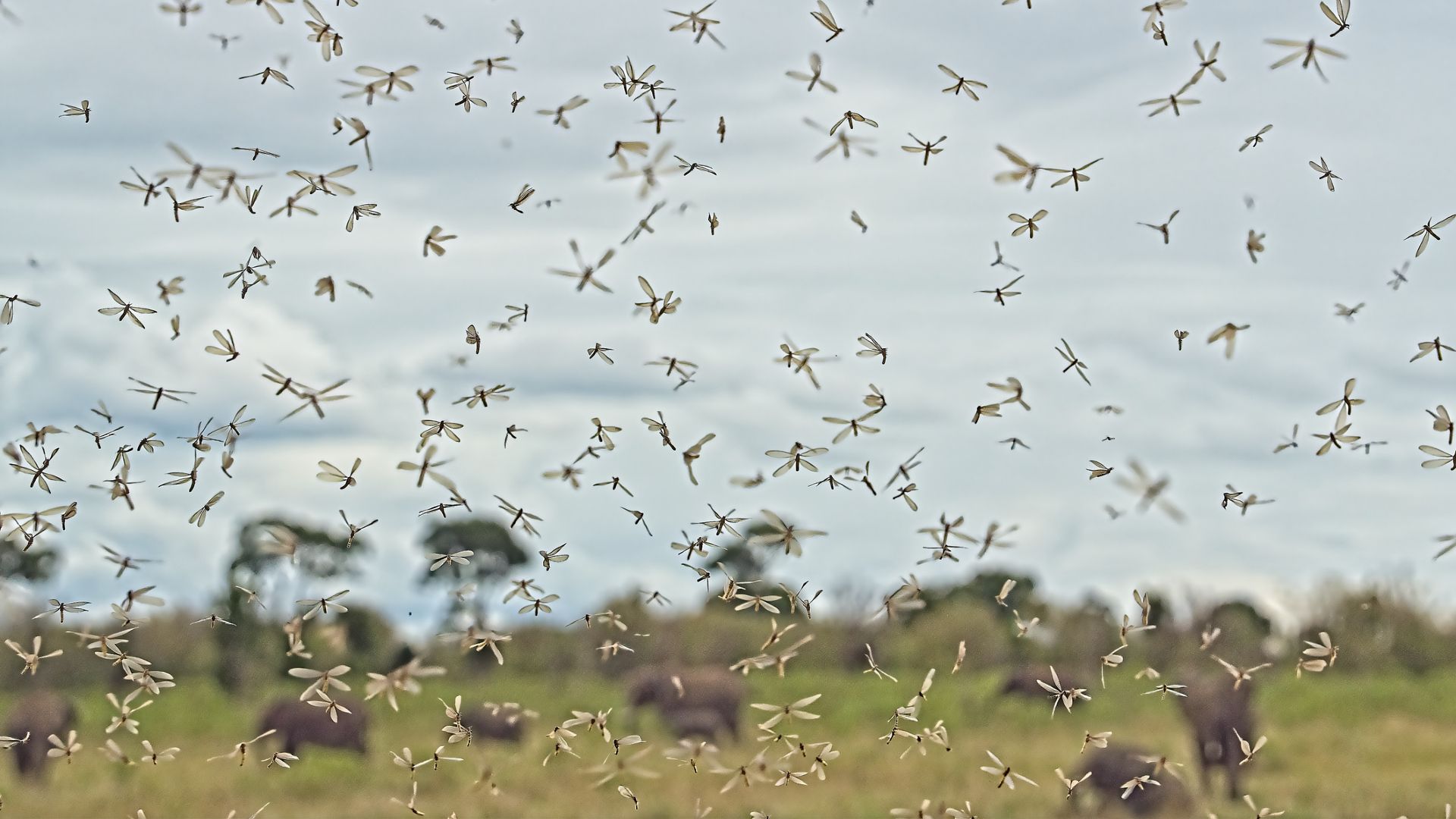
Mosquitoes in the genus Anopheles can carry the parasite that causes malaria.
(Image credit: Paul Starosta via Getty Images)
The study suggests that Central West Africa was hardest hit, he added, and the region remains a malaria hotspot today.
“Archaeology in Central West Africa is limited, but a number of findings agree with a view that populations in this area were highly fragmented,” Manica said.
Malaria hotspots
The study is the first to suggest that the locations of prehistoric human settlements were influenced by the risk of disease, rather than just changes in the climate — although both rainier and warmer weather would have encouraged populations of disease-carrying Anopheles mosquitoes.
“The role of disease in the deep human past, particularly in the earliest, African phases of our species’ prehistory has not been well investigated because we lack ancient DNA from those time periods,” Scerri said.
But the new study showed how the lack of evidence could be overcome. “We have developed a pipeline that is capable of exploring a number of vector-borne diseases,” Scerri said. “It’s an exciting breakthrough and we hope it will open up a new field of inquiry.”
“We have shown that it is possible to track a disease back in time and assess its potential impact on past inhabitation,” Manica added. “The next phase is to start exploring other diseases besides Plasmodium falciparum to see their role.”
Simon Underdown, a biological anthropologist at Oxford Brookes University in the U.K., who was not involved in the new study, said he agreed with the study’s conclusions.
“Disease has always been with us, and it actually shaped what humans could do, where humans could move,” he told Live Science.
Colucci, M., Leonardi, M., Blinkhorn, J., Irish, S. R., Padilla-Iglesias, C., Kaboth-Bar, S., Gosling, W. D., Snow, R. W., Manica, A., & Scerri, E. M. L. (2026). Malaria shaped human spatial organization for the past 74 thousand years. Science Advances, 12(17), eaea2316. https://doi.org/10.1126/sciadv.aea2316
See how much you know about early humans with our human evolution quiz!