




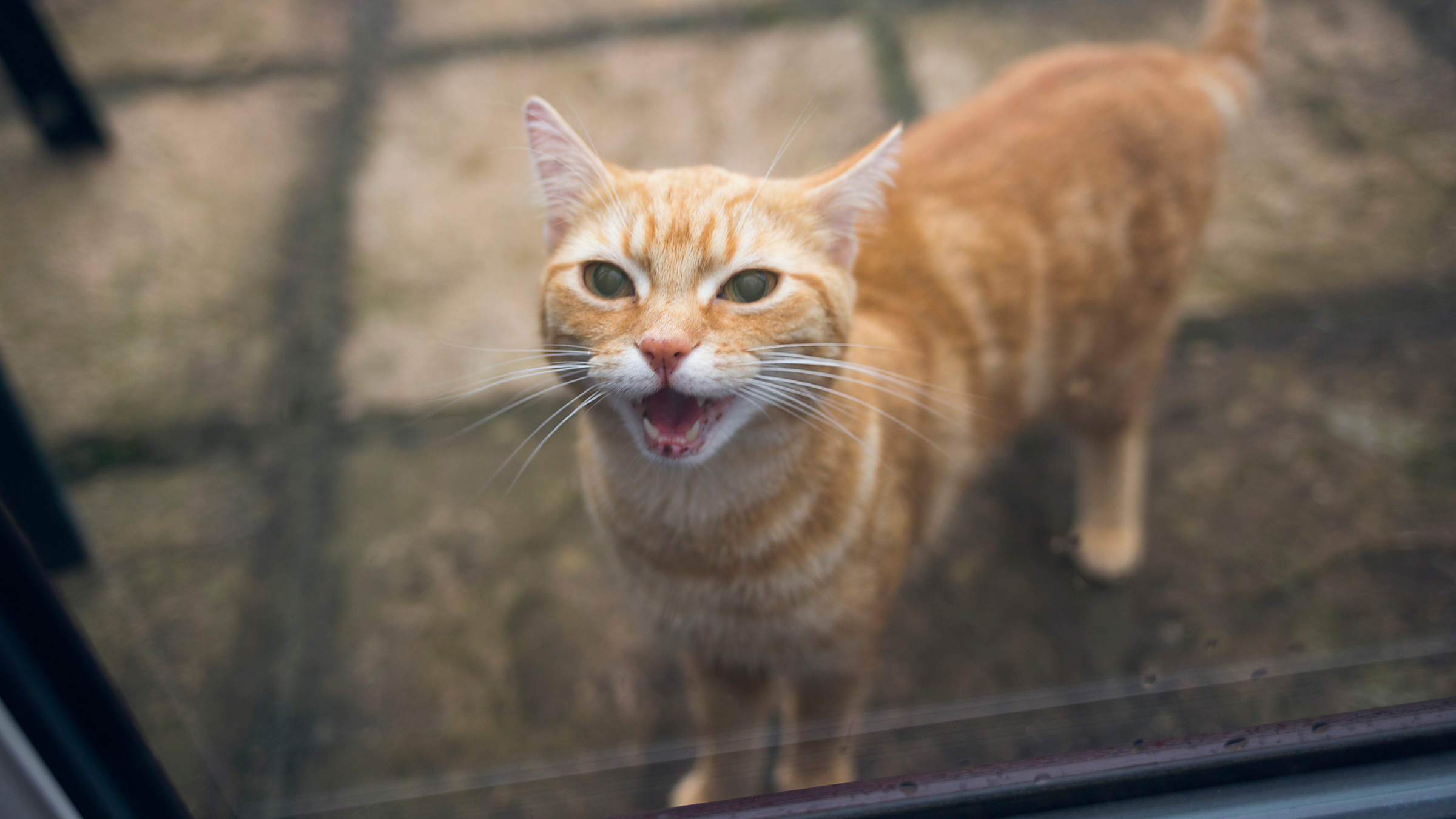
If you’ve ever been jolted awake by your cat letting out a long, mournful cry in the middle of the night, your sleep-deprived brain may wonder why, exactly, your cute little pet yowls all the time.
The answer isn’t as simple as “they want food” or “they’re being dramatic.” The sound people commonly call a yowl can actually mean very different things depending on the situation, and even cat behavior experts don’t always agree on exactly what qualifies as a yowl.
In veterinary medicine, the term often refers to loud, harsh vocalizations associated with aggression or mating between cats. But many pet owners use “yowling” to describe almost any loud cry their cat makes at home, she said.
Latest Videos FromLive Science
That distinction matters, because context is often the biggest clue to what a cat is trying to communicate.
“If you’re talking about a yowl in the strict sense, it’s usually linked to a strong negative emotional state,” said Charlotte de Mouzon, a cat behavior researcher and ethologist at Paris Nanterre University in France. “It represents an emotion that is intense and negative.”
In other words, a true yowl is less like casual conversation and more like an emotional alarm bell.
An ancient warning system
That alarm bell may be older than the house cat (Felis catus) itself and likely predates domestication entirely, said Jay Schwartz, a professor of psychological sciences and head of the Evolution of Emotional Communication Lab at Western Oregon University.
The same vocalization shows up in the African wildcat (Felis lybica), the domestic cat’s closest living relative that has been around far longer than our living room tigers — meaning cats were yowling at rivals long before they ever curled up on a human’s couch, he told Live Science in an email.
Territorial vocalization of this kind is common across the animal kingdom, from a chickadee’s warning whistle to a howler monkey’s booming roar, Schwartz said. Establishing and defending territory is tied to food, safety and mating opportunities, so animals evolved loud, unmistakable signals to defend it without resorting to physical fights every time.
A yowling cat squaring off with a neighborhood rival, in other words, is running a very old evolutionary script.
Cats may yowl in altercations with other cats.
(Image credit: Turnip Towers via Alamy)
Fear, conflict and distress
Beyond territory, cats may yowl when they’re frightened, cornered or trying to make another animal, or person, back off.
“If someone approaches a cat that’s yowling, I would think that cat is saying, ‘Please don’t come any closer,'” said Katherine Anderson, a board-certified veterinary behaviorist at the Cornell Duffield Institute for Animal Behavior at Cornell University.
The same vocalization can happen during stressful situations, such as a trip to the veterinarian, when a cat is restrained, or during conflicts with other cats. Female cats in heat may also produce loud yowls, as can males competing for mates, Anderson told Live Science.
While humans often interpret these cries as a cat “screaming,” de Mouzon said they’re best understood as expressions of intense emotional distress. Sometimes the vocalization is directed at another individual, while other times it’s simply an outward expression of the cat’s emotional state — not necessarily a conscious plea for help.
Sign up for our newsletter

(Image credit: Marilyn Perkins / Future)
Sign up for our weekly Life’s Little Mysteries newsletter to get the latest mysteries before they appear online.
Cats have learned that humans listen
Not all loud vocalizations are classic yowls, however. Cats have an impressive repertoire of sounds, and many of the noises owners hear every day are part of a unique form of communication that developed alongside humans.
Adult cats rarely meow to one another in natural settings. Instead, meowing is mostly reserved for kittens communicating with their mothers. Domestic cats appear to have retained this juvenile behavior into adulthood and redirected it toward people, de Mouzon said.
Schwartz noted that African wildcats also meow, but in a harsher, more yowl-like way than domestic cats do, and typically during conflict with other cats. One hypothesis for why the domestic cat’s meow softened over generations is that it happened to share acoustic similarities with a human infant’s cry, making nearby humans instinctively more responsive to it.
“They learn that meowing is useful for communicating with humans because it gets our attention,” de Mouzon said.
Anderson agrees that cats have become remarkably skilled at shaping human behavior. “I think they learn our behavior faster than we learn theirs,” she said. “They can train us much easier than we can train them.”
That learning goes both ways. If a cat cries at 5 a.m. and its owner immediately fills the food bowl, the cat quickly learns that vocalizing produces results. Over time, the behavior may become more frequent — not because the cat is trying to be annoying, but because it has learned that the strategy works.
Why “yowl” is such a slippery word
Part of the confusion around yowling may come down to how humans classify sounds in the first place. In a 2025 study published in the journal Animal Behaviour, Schwartz’s lab had participants listen to audio clips of cat vocalizations pulled from online sources and sort them into categories like meows, chirps and yowls.
Some categories were easy to define — clips people labeled “chirps,” for instance, were consistently short and high-pitched. Yowls were a different story. The clips people called yowls varied wildly in pitch and length, and listeners agreed with each other less on what counted as a yowl than on almost any other vocalization type.
Schwartz suspects that’s because people aren’t classifying yowls by acoustic features at all — they’re classifying them by the emotion they perceive. If a sound comes across as distressed or upset, listeners are likely to call it a yowl, regardless of its pitch or duration. It’s similar to how a person might describe someone as having “yelled” versus “shouted” based on the emotional tone they picked up on.
That fuzziness may explain why familiarity with an individual cat matters so much. A 2015 study found that owners were fairly accurate at identifying the context behind their own cat’s vocalizations but far less accurate when listening to a cat they didn’t know.

Cats may learn that vocalizing produces results, like getting human attention or food.
(Image credit: Andrzej Rostek via Alamy)
When yowling could signal a health problem
Although vocalization is often perfectly normal, a sudden increase in loud crying, especially in an older cat, can sometimes point to an underlying medical condition.
Two of the most common concerns veterinarians consider are hyperthyroidism, which causes excessive thyroid hormone production, and cognitive dysfunction syndrome, a form of age-related cognitive decline similar to dementia in humans. Both conditions commonly cause nighttime vocalization.
Age is one of the first things Anderson considers when owners report excessive yowling. Cats may also vocalize because they’re anxious, experiencing separation-related distress or in pain.
Rather than focusing on the sound alone, veterinarians recommend looking at the whole picture, such as when the vocalization is happening, and changes to the cat’s routine.
They’re not trying to spite you
One of the biggest misconceptions Anderson encounters is the idea that cats vocalize or engage in other unwanted behaviors to punish their owners.
“I don’t think I’ve ever had a case where I’m like, ‘Yep, that was spite,'” she said.
Instead, behaviors that frustrate owners usually have simpler explanations. A cat that cries constantly may have learned that vocalizing earns food or attention. Another may be fearful, anxious or experiencing an illness that isn’t immediately obvious.
Cats may not communicate the way humans do, but they’re almost always communicating something. The challenge isn’t getting them to speak, it’s learning how to interpret what they’re already saying.
How much of a cat fan are you? Find out by taking our cat quiz!
TOPICS