




Archaeologists have excavated a perfectly preserved wood-and-wax notebook in a leather satchel from a medieval latrine in Germany. The 10-page notebook, which features Latin cursive writing, was likely dropped by a medieval merchant nearly 800 years ago — possibly while he was wiping with silk toilet paper.
The book and satchel were discovered in the northern German city of Paderborn during construction for a new building, according to a May 12 translated statement from the Regional Association of Westphalia-Lippe (LWL). Archaeologists excavated five medieval latrines that were sealed and airtight, which preserved a number of organic artifacts that would have decomposed otherwise.
“Even after so many centuries in the ground, the latrine find still had a rather unpleasant odor,” Susanne Bretzel, a conservator at LWL, said in the statement.
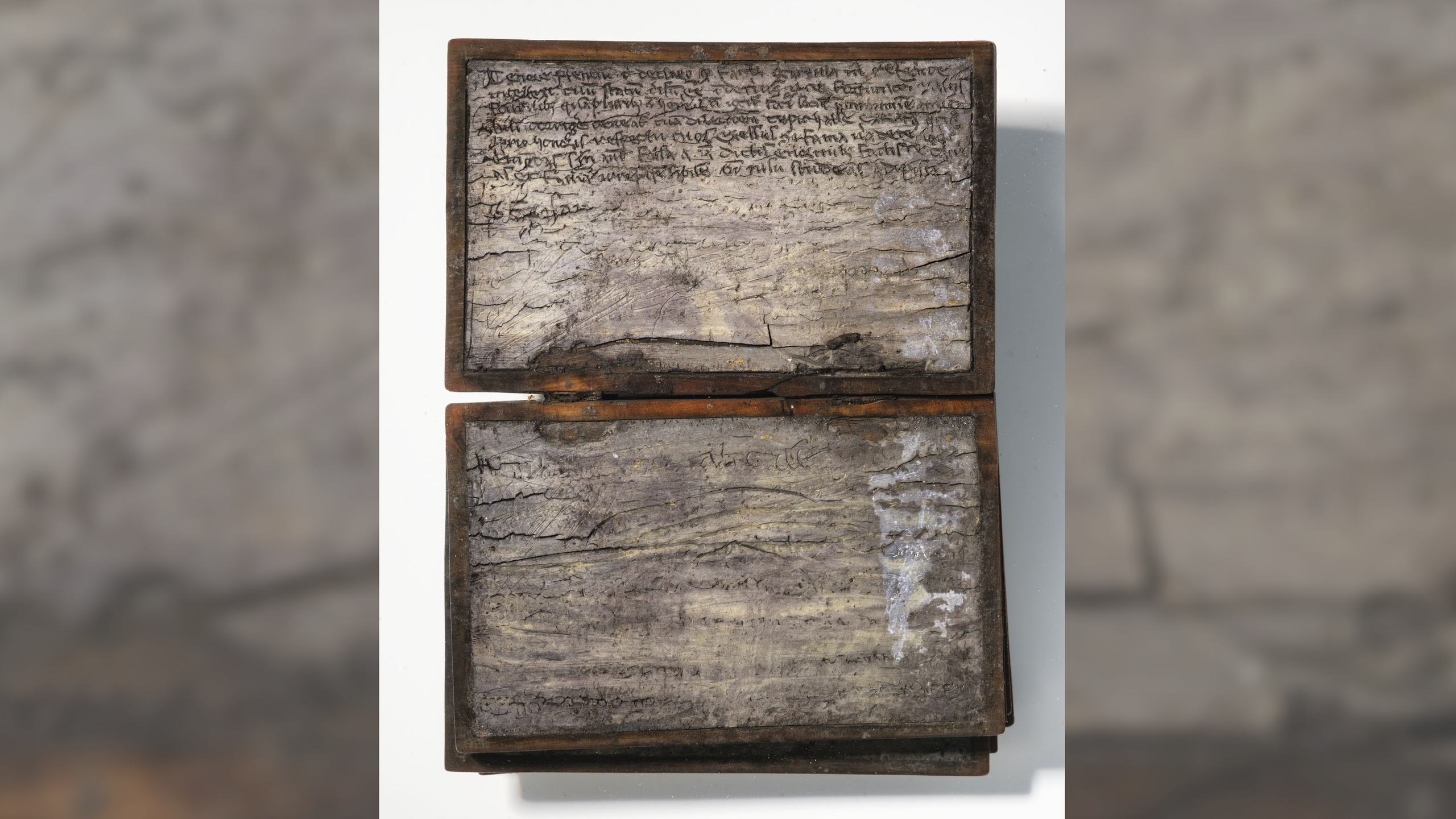
The small notepad measures about 3.4 by 2.2 inches (8.6 by 5.5 centimeters) and was kept in a slightly larger leather case decorated with a fleur-de-lis pattern. Eight pages of the wooden notebook are double-sided, and two are single-sided; all contained wax that could be written in with a stylus.
Inside the notebook, experts found numerous lines of cursive Latin text, some of which had been written over other lines and in different directions, making it difficult to translate.
“Individual words are recognizable, but the transcription will take some time, as some words may have been corrupted by incorrect spellings,” Barbara Rüschoff-Parzinger, an archaeologist and head of cultural affairs at LWL, said in the statement. Based on the characteristics of the script, the book was used between the 13th and end of the 14th centuries.
The tablet was discovered in a leather satchel with a fleur-de-lis decoration.
(Image credit: S. Bretzel/Landschaftsverband Westfalen-Lippe (LWL))
The leather case is also being studied. The embossed fleur-de-lis decoration may suggest the book was a prized possession of an elite member of society, as the lily was a symbol of royal power and divine favor in the Middle Ages, according to the statement.
But the notebook’s owner is still a mystery. “A Paderborn merchant may have been the author, jotting down business transactions and recording his thoughts,” Sveva Gai, the LWL city archaeologist in Paderborn, said in the statement. Unlike most people in this time period, merchants were educated and could read and write, making them among the elite of society, Gai said.
Other artifacts found in the latrines included barrels, a knife, stoneware pottery, pieces of baskets and fragments of silk fabric. These finds help confirm the 13th-to-14th-century date of the book and the elite status of the book’s author.

Conservator Susanne Bretzel holds the small wax booklet.
(Image credit: E. Daood/Landschaftsverband Westfalen-Lippe (LWL))
“The silk fabric remnants from the latrine were partially torn into rectangular pieces, some extremely finely woven and decorated,” Bretzel said. “Perhaps this was used as toilet paper after the once-elegant fabric was to be discarded.”
Further research may be able to identify the bumbling merchant who accidentally jettisoned his notebook into the toilet.
“As soon as this latrine can be assigned to a specific plot of land, archival research could be used to try to identify the residents of that plot. Then, in the best-case scenario, it would be possible to link the wax tablet to the name of a specific person,” Gai said.
The entire conservation process could take up to a year, Bretzel said, after which the notebook and case will be exhibited at the LWL Museum in Paderborn.
See if you know what these mysterious artifacts are with our archaeological fragments quiz!