



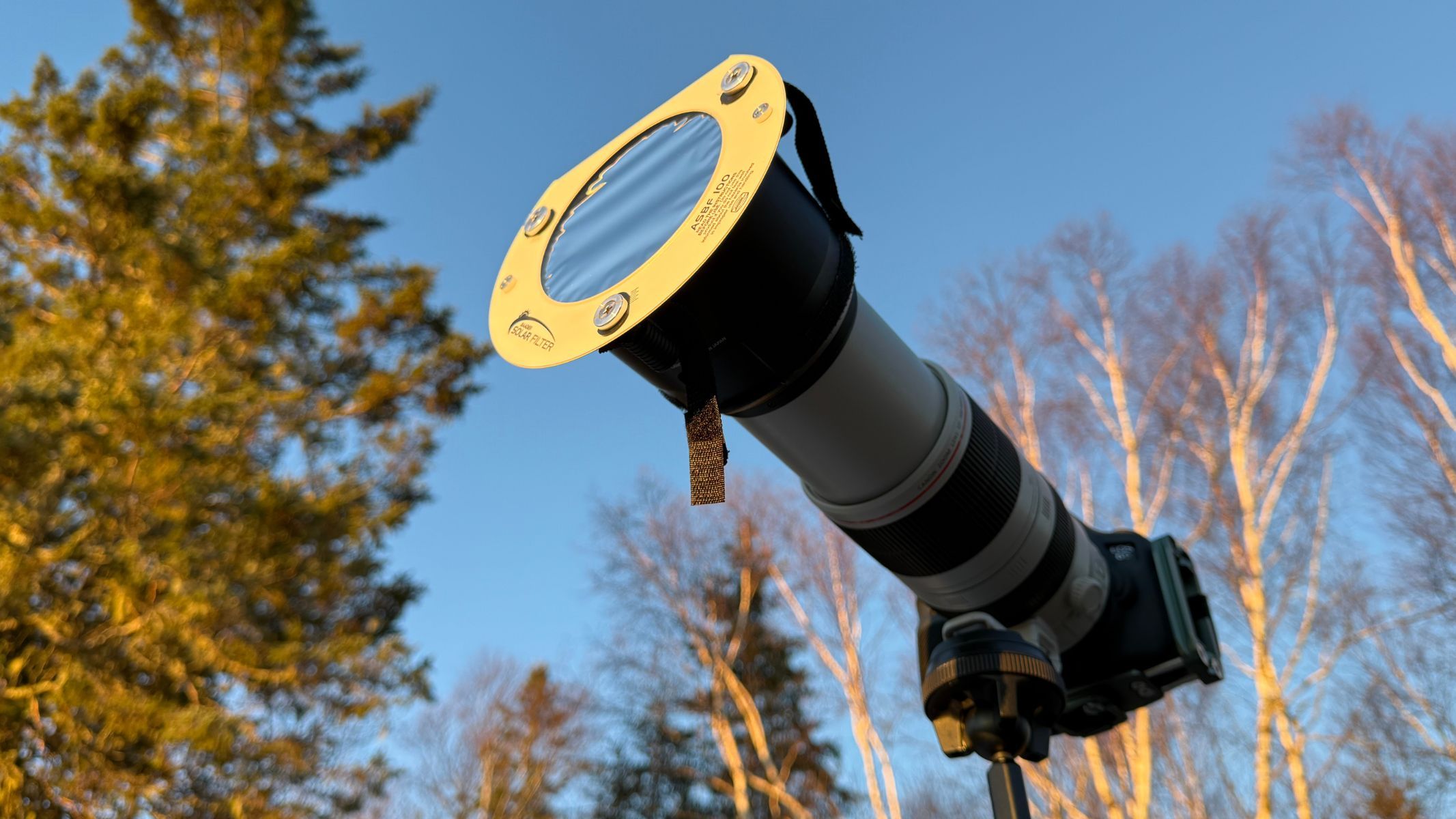
Baader AstroSolar Filter Film OD 5.0 is one of those “secret” astronomy products that looks almost too simple to be special. In its most familiar form, it’s a thin, silvery A3 or A4 sheet of metalized film that can be cut and mounted in cardboard, plastic or commercial filter cells. Surely it’s better to have a pre-made filter for your camera? Go to any solar eclipse, and you’ll get your answer: experienced eclipse photographers, solar observers and anyone wanting to safely point a camera or binoculars at the sun very often rely on Baader AstroSolar Filter Film OD 5.0.
Its popularity does not come from its ruggedness nor its out-of-the-box convenience. Whether bought as a loose sheet for making filters or as ready-made Baader solar filters for binoculars, camera lenses and telescopes, it enables super-sharp captures of sunspots on the sun, allowing much faster shutter speeds than some rival solar filter materials.
Although a brighter Baader AstroSolar Filter Film OD 3.8 Photo Film is also available (which is not designed for visual use), this review focuses on the Baader AstroSolar Filter Film OD 5.0, both as a practical DIY filter material and as the core of ready-made solar filters.
Baader AstroSolar Filter Film OD 5.0: Design
Image 1 of 2
(Image credit: Jamie Carter)

(Image credit: Jamie Carter)


- Thin and delicate
- Perfect for crafting homemade solar filters
- Available as A4 and A5 sheets and ready-made filters
The defining feature of Baader AstroSolar Filter Film is how little there is to it. The film is extremely thin — around 0.01 mm — and feels much more fragile than tougher solar polymer materials. That can be disconcerting the first time you handle it. It wrinkles easily, but should never be pulled tight. However, initial fears are misplaced because a good homemade solar filter does not require the film to be flat. In fact, it should be mounted slightly slack, because wrinkles and ripples in the filter material actually improve the image.
The real design advantage is that AstroSolar Film is hugely versatile and can be cut to suit almost anything. A single sheet can be used to make a front filter for a telephoto lens or two, as well as for a couple pairs of binoculars. Any filter must always go over the front of the optics, never behind them. For binoculars, make a filter for one objective lens for safe one-eyed viewing and securely cap the other.
Key specifications:
Product type: AstroSolar Safety Film OD 5.0 solar filter film
Material: Metalized film
Thickness: Around 0.01 mm
Light reduction: OD 5.0 blocks 99.999% of visible sunlight
Solar color: Neutral white
Formats: Loose sheets and pre-made filters
The film is sold as a loose sheet of material for DIY use in four sizes: ECO (140×155 mm/5.5×6 in), A4 (20×29 mm/8×12 in), 100x50mm/40×20 in, and Giant (117×117 mm/46×46 in). Also sold are the ASTF: AstroSolar Telescope Filter OD 5.0 (80-280mm), ASSF: AstroSolar Spotting Scope Filter OD 5.0 (50-150mm) and ASBF: AstroSolar Binocular Filter OD 5.0 (50-100mm). All come in multiple sizes.
They are, of course, neater and more durable than homemade cardboard versions, but the optical principle is exactly the same. Besides, the loose sheet version is more attractive if you have several lenses or binoculars to cover, or if you want to make a filter that precisely fits a specific lens hood.
Get the world’s most fascinating discoveries delivered straight to your inbox.
Baader AstroSolar Filter Film OD 5.0: Performance
Image 1 of 2

(Image credit: Jamie Carter)

(Image credit: Jamie Carter)


- Sharp solar detail
- Neutral white color
- Suits cameras and binoculars
Although its versatility makes it unusual, making DIY solar filters won’t be for everyone. However, the main reason to choose Baader AstroSolar Filter Film is for its image quality. When used correctly, it produces a sharp, high-contrast, white-light view of the sun. Sunspots appear cleanly defined, the solar limb looks crisp and the image has a neutral white tone, rather than the deep orange produced by some polymer filters.
That white rendering will not be to everyone’s taste. Casual eclipse watchers often expect the sun to look orange through solar filters because that is how it often appears through eclipse glasses and some glass or polymer solar filters. Baader’s version is a lot more clinical. For photographers, however, that is an advantage. A neutral white solar disk is easy to warm up later in editing, while a heavily colored orange image gives a little less flexibility. It all depends on your point of view.
The sharpness advantage comes from the fact that it allows shorter exposures, something that becomes more obvious as the focal length increases. In a short-lens or wide-field composition, the sun is small, so differences between filter materials are less obvious.
On a 400mm, 500mm or 600mm lens, where sunspots and the edge of the solar disk matter more, Baader AstroSolar Film OD 5.0 shows why it has such a strong reputation among eclipse photographers. In our tests at 400m set to f/8 and ISO 100, we found that exposures of 1/800s and 1/1,000s achieved the best results.
Image 1 of 4

(Image credit: Jamie Carter)

(Image credit: Jamie Carter)

(Image credit: Jamie Carter)

(Image credit: Jamie Carter)
It also works well with binoculars. In fact, we’ve been traveling to watch solar eclipses using the same DIY solar filter fashioned from Baader AstroSolar Film OD 5.0 for a decade. Over the years, it’s been reinforced with plastic tape to extend its lifespan. It turns a pair of 10×50 binoculars into a safe solar-viewing instrument for the partial phases of an eclipse (just remember to cap the non-filtered lens).
The use of Baader AstroSolar Film is, of course, solely for capturing the partial phases of a solar eclipse, allowing safe imaging of the shrinking solar crescent. If you’re in the path of totality and about to watch a total solar eclipse, you’ll need to gently remove the filter when it gets dark.
That makes a homemade slip-on filter particularly attractive: it can be designed to slide off quickly, avoiding the fiddly delay of unscrewing a hot, threaded plastic or metal filter during the brief moments of totality. It’s wise to have an empty shirt pocket ready to take that filter for the few minutes of totality, which will keep it safe until the post-totality partial phases a few minutes later.
Baader AstroSolar Filter Film OD 5.0: Functionality
Image 1 of 2

(Image credit: Jamie Carter)

(Image credit: Jamie Carter)


- Easy to use for DIY projects
- Works across many optical devices
- Safety checks required
If you buy a solar filter that uses Baader AstroSolar Filter Film OD 5.0, you have an excellent product that requires care when traveling and storing. If you purchase it as a sheet of material, it requires some time and patience as well as cardboard, tape, glue and scissors to custom-build your own Baader AstroSolar Solar Filter for almost any optical device. That’s a huge advantage over many screw-in photographic filters, which only fit specific thread sizes.
As you’d expect, making a new solar filter for any new gear from an existing sheet of Baader AstroSolar Filter Film is much cheaper than investing in an all-new screw-in photographic filter.
The DIY construction is simple: two cardboard rings sandwich the film, then a short cardboard sleeve fits snugly over the lens hood, binocular objective or telescope tube. The result should be secure enough that it cannot fall off accidentally, but easy enough to remove deliberately. It’s a good idea to have some masking tape handy in your camera bag for added security, particularly if it’s windy and/or the sun is low on the horizon.
Whether your solar filter is pre-made or homemade, it’s important to inspect it before use, especially when using Baader AstroSolar Filter Film. Any holes, tears, or scratches are reasons to stop using the filter.
Should you buy Baader AstroSolar Filter Film?
Buy it if:
✅ You want to make your own solar filters.
✅ You need filters for camera lenses and binoculars.
✅ You want sharp, white-light solar images.
Don’t buy it if:
❌ You want the simplest possible eclipse-viewing option.
❌ You don’t have the patience to craft your own solar filter.
❌ You prefer an orange solar image.
Baader AstroSolar Filter Film OD 5.0 is neither the most robust nor the quickest solution for casual eclipse viewing. Its delicate construction demands careful handling, storage and inspection before every use. For some users, a ready-made polymer or glass filter will be less stressful.
However, for photographers and binocular users, it’s hard to beat. It is light, sharp, adaptable and available in various forms for different solar imaging needs. Its greatest strength is that it allows you to create exactly the filter you need, whether that’s for a 400mm camera lens, one side of a pair of binoculars, a compact travel telescope or any other equipment.
Treat it gently and mount it securely, and Baader AstroSolar Filter Film remains one of the most useful solar filter materials available.