




Yellow fever is appearing in regions that haven’t seen cases of the disease in years, largely as a result of climate change.
Historically, the virus ravaged cities across the Americas, Europe and Africa, until a vaccine was introduced in 1937 and its range shrunk significantly. But now, as climate change creates favorable conditions for virus-carrying mosquitoes, scientists are seeing outbreaks in unexpected areas.
“Yellow fever is a highly deadly disease,” Dr. Joelle Ivy Rosser, an infectious-disease researcher at Stanford University, told Live Science, “so any environmental pressures that increase the likelihood of future yellow fever virus outbreaks … is highly concerning.”
How is climate change contributing to this pattern, and could it get worse in the future?
How rising temperatures impact yellow fever
Yellow fever is a mosquito-borne disease caused by the Orthoflavivirus flavi virus, better known as yellow fever virus (YFV). The infection causes fever, muscle aches, headaches and vomiting. About 15% of cases become severe, with patients showing jaundiced skin and eyes, bleeding from the mouth, eyes, nose and stomach, or organ failure.
Primates, such as howler monkeys, carry the yellow fever virus, which then gets picked up mosquitoes that bite the monkeys and later spread the germ to humans.
(Image credit: CDC)
Devastating yellow fever epidemics spread in the 17th to 19th centuries, before the development of a vaccine. Nowadays, an estimated 31,000 to 82,000 yellow fever deaths occur each year; severe cases have an estimated fatality rate of 20% to 50%.
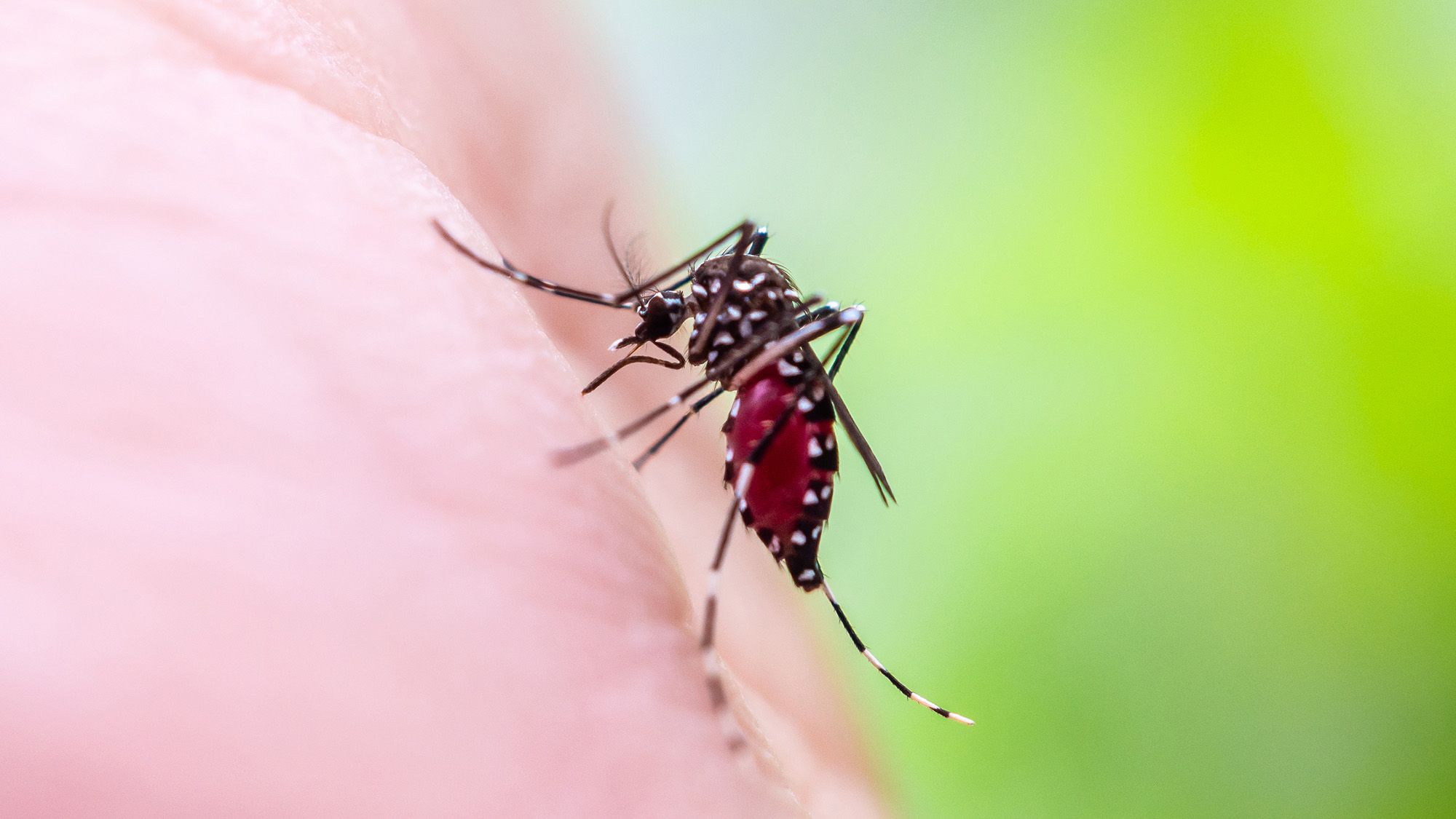
Most yellow fever infections are a result of spillover from nonhuman primates; mosquitoes bite monkeys that carry the virus, such as howler monkeys, and then the infected mosquitoes bite humans. Several types of mosquitoes carry the virus, but the species Aedes aegypti is the main vector for yellow fever in cities, where high population density can make outbreaks especially severe.
Although there is an effective vaccine for yellow fever, cases have been on the rise in the past three decades. This led the World Health Organization (WHO) to set out a strategy in 2017 for eliminating yellow fever epidemics by 2026 through outbreak prevention and containment.
Climate-change-driven warming and extreme weather events may have heightened yellow fever risk over the past few decades, experts say. Rising temperatures make mosquitoes bite more because heat makes their metabolisms more active, said Dr. Seth Judson, an infectious-disease physician-scientist at UCLA. Warming also cuts down the virus’s extrinsic incubation period, meaning the time it takes for the virus to replicate in a newly infected mosquito and then get passed on to another person, he told Live Science.
Weather patterns and deforestation
Changing weather patterns play a role, too. In 2017-2018, Brazil saw its first yellow fever outbreak in a city in almost a century. That outbreak, primarily in Belo Horizonte and São Paulo, was likely a result of drought, according to one study.
Extremes of weather in either direction can exacerbate mosquito-borne disease transmission
Dr. Joelle Ivy Rosser, infectious-disease researcher at Stanford University
While heavy rainfall creates a breeding ground for mosquitoes, in this case, drought pushed forest-based mosquitoes — as well as YFV carriers like marmosets and howler monkeys — closer to cities as the animals searched for water. Drier conditions can also prompt dehydrated mosquitoes to bite more as they search for fluids, study co-author Jamie Caldwell, a disease ecologist at Princeton University, told Live Science.
“Extremes of weather in either direction” — very wet or very dry — “can exacerbate mosquito-borne disease transmission,” Rosser said.
Parts of Africa and South America that were considered low-risk for yellow fever have already been seeing new outbreaks, Judson said, so maps of yellow-fever-affected areas have had to be updated. In research that’s been released as a preprint but not peer-reviewed yet, Judson found that yellow fever is reemerging in an area of the Colombian Andes where it hadn’t been reported since 1940.
Experts are paying particular attention to the edges of cities, where urban centers meet the forest. The risk of yellow fever transmission from monkeys to humans via mosquitoes is rising at these edges due to both climate change and deforestation.
“Humans are expanding the agricultural frontier and encroaching on forests where yellow fever mosquitoes … are found,” Gabriel Parra-Henao, a biologist with the WHO, told Live Science in an email. “[This] results in more people being exposed to their bites.”
Similar patterns have been seen with other mosquito-borne infections, such as malaria.

The yellow fever virus (pictured) is in the family Flaviviridae, which also includes the dengue and Zika viruses.
(Image credit: BSIP via Getty Images)
Could yellow fever return to the U.S.?
Climate change is expected to bring yellow fever to new areas. One study predicts that, under the most severe climate change scenario, nearly a billion people could face their first exposure to the mosquitoes that can carry YFV in the next century. While that worst-case scenario may not be the most likely, the mosquitoes’ ranges are still expected to expand under less-severe conditions.
Europe is predicted to face the largest increase in exposure to Ae. aegypti mosquitoes compared to the rest of the world, and the U.S. and Canada are predicted to see increases too. In the U.S., the mosquito species already lives in a number of states, including Florida, Mississippi, Arizona and New Mexico. However, warming would increase the chances of mosquitoes surviving in locations further north, such as Philadelphia and New York, which suffered major yellow fever outbreaks in the past. One model predicts Ae. aegypti could spread as far north as Chicago by 2050.
I think many people don’t realize that we’re still seeing significant yellow fever outbreaks.
Dr. Seth Judson, infectious-disease physician-scientist at UCLA
Although the mosquito lives in the U.S. already, yellow fever cases are exceedingly rare within the country because the virus is not present in local populations. That’s because of an international campaign that the U.S. spearheaded in the 20th century, which involved researching YFV, eradicating mosquito breeding grounds, and vaccinating people widely.
“If yellow fever virus reestablished itself in our local Aedes aegypti population, then that would be very concerning,” Rosser said.
One way yellow fever could return to the U.S. would be via people carrying the virus home with them after traveling to regions where the disease regularly circulates. Local mosquitoes could then catch the virus by biting those infected people, and then pass it on to others.
For local transmission to take hold, “there needs to be significant numbers of infections [passed to locals], and infections among travelers,” Judson said. “But … it’s in the realm of possibility.”
With climate change driving resurgences of yellow fever in more places, and more regions of the U.S. becoming hospitable to the mosquitoes, that reintroduction scenario may become more likely. But some scientists think that even if North American cities saw yellow fever outbreaks, the outcome would likely not be devastating. Infrastructure in wealthier cities could be the difference between a disaster and a manageable health concern.
“There’s access to medicines and vaccines; we pipe water to our homes, so we don’t have standing water around,” Caldwell said. “So it is a concern, but it’s never going to be the next COVID.”
Other experts noted that diligent surveillance of yellow fever infections can help public health officials prepare. In places where yellow fever is circulating in forest primates, forest conservation can limit contact among humans, wildlife and the mosquitoes that spread diseases among them. It’s also crucial to make vaccines widely accessible to people who live in the virus’s endemic regions and to travelers who visit those regions.
The WHO’s yellow fever campaign is set to conclude at the end of this year, and its next steps are unclear. There’s ongoing discussion of what comes next, Judson said, with questions about whether the control of yellow fever outbreaks will rely more on national strategies than on international coordination via the WHO.
Whatever happens, this is a time for heightened awareness of the virus, Judson said.
“We think of yellow fever as this historic disease,” he said. “I think many people don’t realize that we’re still seeing significant yellow fever outbreaks. … It’s really important to be aware of the risks and think about how we prepare for that.”
This article is for informational purposes only and is not meant to offer medical advice.