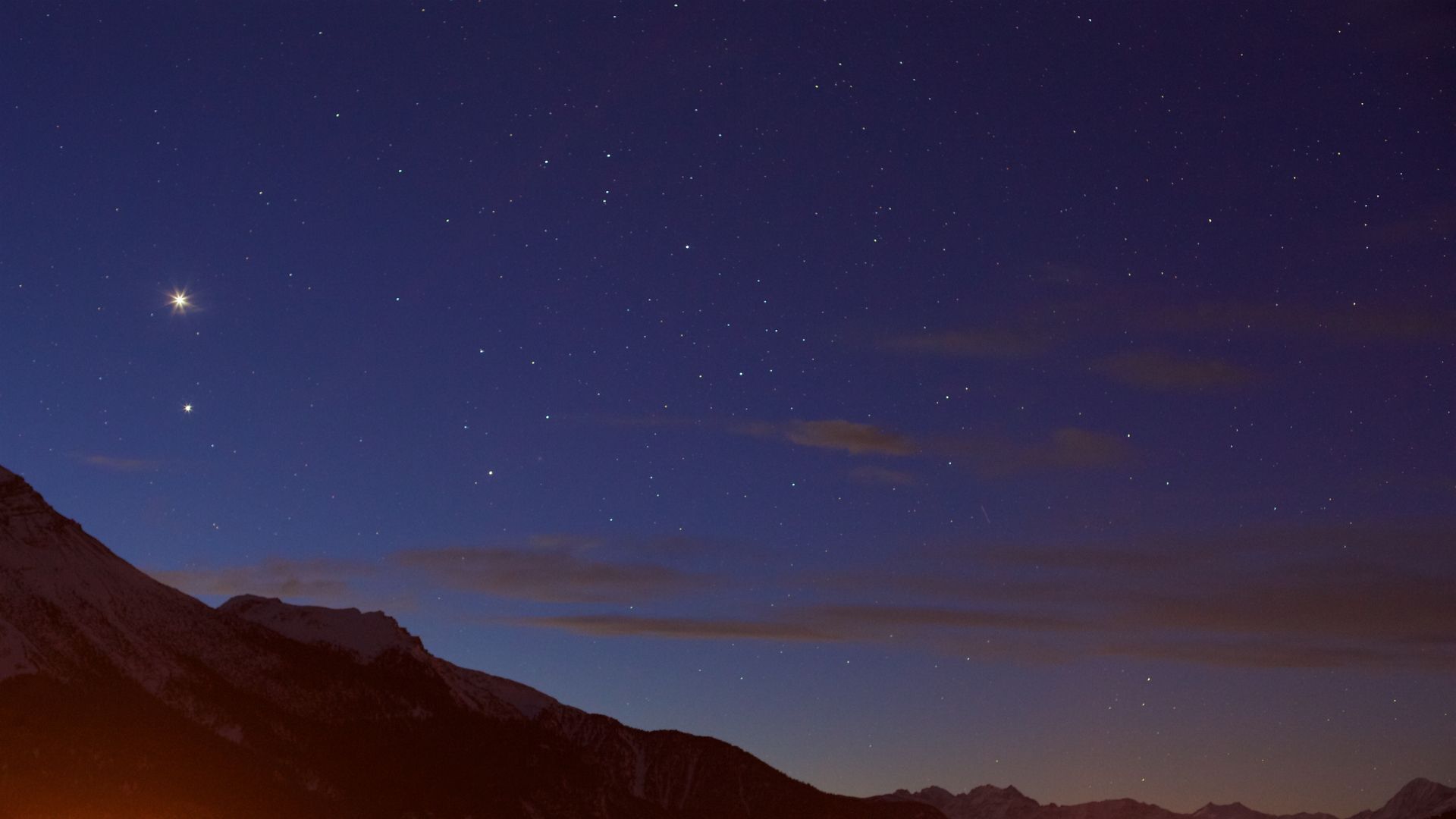
In one of 2026’s skywatching highlights, the two brightest planets in the night sky will appear very close to each other for a string of several evenings.
This conjunction of Venus and Jupiter will occur in the western sky during twilight and be easily visible to the naked eye. The best time to look will be from about 45 minutes to two hours after sunset on Tuesday, June 9, though the evenings on either side will offer almost the same view. Find a location with a clear view of the western horizon for the best show.
On June 9, the two worlds will appear to be just 1.6 degrees apart — about three times the width of a full moon. To measure that distance in the night sky, hold up either a single index finger or two pinky fingers side-by-side at arm’s length. It’s a close enough conjunction to fit comfortably within the field of view of standard binoculars — a rare opportunity for skywatchers.
For all of its beauty, the conjunction is an optical illusion. Jupiter, an outer planet with respect to Earth, will be much farther away. The gas giant will be about six astronomical units (au), or six times the Earth-sun distance, from Earth at the time of the conjunction. Venus, an inner planet, will be just 1.2 au away — five times closer than Jupiter.
What’s happening is that Venus is rising while Jupiter is receding in Earth’s sky. Sooner or later, they must appear to pass closely in the night sky. To understand why, consider the speeds of the three planets involved — Venus, Earth and Jupiter.
Venus takes 224.7 days to orbit the sun, Earth takes 365.25 days, and Jupiter takes 11.86 years. As can be seen on The Planets Today, Earth is currently racing away from Jupiter, causing it to appear to sink in our evening sky. On July 29, Jupiter will be lost in the glare of the sun. However, the faster-moving Venus is approaching Earth, causing it to rise in our evening sky. Venus will shine brightly as the “Evening Star” all summer, reaching its farthest distance from the sunset in mid-August.
As well as being dramatically closer to Earth, Venus will also be vastly brighter in the sky. During the conjunction, Venus will shine at -3.9 magnitude with Jupiter at -1.7 magnitude (in skywatching, a lesser magnitude corresponds to a brighter object). That makes Venus about 7.5 times brighter than Jupiter as seen from Earth. As well as being closer than Jupiter, Venus reflects significantly more sunlight because of its thick cloud layers.
Although you can see the conjunction with the naked eye, a pair of stargazing binoculars will help you see both planets together, while with a good backyard telescope, you may see some of Jupiter’s four large Galilean moons — Ganymede, Europa, Callisto and Io — as dots of light in a line on either side of the giant planet. A decent camera will also let you take stunning photos of the conjunction.
The next major planetary conjunction will take place before sunrise on Nov. 15, when Jupiter and Mars will appear just 1.2 degrees from each other.