





Mercury, which is about one-third the size of Earth, may have shrunk more in its evolution than scientists originally thought.
A new study suggests that the tiny planet may have contracted 10% to 30% more than previous models suggested — meaning the planet’s total diameter shrunk almost 12 miles (19 km) since Mercury was formed. (Mercury’s diameter today is roughly 3,032 miles (4,880 km).
Previous missions overlooked the extent of the shrinkage because impact-crater debris on Mercury’s surface hid the evidence, according to a study published Thursday (Sept. 10) in the journal Geophysical Research Letters. That size difference is important when researchers consider the planet’s history, said Gaku Nishiyama, a planetary scientist at the German Aerospace Center Institute of Space Research and an author of the study.
Latest Videos FromLive Science
“Because Mercury’s evolution is driven by its cooling, the amount of contraction — an indicator of the extent of cooling — is one of the most important observables that can be compared to models for estimating its evolution scenario,” Nishiyama told Live Science in an email.
There could also be implications for the planet’s composition. For example, more shrinkage at Mercury could mean the planet would have a larger metal core and fewer light elements, such as silicon, inside that core, according to an American Geophysical Union statement.
“The interior of Mercury would reflect its formation,” Nishiyama said, and possibly hint at the innermost part of our solar system. “Therefore, to understand how our solar system has evolved up to now, information that can be extracted from this estimation — such as core composition and initial temperature condition — is critical.”
A violent history
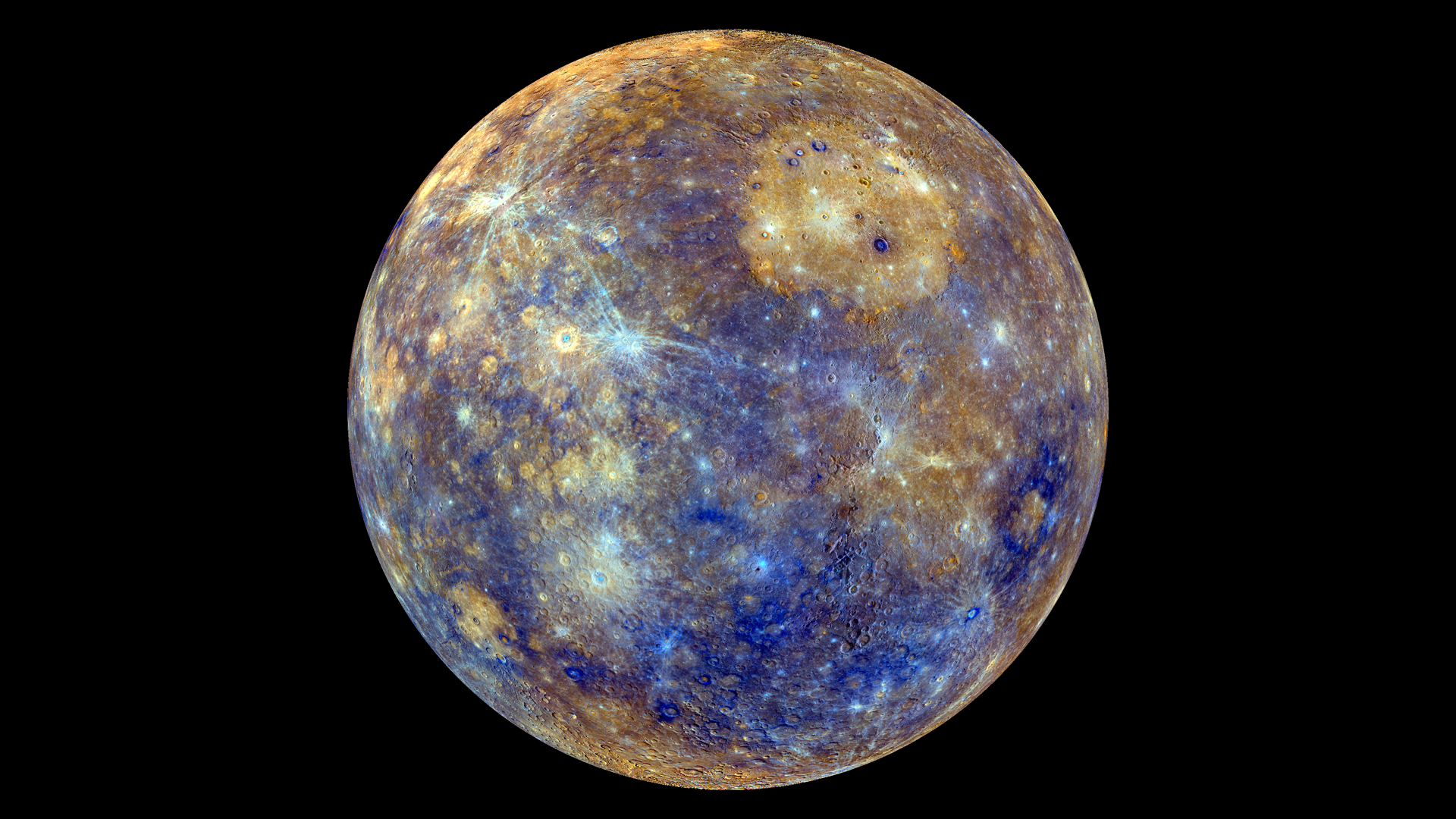
Observations from NASA’s MESSENGER spacecraft (examples shown here) helped the team build new maps of the planet’s shrinkage.
(Image credit: NASA/Johns Hopkins University Applied Physics Laboratory/Carnegie Institution of Washington)
Mercury and the rest of the solar system planets formed due to the gradual collisions and aggregations of rock and gas upon asteroids and comets. Some of those impacts that created the planets also released a lot of heat. Mercury has been slowly cooling from those ancient impacts, and its interior has been shrinking along the way.
Get the world’s most fascinating discoveries delivered straight to your inbox.
While this kind of cooling affects the entire planet’s landscape, impact craters can mask the effects because each crash into the surface generates its own surface changes, including debris and new divots. The craters build up over time, making it difficult to spot more ancient geology underneath.
Nishiyama’s team compared two sets of maps from Mercury, using data from NASA’s MESSENGER mission, which orbited Mercury between 2011 and 2015. One set of maps charted geological features showing contraction, and the other set estimated the roughness of the planet’s surface. Their work covered the entire surface and demonstrated that the most rugged spots on the planet have fewer wrinkles from shrinking. In other words, according to Nishiyama, the debris from more recent impacts is covering up the evidence of shrinking.
Nishiyama said more information will help to confirm the estimate. Such data could come from the European Space Agency’s BepiColombo spacecraft, which began its arrival sequence at Mercury earlier this month after nearly eight years of space travel. Once the mission settles in, the spacecraft will take higher-resolution imagery of the surface than MESSENGER did. Nishiyama’s team expects BepiColombo to pick up smaller impact craters, as well as scarps and ridges, that could further refine the measurements.
“Stay tuned for future topography measurements by BepiColombo,” Nishiyama said. “Future data from laser altimetry on BepiColombo will collect more information on planetary contraction by measuring topography more precisely.”