



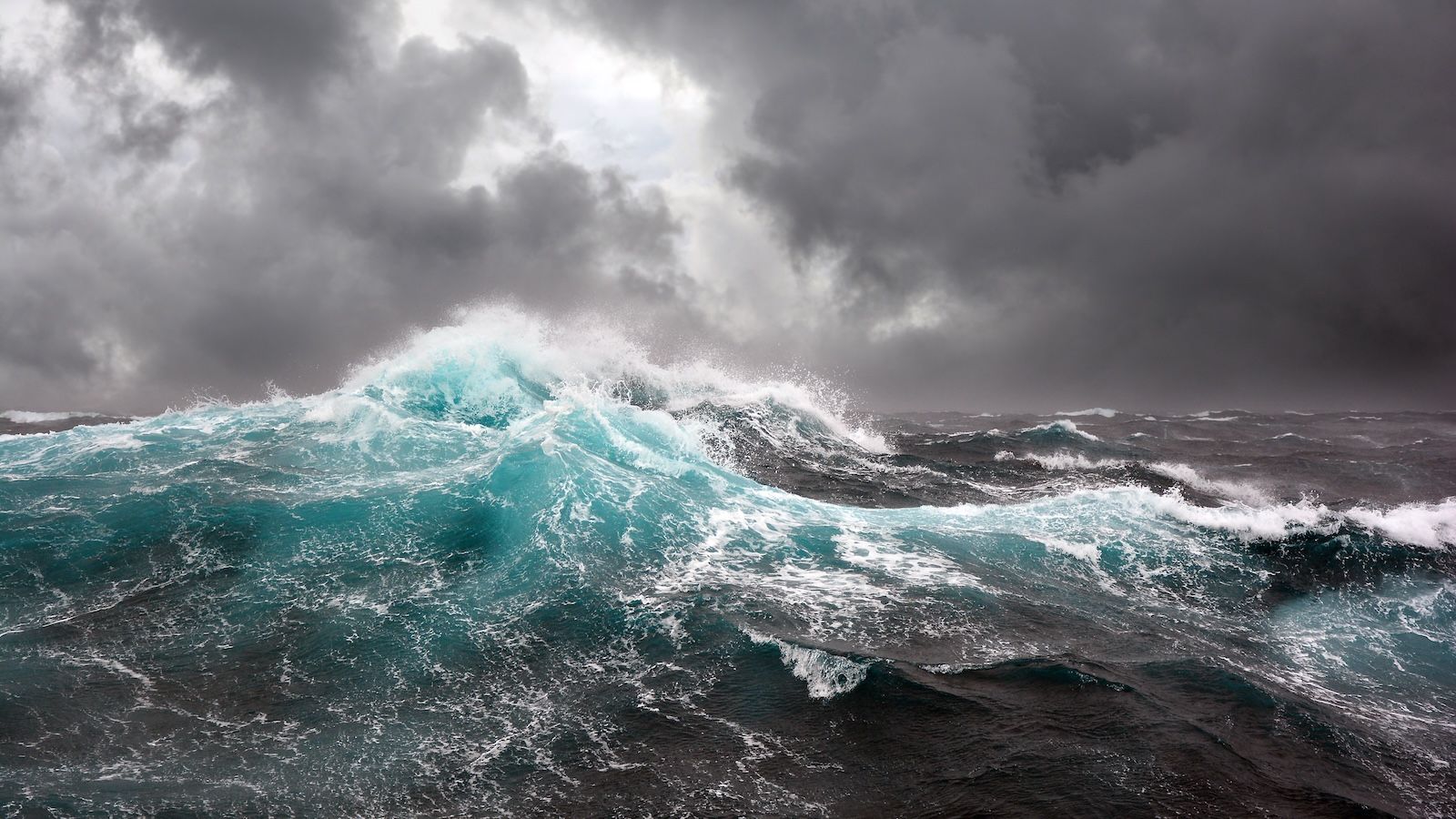
Atlantic Ocean currents that are vital for keeping Earth’s climate in check will halve in strength by 2100 and may be closer to collapse than first thought, a new study finds.
The Atlantic Meridional Overturning Circulation (AMOC) acts as an oceanic conveyor belt, circulating warm water north from the tropics and cold water south. This regulates climates across Europe, Africa and America while also sustaining aquatic life.
Now, a study estimates the AMOC will slow down between 43% and 59% by 2100 — a 60% stronger weakening than past models predicted. The research corrects for biases in previous estimates by including the temperature and saltiness of the Atlantic Ocean’s surface, according to the study published Wednesday (April 15) in the journal Science Advances.
This “more substantial AMOC weakening” means that a critical planetary system is closer to a tipping point — an irreversible “point of no return” for the climate — than many past models suggest, the authors wrote in the study.
However, other experts note that the predicted magnitude and speed of an AMOC slowdown varies greatly from study to study.
“In my opinion there is a need to interpret new results for each study into a wider context,” María Paz Chidichimo, a physical oceanographer at the National University of San Martín in Buenos Aires, Argentina, told Live Science in an email. “Studies predict AMOC decline on a range from small decline to large decline, but I think the magnitude and timing of AMOC decline are still uncertain given the large spread in model projections,” she said.
Laura Jackson, an expert in North Atlantic ocean currents at the Met Office in the U.K., agreed. “It is still an open question as to which model AMOC projections are most likely,” she told Live Science in an email.
Catastrophic collapse
An AMOC collapse would last for hundreds to thousands of years and have catastrophic consequences. It would send temperatures in northern Europe plummeting while southern Europe experiences extreme droughts. The sea level would rise along the northeast coast of North America. Disruption would spread across food webs and ecosystems in the ocean and on land — for example, the amount of land available for growing wheat and maize, which supply two-fifths of global calories, would be cut by more than half.
Modeling the AMOC slowdown
Observations reveal that the AMOC has weakened compared with its 1850 to 1900 baseline. Previous research has attempted to estimate the strength and pace of the AMOC slowdown, with some studies finding minimal weakening by the end of the century while others predict an imminent collapse.
However, because continuous AMOC monitoring only began in 2004, few previous studies have included real-world observations in their calculations. And where real data has been used, most studies only incorporated a single observable variable, such as past AMOC strength or average seasonal temperature changes, the authors wrote in the study.
Yet since AMOC is a complex system, multiple observable variables should be considered in climate models, the authors wrote.
In this new study, the researchers used different statistical methods to compare the performance of various climate models that project an AMOC based on different emission scenarios, evaluating which was most accurate at predicting the future AMOC’s slowdown.
The scientists found that the most accurate model paired sea surface temperatures and salinity across the Atlantic with a statistical method rarely used in climate modeling. This method, called “ridge-regularized linear regression”, reduced the prediction error of the model by 79% compared with the standard modeling approach.
This model estimated that AMOC will slow by around 51% from its 1850 to 1900 average. The Intergovernmental Panel on Climate Change’s (IPCC) 2022 report called a 50% AMOC slowdown a “substantial weakening.”
“This is a key result with implications for the future climate of the Atlantic and beyond,” the authors wrote in the study.
While these results are not particularly surprising, the finding that “the projected weakening is larger than previously thought is clearly worrying,” David Thornalley, a professor of ocean and climate science at University College London in the U.K. who was not involved in the research, told Live Science in an email.
The predicted AMOC is “so weak that it is then very likely on the way to full shutdown,” Stefan Rahmstorf, a professor of ocean physics who heads the Earth system analysis department at the Potsdam Institute for Climate Impact Research in Germany, told Live Science in an email.
Even so, experts told Live Science that AMOC model estimates are largely driven by which variables are included in the analyses, so results can vary. And although the new study corrects for previous biases, there “remains uncertainty in how well models can simulate and predict changes in the AMOC,” Thornalley said.
Focusing too heavily on an AMOC collapse may not be the most helpful path forward, Chidichimo said. “We have enough scientific evidence of AMOC variability and slowdown, and we are already experiencing environmental changes associated with AMOC change which have important socioeconomic impacts world wide,” she said. “Nations need to prepare now.”
Portmann, V., Swingedouw, D., Khattab, O., & Chavent, M. (2026). Observational constraints project a ~50% AMOC weakening by the end of this century. Science Advances, 12(16). https://doi.org/10.1126/sciadv.adx4298