



HEIDELBERG, Germany — Often considered the slowest, most methodical and most abstract of the sciences, mathematics usually advances so incrementally and esoterically that it rarely troubles the mainstream media.
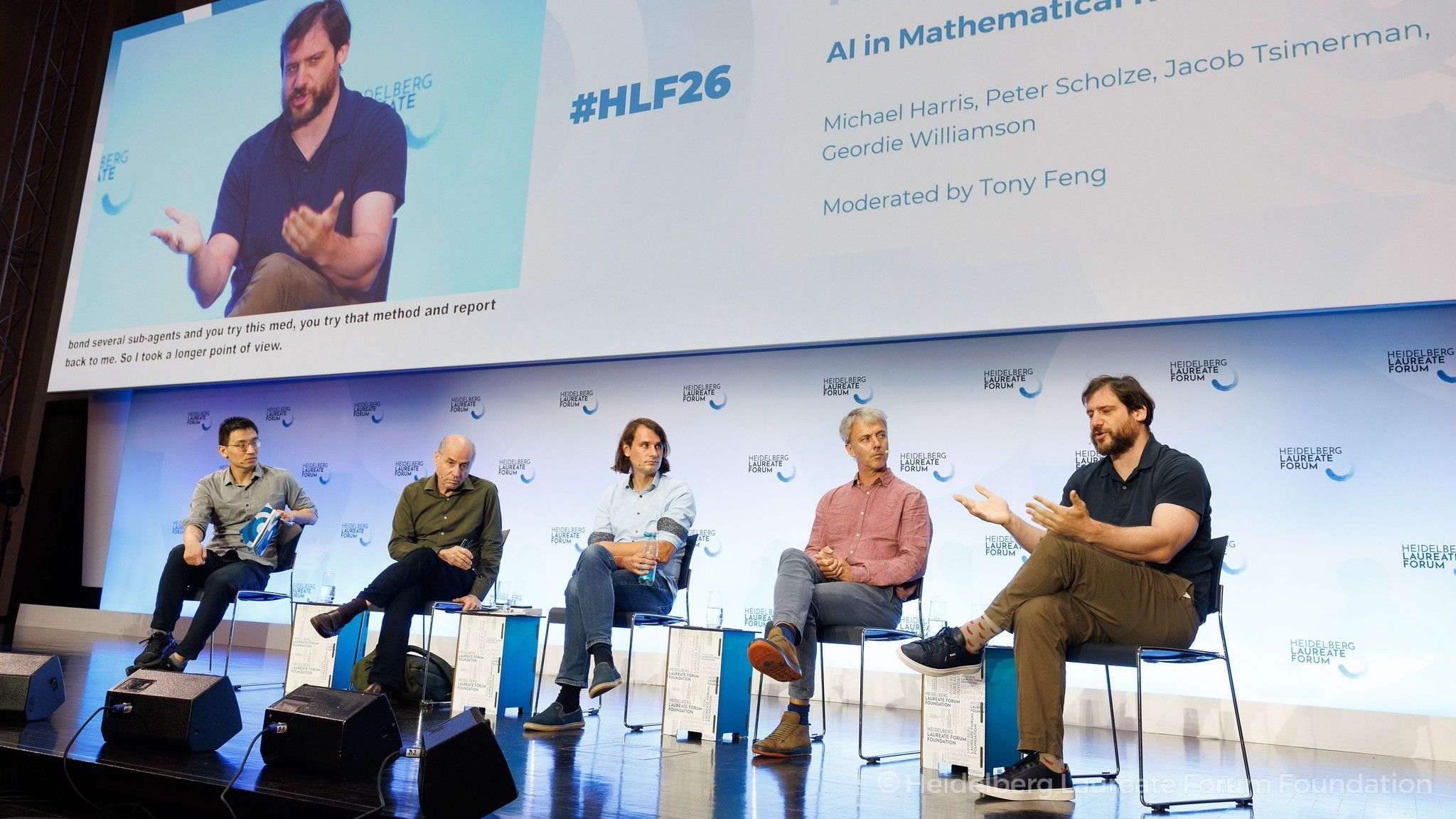
It was therefore with some discomfort that a panel of elite mathematicians took to the stage Sept. 15 here at the Heidelberg Laureate Forum, a conference that unites young researchers with award-winning mathematicians and computer scientists. The focus of the panel: to confront the rapid rise of AI, whose threat to their quiet discipline has thrust them into the limelight.
In the past year alone, AI systems have made substantial contributions to the solutions of dozens of problems posed by prolific Hungarian mathematician Paul Erdős, conducted publishable doctoral-level research, formally verified two proofs that had previously won their authors the Fields Medal (an award considered equivalent to a Nobel Prize in mathematics) and made progress on 10 other long-standing tough open problems.
Then, on Sept. 8, OpenAI made the bombshell claim that it had deployed 10,000 AI agents to solve the Navier-Stokes existence-and-smoothness problem, one of seven fiendishly difficult Millennium Prize Problems posed by the Clay Mathematics Institute in the year 2000 (of which only one, the Poincaré conjecture, has been solved to the institute’s satisfaction until now). The prize for solving any of these problems is $1 million.
Crucially, mathematicians Tristan Buckmaster and Levent Alpöge had been working on the Navier-Stokes problem for roughly a year when they alleged that OpenAI found out about their work and raced to scoop them, claiming that an OpenAI representative threatened them not to go public.
It is in the bow wave of this news that the Heidelberg Laureate Forum panelists debated the controversy surrounding what the rise of AI means for the future of their discipline. Addressing the OpenAI announcement head-on from the outset was Michael Harris, a professor of mathematics at Columbia University.
“There’s no legal obstacle to the kind of predatory behavior that we’ve seen particularly over the last month, in the same way there was no legal obstacle in the 19th century to … the violent acquisition of territory by colonial powers,” he said.
Get the world’s most fascinating discoveries delivered straight to your inbox.
Harris broke the OpenAI Navier-Stokes story on his Substack newsletter Silicon Reckoner, largely to reveal what he views as an important controversy relating to how OpenAI may have used Buckmaster and Alpöge’s research.
Harris, who describes the big tech companies developing AI as “gangsters,” would like to see a regulatory framework implemented to protect mathematics and mathematicians from similar actions in future. In the meantime, “those who act in a way that’s destructive of the community should not be considered members of good standing,” he suggested.
Though this sentiment was shared by fellow panellist Geordie Williamson of the University of Sydney, 2026 Fields Medalist Jacob Tsimerman, a professor of mathematics at the University of Toronto who in July joined OpenAI as an AI safety researcher, was keen to highlight the magnitude of the achievement by the company’s internal AI model.
“I do think the top line is getting buried a little bit,” he said. “AI has solved a Millennium [Prize] Problem, and I don’t think it’s had the kind of effect of at least informing people of AI’s capabilities that it’s meant to have had.”
Tsimerman is highly focused on AI safety at OpenAI and his newly formed independent nonprofit, the Mathematical AI Safety Institute. He believes OpenAI’s Navier-Stokes announcement represents a watershed moment in how mathematics is conducted, and by whom.
“If we put our value in human beings doing research in mathematics at the frontier level, developing expertise and slowly making progress, then I think that’s coming to an end,” he said during a separate news conference held at the forum. “If we put our value in new mathematics being created, and it both serving society and giving mathematicians something to study, then that seems like a golden age.”
Peter Scholze, co-director of the Max Planck Institute for Mathematics in Germany and a 2018 Fields Medalist, had a completely different perspective. Dismissing the OpenAI Navier-Stokes news as “some kind of PR,” he stated that the point of the Millennium Prize Problems is not just to solve one math problem but to bring a fresh perspective to a host of related open questions in a way that builds human understanding — something that a long, machine-produced proof is unlikely to deliver.
Moreover, Scholze — who confessed to never having prompted a large language model and proudly showed off his “dumb phone” to the audience — said AI largely just accelerates mathematical progress, which is in his opinion of little value when it is already impossible to acquire a genuine understanding of all the progress that has been made.
So where does all of this leave mathematics and mathematicians? A number of initiatives — such as Proofs and Prompts, Mathematical Discourse, and the Association for Human Mathematics — aim to preserve a kernel of human mathematics so the field can continue to be a home for human culture and understanding.
But for all the panelists, the speed of change and advancement in AI means they cannot offer clear predictions of the impacts of these initiatives or what the field might look like in the future.
“To be honest, whenever anyone talks about 10 years from now, or even five years from now … it just seems unfathomably far away,” Tsimerman said. “The world in two years is going to look so incredibly different than it does now.”