




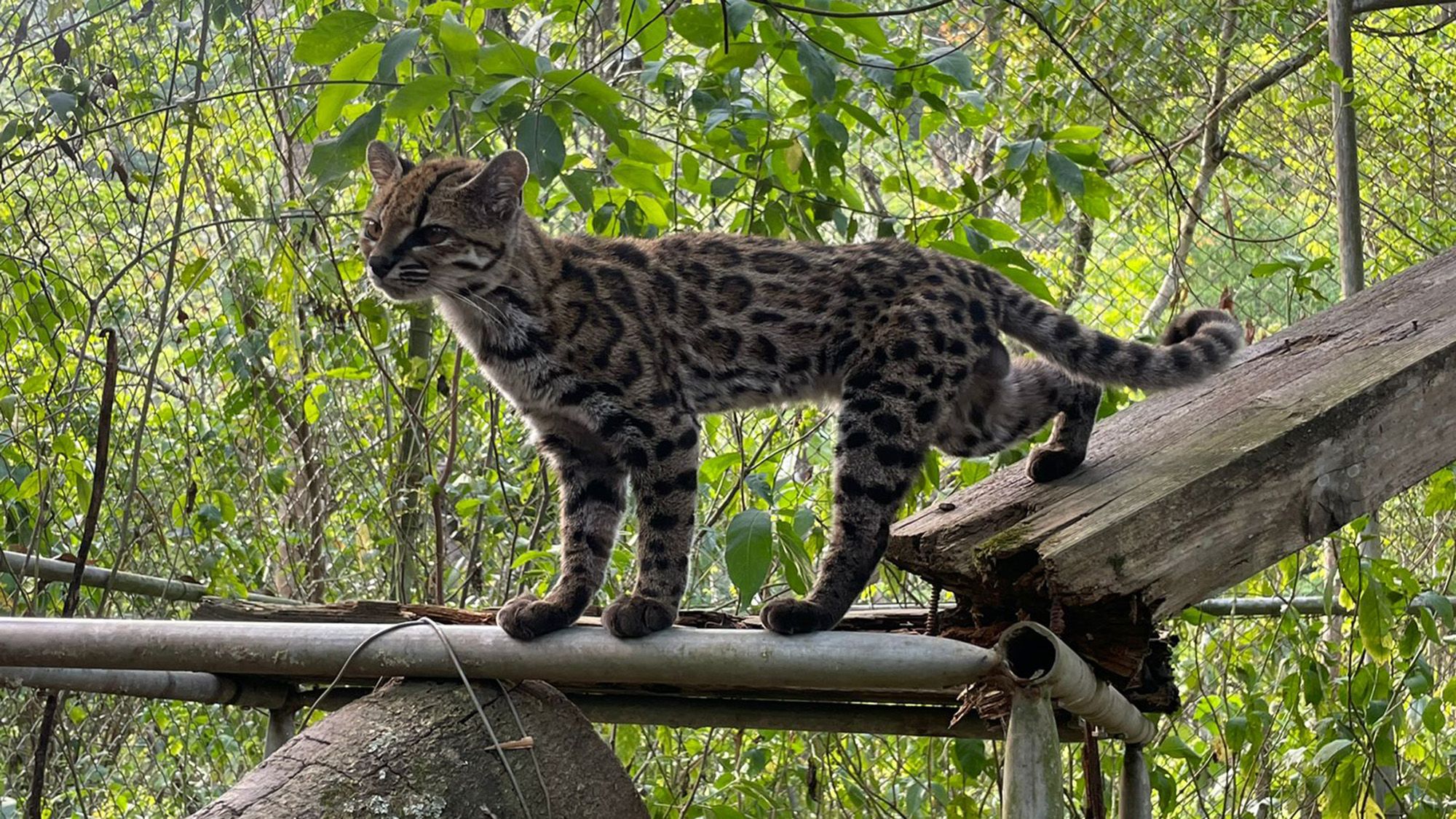
For the first time in a century, scientists have identified a new cat species, thanks to genetic analysis — and it’s resolved a long-standing debate about the cat family tree.
The newly identified species, Leopardus tilcayo, is a type of tiger cat — a small, spotted wild cat — that lives in the Yungas cloud forest region of Bolivia. The analysis also revealed a subspecies of another tiger cat species, named Leopardus tigrinus antisuyo, which lives in Peru.
Previously thought to be a northern tiger cat (Leopardus tigrinus), L. tilcayo split off from other Leopardus species 1.4 million years ago, the study found. This makes it the first novel living cat species to be discovered in over a century, since the Uruguayan pampas cat (Leopardus fasciatus) was described in 1923. The name L. tilcayo refers to what locals call the cat, “tilcayo.”
Latest Videos FromLive Science
Descriptions of L. tilcayo are based on only two live individuals in Bolivia: one specimen caught and photographed in the wild, and another living in captivity. These small cats weigh 3 to 4 pounds (1.5 to 2 kilograms) and reach up to 20 inches (50 centimeters) without their tail, with the tail adding about 10 inches (25 cm). The male L. tilcayo in captivity, nicknamed Tigrino, is the species’ “type specimen” — an individual that acts as the reference for the whole species.
“It’s smaller than a house cat,” Paola Nogales-Ascarrunz, a biologist and co-author of the new study, told Live Science. Nogales-Ascarrunz works with Senda Verde, a refuge in Bolivia for trafficked wildlife where Tigrino lives. Tigrino arrived about 10 years ago, Nogales-Ascarrunz said. “It didn’t look like the other Cats,Animals,Land Mammals,” Nogales-Ascarrunz said, “but we didn’t expect a new species itself.”
“Highly contentious” cat family tree
The newfound species Leopardus tilcayo, photographed at La Senda Verde Animal Refuge in La Paz, Bolivia.
(Image credit: Copyright © Paola Nogales-Ascarrunz)
L. tilcayo and L. tigrinus antisuyo form part of a long-contested tiger cat family tree that the new genetic analysis has resolved.
The tiger cat was first described in 1775 in French Guiana. Throughout the 18th and 19th centuries, European naturalists came across tiger cats in various South American countries and assigned them different species names.
Get the world’s most fascinating discoveries delivered straight to your inbox.
In the 20th century, taxonomists began lumping all tiger cats together into one species, L. tigrinus. Tiger cat species look very similar; they are distinguishable only by genetic analysis or small differences in markings.
Over the past decade, modern genomic techniques have enabled scientists to differentiate and validate tiger cat species. In 2013, scientists split tiger cats into two species, with L. tigrinus classified as the northern tiger cat and Leopardus guttulus as the southern tiger cat. The eastern tiger cat (Leopardus emiliae) was proposed as a separate species in 2017, and the clouded tiger cat (Leopardus pardinoides) split off in 2024.
Yet there were limited genetic data on L. tigrinus. The tiger cat’s family tree has been “highly contentious and poorly understood,” Fabio Oliveira do Nascimento, taxonomist at the Museum of Zoology at the University of São Paulo in Brazil who was not involved with the new study, told Live Science.

Not much is known about Leopardus tilcayo, but scientists hope to soon learn more about its diet, range and population numbers in the wild.
(Image credit: Copyright © Paola Nogales-Ascarrunz)
In the new study, published Thursday (Sept. 17) in the journal Current Biology, researchers sequenced and analyzed the complete genomes of 38 cat samples from South and Central America, including eight from museum specimens. They examined teeth, bones, muscle tissue, skin and fur from cats across Costa Rica, Colombia, Peru, Bolivia, Brazil, Suriname, Guyana and Venezuela.
By comparing these genomes, the researchers were able to map the history of the lineage and when the species diverged. They concluded that the group referred to collectively as tiger cats actually comprises five distinct species, verifying four that had previously been proposed — L. guttulus, L. emiliae, L. pardinoides and L. tigrinus — and naming one new species, L. tilcayo. The team also identified one new subspecies of L. tigrinus, called L. tigrinus antisuyo.
The findings clarify the long-debated tiger cat family tree, Nascimento said. “Our understanding of the natural history, evolution and taxonomy of the group has begun to become clearer, resolving long-standing questions while raising new ones,” Nascimento noted.
Because L. tilcayo is a new species, scientists don’t know much about its behavior, diet or range, Nogales-Ascarrunz said. The next steps are to get more accurate numbers of their populations and estimates of their ranges.
The IUCN Red List currently classifies the northern tiger cat and southern tiger cat as vulnerable species with decreasing populations, but these risk categories could now change.
“Species that are currently considered ‘vulnerable’ under the single label of ‘northern tiger cat’ may increase to ‘endangered’ when assessed on their own,” Jonas Lescroart, an evolutionary biologist at the University of Antwerp in Belgium and co-author of the new study, told Live Science. Accurate population numbers can help governments and environmental agencies implement targeted conservation strategies.
Tiger cats are threatened by deforestation, wildlife trafficking and diseases transmitted by domestic dogs. “This discovery is definitely expected to increase conservation attention — or, we hope so,” Lescroart said.
Think you know about lions and tigers? Test your smarts with our big cat quiz!