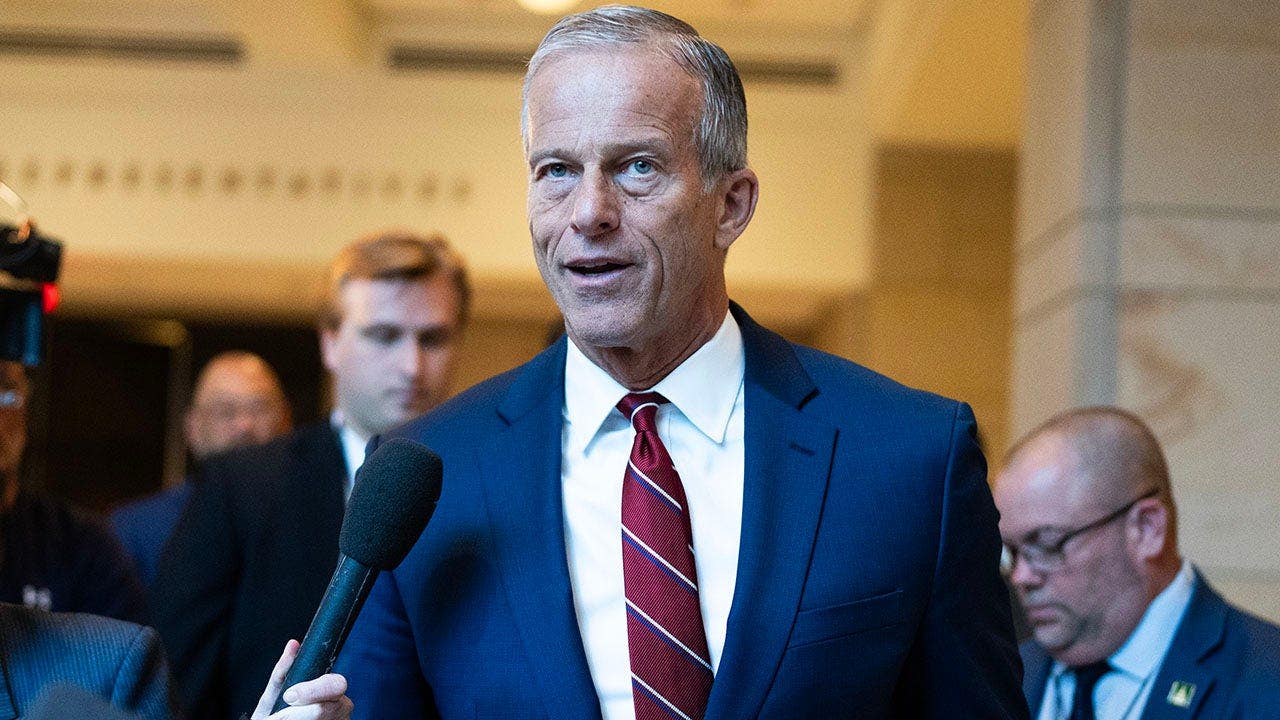



WASHINGTON — Senate Republicans tapped John Thune for a second two-year term as conference leader Tuesday following a contentious hours-long meeting.
GOP senators gathered behind closed doors for their first confab since losing at least seven seats in last week’s midterm elections, leaving Thune (R-SD) to lead a minority of no more than 46 senators when the new Congress convenes Jan. 3.
Sen. Rand Paul (R-Ky.) said an initial morning meeting consisted of “mostly dissent,” though Paul added he didn’t blame Thune for Republican losses.
“I don’t think anybody in Texas who voted for the Democratic governor was voting against John Thune. So if you diagnose that as a problem, you’re misdiagnosing the problem,” Paul told reporters.
Sen. Jim Justice (R-W.Va.) said that there was no clear alternative to Thune as leader, but added: “There is a legitimate argument that if we lost as badly as we lost, why would we continue on with the same leadership?”
Democrats flipped Republican-held seats in Iowa, Kansas, Maine, North Carolina, Ohio, South Carolina and Texas. Their candidates also lead in Alaska and Mississippi with those races yet to be called.
Sen. Ron Johnson (R-Wis.) had led a coterie of seven Republicans — Rick Scott of Florida, Mike Lee of Utah, Ted Budd of North Carolina, John Kennedy of Louisiana, Jim Banks of Indiana and Dave McCormick of Pennsylvania — demanding the vote for new leadership be held off until the outcome of the midterms could be fully analyzed.
“I simply won’t participate in business as usual,” Johnson wrote on X Monday evening. “An election defeat of this magnitude demands change.”
“We need to elect Republican leadership in the Senate, but [Tuesday] is too soon,” Banks had argued in a separate statement.
Lee argued no leadership contest ought to happen before the outcomes of the Alaska and Mississippi races were known.
Scott, who unsuccessfully sought the GOP leadership two years ago, said his vote would depend on what plan Thune laid out for the lame-duck session — the last weeks in which Republicans hold the majority and can steer President Trump’s priorities.
Post-election dissent is not without precedent in the Senate GOP.
After a limp 2022 midterm performance, Scott and his allies challenged then-leader Sen. Mitch McConnell (R-Ky.), who was re-elected over Scott, 37-10.