




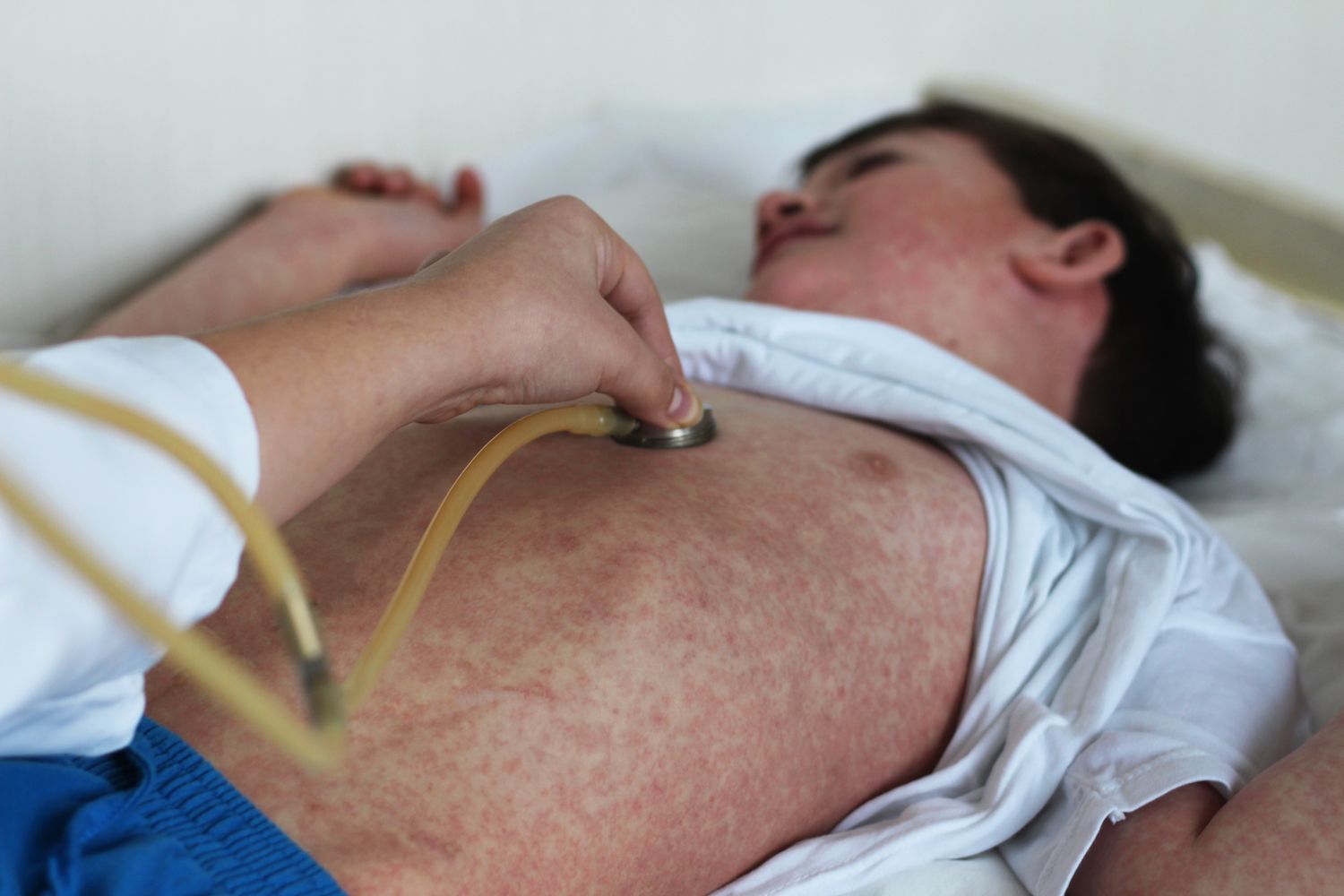
The United States successfully eliminated measles decades ago by taking measures to ensure the virus stopped spreading consistently within the country — but now, it’s likely that measles is back.
Toward the end of 2025, experts cautioned that the U.S. could lose its “measles elimination status” within months as various outbreaks raged across the country. If the U.S. does officially lose this status — meaning the country will have experienced sustained measles spread for over a year — it would join a list of countries, including the U.K. and Canada, that have also seen local resurgences of measles as their vaccination rates have declined.
An assessment of the United States’ elimination status is scheduled for November. In the meantime, experts have issued a progress report for the nation. Live Science spoke with two authors of the report from Boston Children’s Hospital — Dr. Anne Bischops, a pediatrician and postdoctoral research fellow, and Maimuna Majumder, a distinguished scholar in the Computational Health Informatics Program — to understand where America’s elimination status stands and what to expect in coming months.
Nicoletta Lanese: We saw measles cases start to rise in the U.S. around January 2025. Were you concerned at that point about the country losing its elimination status?
Maimuna Majumder: I’ve personally been working on measles for over a decade, and given that, what I will say is that my concerns around elimination status far predate even January 2025.
When January 2025 picked up, I felt like this might be the point of no return. But it was not in any way the first red flag. I do want to just stress that measles elimination has always been a tenuous prospect, and it is, by design, tenuous. Maintaining elimination status is, by design, difficult.
When you start to see these clusters turn into outbreaks that threaten to spill over into neighboring states, when you see the rapidity with which small outbreaks become larger outbreaks — those tend to be the signals that [say] “I don’t think that we’re going to be able to get the cat back in the bag here.”
Get the world’s most fascinating discoveries delivered straight to your inbox.
Dr. Anne Bischops: The trend of the increase of vaccine-preventable diseases has been ongoing for several years already, and it’s something that has spilled into the daily life working in the ER. We’ve seen increasing cases of measles. And especially after the COVID-19 pandemic, we have this increase of vaccine fatigue adding to that.
This has been, globally, an increasingly important topic. For the current outbreak in the U.S., our study team has been closely monitoring that from the beginning.
NL: What factors set our current situation apart from past measles outbreaks?
MM: My very first domestic measles response was during the Disneyland measles outbreak in [late 2014 and] 2015. It was a different time. It was a radically different political administration; it was a radically different time, culturally, for how the United States felt about vaccines. It was an optimal time to make strides in policies that would help ensure that we didn’t lose our elimination status.
Disneyland was the site of a major measles outbreak just over a decade ago.
(Image credit: FREDERIC J. BROWN via Getty Images)
In response to the Disneyland outbreak, we ended up passing SB-277 in California and a number of other important vaccination bills across the United States that allowed us to get rid of personal belief exemptions, for example. That really led to fantastic strides in reclaiming our measles protection, as a whole.
Now, in the 10 years that have since passed, a lot of things have changed. We are now in the second Trump administration, and there has been a massive pandemic in between that eroded the public’s trust in public health and vaccines. A lot of that is driven by the pervasiveness of misinformation that’s run rampant.
When the Disneyland outbreak happened, we largely had a feeling of hope that, “We can use this opportunity to pass bills that are going to protect the American people.” What happened when the [2025] Texas outbreak started was the opposite of that. That’s when the likelihood that you’re going to lose your status becomes imminent, because the levers that you would typically use to rescue elimination status are no longer viable.
NL: In your report, you describe seven indicators that should be met for a country to achieve elimination status, noting that the U.S. has now missed — or essentially, failed — four out of seven. Why is it useful to define these indicators?
AB: The Pan American Health Organization [PAHO] has these recertification meetings [such as the one planned for November] where very detailed, granular data for every single transmission chain are presented, and this is very time-intensive.
We saw that the meeting had been moved from April to November, so our goal with the seven indicators was to provide an early warning framework ahead of that decision, using readily available data that we can use now. We have looked on the broad national level, using only national estimates. We really see it as a rapid assessment before then, in November, when a very detailed analysis will be done on the transmission-chain level, where every single transmission chain will be followed.

(Image credit: Live Science)
NL: For the indicators that haven’t been “missed” yet, do we suspect they’ve been missed but just don’t yet have the data to show that?
AB: Exactly. For example, for the genotyping criteria, we have some samples where we can already see that they all share the same genotype, but we are lacking the detailed genotyping data for every single transmission chain. So we can assume that this has been missed, but we need to confirm with the detailed analysis.
For vaccine coverage, we only have the kindergartners’ estimates [regarding the percentage of kindergarteners who are up to date on measles vaccination], and we don’t have immunity data. But based on the data available, we could think that has already been missed.
NL: Experts have said we’re likely undercounting our current measles cases. Is that a fair assessment?
MM: I personally agree that it is very likely an undercount. One reason is that measles in general does not have to be super severe in pathology. So sometimes, kids will get sick and their parents may not take them in to get looked at. When we think about the way that infectious disease surveillance is done in the U.S., in order for mandatory reportable diseases like measles to be reported, there needs to be an encounter with the healthcare system. If you have a disease where that may not always happen, then certainly, by default, you’re going to be undercounting the disease.
Our best indicator is wastewater surveillance [where germs are screened for in wastewater], and right now, we don’t do a ton of wastewater surveillance for measles. The next question would be, how do we track this better? That is perhaps one of the better solutions.
NL: Do you think wastewater surveillance is something that could be feasibly expanded? I know our current coverage differs state to state.
MM: The technology is there, so this is possible. What is challenging — and this is true for all wastewater surveillance, not just measles — is that our interpretability of wastewater signals is, mind my language, still very much in the shitter.
We see numbers go up in the wastewater, so we know that numbers are going up in the community. To what degree that scaling factor is true is dependent on so many things that it’s really difficult to have kind of a 1:1 [translation] based off of what the wastewater signal says — just how many cases there are in a given community at the time.
One of the big factors, of course, is that wastewater is very, very vulnerable to rainwater fall [in that rainfall dilutes wastewater and must be taken into account to interpret the results]. So there are a lot of physical engineering components to this that we have not fully figured out yet. It’s harder to say, “Oh, there are exactly this number of cases because there’s this much wastewater indication of this disease in this location.” We can’t do that yet, not in a meaningful way.
What we can do is use wastewater to predict when hospitalizations for respiratory disease will increase, when we might expect upticks and people seeking PCP [primary care provider] care for a given disease — this is something that the wastewater is very, very useful for. That is where I do believe that there is room for improvement, and this is something that can be done.
Massachusetts is one of the leaders in wastewater surveillance, and we have our own dedicated wastewater surveillance teams. So if I were to think of states that would probably be leaders in this, states like Massachusetts would probably be the most likely to pilot a measles wastewater program.
NL: Your report indicates we’re on the brink of losing elimination status, and getting vaccination rates up is a key solution. Will that effort mostly be at the state and local levels, given the federal government’s stance?
MM: All of our states operate as their own little entities that manage their own state’s health, so we don’t have a ton of programs that are universal, national. Even if Trump were not in office, we would expect most vaccination campaigns to happen at a more localized level. That has always been the case.
However, now you have a federal government that is pretty staunchly anti-vaccine, even when RFK Jr. is reneging and saying, “Actually, vaccines are alright.” There’s quite a bit of waffling even at the federal government level that we should acknowledge. I would not call it vaccine hesitancy at the federal government level; I would call it skepticism. What that does is that it seeds doubt. That has a trickle-down effect to the individual who is living in a given state.

Measles vaccines are very effective at preventing measles infections and the deaths and long-term complications that can stem from them.
(Image credit: FatCamera/Getty Images)
The public discourse around vaccines is very, very heavily influenced by federal discourse.
While federal discourse does not affect states’ rights to pass bills that are going to protect their public by encouraging more vaccination, what it does do is affect the way that individuals in those states perceive vaccines. The vast majority of people in this country are more aware about federal politics than they are about state politics; that is the reality of the situation that we live in.
You end up with a situation where, even though the federal government does not really have much control over what the state will mandate is required for a child to enter public schools, there is a control that is exerted through the communication strategy that is used by the federal government to reach individuals across the United States.
AB: From the pediatrician perspective, we can see day to day, there can be 10 positive vaccine-promoting campaigns, but it only takes one short online comment to spread doubts everywhere. So, for me as a pediatrician, it’s very important to be very careful with health communication about that — I think we need efforts on all levels.
NL: Is there anything else you hope people take away from your progress report?
MM: Because we see this global resurgence of measles and we have a bunch of other countries that have also lost their status or who are also on the brink, we think that this [framework] might also be applicable to other countries who could use it as an early warning.
It’s not just the U.S. that is dealing with this problem; it’s not something that’s happening in a vacuum.
The politics across most high-income countries are exhibiting similarities across the board that are absolutely influencing the pervasiveness of this issue, and the fact that many high-income countries have lost their measles elimination status in the last year is a very, very good indicator of that. But I’d like to stress that it’s not entirely politics, either. Part of it is system memory.
What I mean by that is, the people that are having kids right now are people who have never known a person who has been gravely affected by measles. They have no clue that in previous generations, people died from this disease or were left with terrible post-acute conditions that have plagued them for the rest of their lives. That lack of exposure makes it seem like it’s not that serious.
When public health works, nobody knows that it’s working — that’s a statement that we often make in this discipline. The reason nobody died from measles when I was a kid is because everybody was vaccinated. This particular thing is very difficult; it’s very human to start questioning the severity of something when you haven’t seen that severity yourself.
NL: To date, all signals seem to point to the U.S. losing its status in November. Would you agree?
MM: I would be very surprised to see it turn out otherwise. I would be delighted if we can turn it around, but it is unlikely.
Why that might happen is if we as a society decide that the strict criteria that we have been using to date are no longer the criteria we want to use. We could say we still have elimination status because we’re changing what the criteria are; we’re moving the benchmark. If that happens, I will be extremely unhappy.
Either we lose the status because we kept the criteria the same and nothing changed, which seems like the most likely circumstance, or we don’t lose status because we changed the criteria, because we don’t want to be seen as failures. The least likely but the most positive option is somehow we manage to get it together in the next six months and we don’t change the criteria.
AB: There’s no standardized criteria or cutoff points for deciding elimination status. In the end, it’s completely up to the expert panel in November, so we don’t know what exact cutoffs they will use. But based on the data we saw, for now, I think it’s highly likely that we will, sadly, lose status.
NL: Could the expert panel move the benchmarks, like you said?
AB: So, the CDC [Centers for Disease Control and Prevention] has determined an expert panel that runs the analysis and will then present to the Pan American Health Organization meeting in November.
MM: That’s why I’m saying that that second option is a possibility. There are people [on the panel] that can decide that the criteria are different.
NL: But if the PAHO doesn’t think the presented data is valid, could they say that?
MM: They can do it — will they do it is a different question. The World Health Organization [WHO] and its ancillary branches [like the PAHO] are not typically shy about making statements when they believe that certain governments are not being truthful. This tends to happen in highly politicized situations where you are expecting that the data coming out of the country are not fully viable.
So the WHO has absolutely made statements in the past to this effect. The U.S. is a different type of entity though, right? I think that we’re now getting into the question of “Does it harm the WHO and PAHO too much to take a stand against the CDC?” It’s a very interesting question that I don’t think that there is a very clear answer to yet.
To answer that question, can they do that? They can. There is precedent for other countries. But the U.S. is not just any country, and we need to acknowledge that.
As a region, we’ve already lost that status [given that Canada lost its elimination status already]. My hope is that that would make everybody more honest. I do feel that the situation would be significantly more tense if the U.S. was going to be the “make or break” for whether or not the Americas lost their elimination status.
Editor’s note: This interview has been lightly edited for length and clarity. Live Science spoke with Bischops and Majumder in May, so the text may not reflect more recent developments.
This article is for informational purposes only and is not meant to offer medical advice.